
pplx-decider-v1.3
A multimodal classification model from Perplexity that answers choice, yes/no, and score questions about a given state and extracts verbatim text spans.
At a Glance
About pplx-decider-v1.3
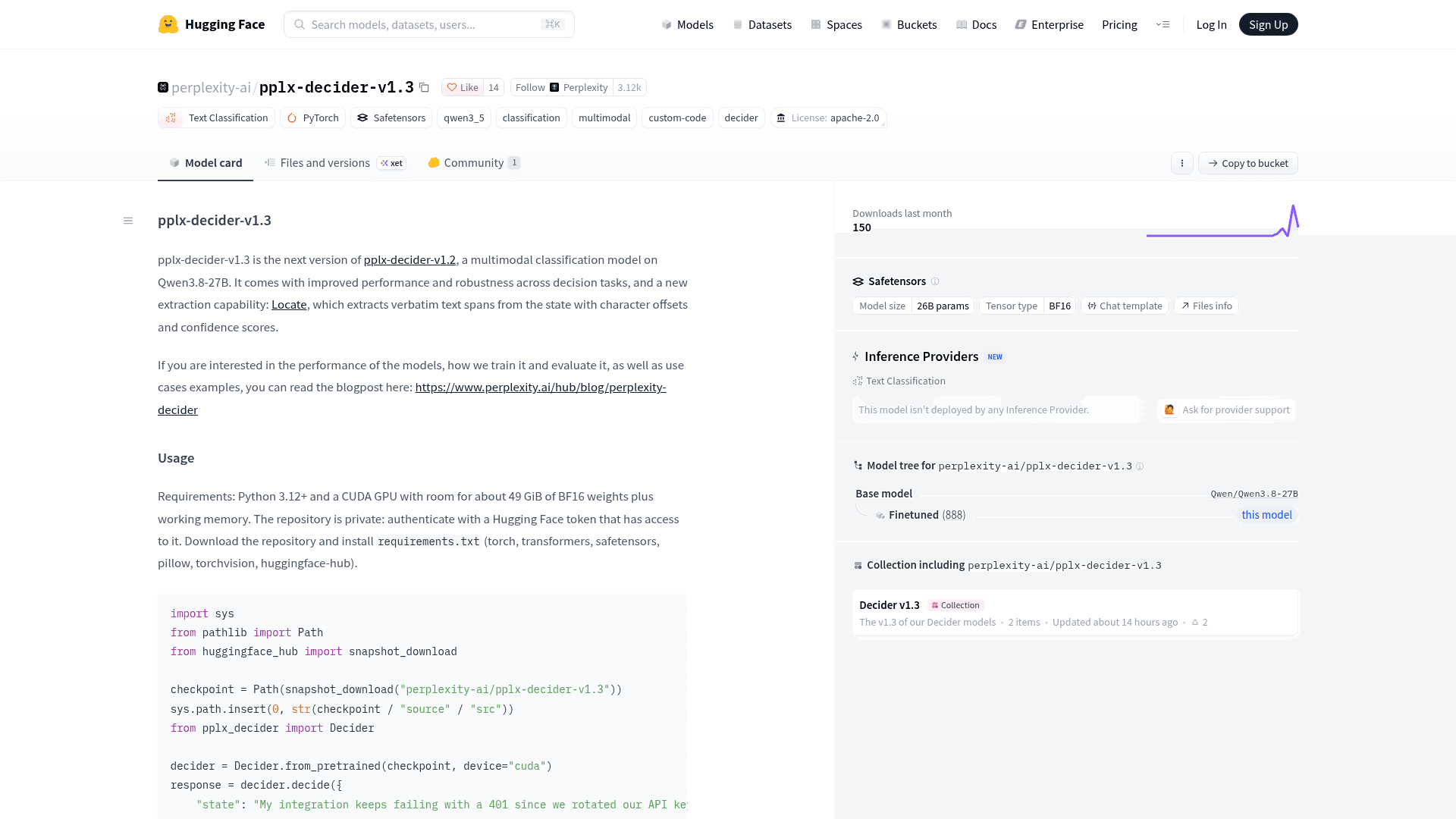
pplx-decider-v1.3 is a model released by Perplexity on Hugging Face under the Apache-2.0 license. It is a multimodal classification model fine-tuned from Qwen3.8-27B, and it succeeds pplx-decider-v1.2. It answers structured decision questions about a piece of context and adds a new Locate capability for extracting text spans.
What It Is
pplx-decider-v1.3 is a decision-making classifier. Given a state (text, JSON, or a list, optionally with images) and one or more questions, it returns answers with probabilities and confidence rather than generating free text. Question types are choice (1 to 255 options), noul (a true/false probability), score (an ordered scale of 2 to 255 levels), and locate.
The model card gives a customer-support example. It routes a message to a team, checks whether the customer is blocked, and rates the customer's frustration level.
How It Works
The Python package pplx_decider loads the checkpoint with Decider.from_pretrained and exposes decide, which takes a request and returns answers plus token usage. By default each question is answered in its own sequence, so answers do not change when other questions are added or reordered. An alternative isolated mode reads the state once and is cheaper for many questions over a long state, though 1.5-2.2% of top answers differ on the authors' samples. A fast mode packs sequences and uses torch.compile, and the card reports speedups against the reference paths.
A temperature fitted on held-out calibration data is applied to the probabilities. The card recommends calibrating on your own traffic if you rely on probability values, and using the noul logit margin for ranking.
Locate: Span Extraction
Locate extracts verbatim spans from a text state, returning character offsets, the text, and a score. The question key serves as the label, which optional instructions can replace. It requires non-empty text with no images and allows at most 128 questions per request. It can be mixed with decision questions, at the cost of extra forward passes.
Setup and Limits
The card lists Python 3.12+ and a CUDA GPU with room for about 49 GiB of BF16 weights plus working memory. Inputs are never truncated, and the default maximum length is 32,768 tokens. Images are resized to at most 1.6 megapixels. The card links to a Perplexity blog post covering training, evaluation, and use cases.
Community Discussions
Be the first to start a conversation about pplx-decider-v1.3
Share your experience with pplx-decider-v1.3, ask questions, or help others learn from your insights.
Pricing
Open-source model (Apache-2.0)
Model weights published on Hugging Face under the Apache-2.0 license, as declared on the model page. Hugging Face Hub, Spaces and Inference Endpoints prices are separate platform services and are not included.
- License: apache-2.0 (declared on the model page)
- Free to download and use under the Apache-2.0 license; self-hosting costs are external
Capabilities
Key Features
- Choice, yes/no (noul), and score question types
- Multiple questions per request over the same state
- Multimodal input with images
- Locate verbatim span extraction with character offsets and scores
- Temperature-based probability calibration
- Fast mode with torch.compile and CUDA graphs
- Raw readout logits for ranking
- Apache-2.0 license