
Prelint
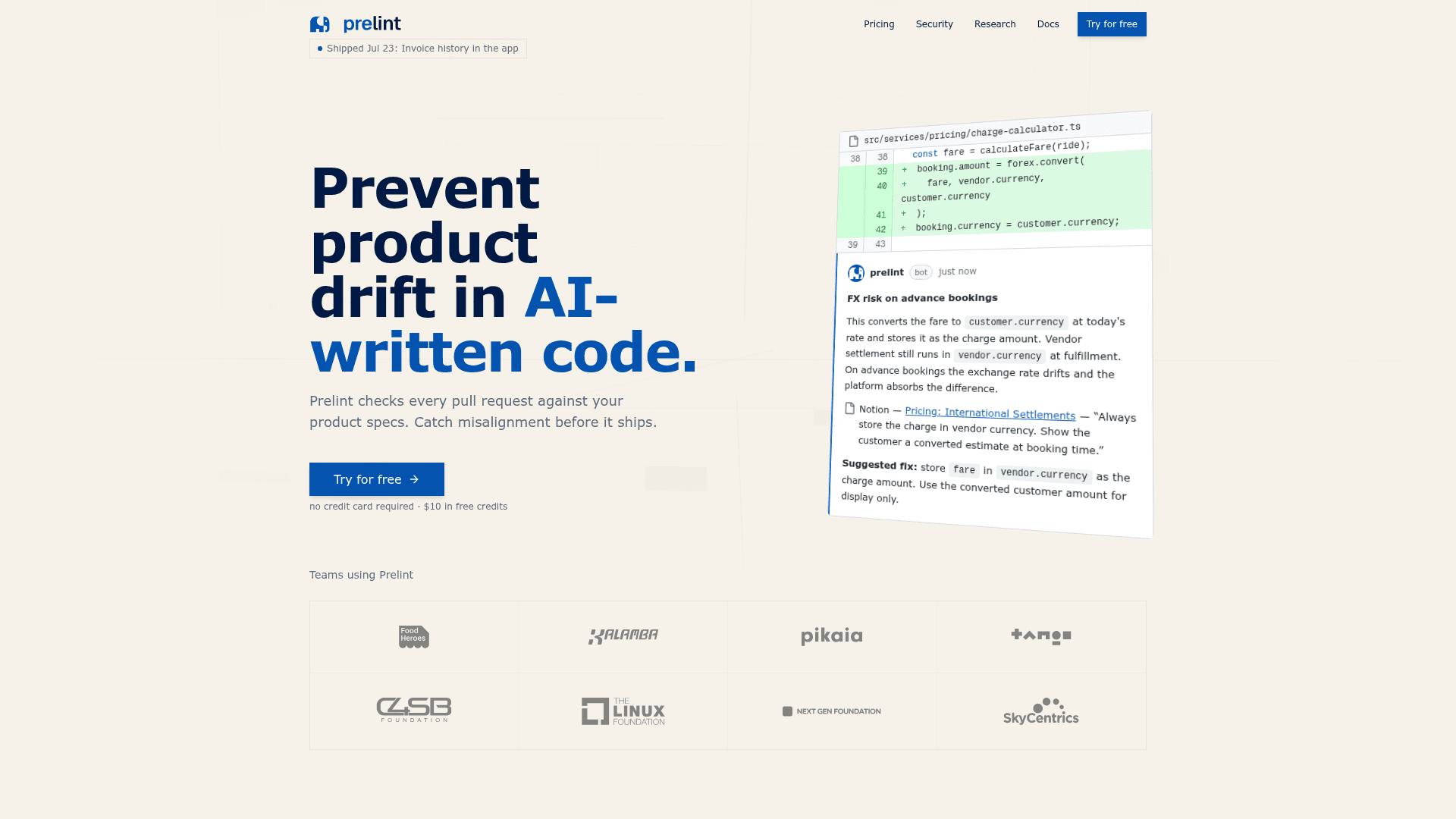
Prelint reviews every pull request against your product specs to catch business logic drift, compliance violations, and scope creep in AI-written code before it ships.
At a Glance
About Prelint
Prelint is a product review tool that sits alongside code review to check whether pull requests match what the team actually agreed to build. It reads product specs, architecture decision records, and compliance rules stored in your repository, then automatically reviews every PR for drift, contradictions, and business logic errors. The tool is part of the NVIDIA Inception Program and targets teams using AI coding agents that write technically correct code but violate product intent.
What It Is
Prelint operates at the product layer — a distinct layer from linters, type checkers, and security scanners. Where code review tools ask "does the code work?", Prelint asks "should this code exist?" It indexes markdown files, YAML, and structured docs in your repository and uses them as review criteria, flagging inline findings pinned to the exact lines that triggered them. The tool integrates with GitHub and GitLab via an app install, requiring no CI changes, no YAML configuration, and no build step.
The Problem It Solves
AI coding agents produce correct, passing, well-structured code that can silently violate product decisions. Prelint identifies six categories of drift it is designed to catch:
- Business Logic — pricing, discount, or billing rules changed without understanding financial impact
- Compliance — data stored without consent flows or retention policies, creating GDPR/CCPA exposure
- Tooling & Infrastructure — new vendors or SaaS dependencies introduced when standards already exist
- Domain Language — generic terms introduced alongside established internal terminology, splitting concepts
- Scope Creep — features built that nobody requested (e.g., i18n for a US-only product)
- Strategic Drift — off-roadmap features, public APIs for internal tools, or premature abstractions
How the Review Pipeline Works
Setup takes minutes: install the GitHub or GitLab app, point Prelint at spec files in the repo, and it activates on the next pull request. The docs describe a five-stage pipeline from PR webhook to inline comment on the diff. Context is assembled within an 80K character budget, prioritized from most specific to most general — project-level specs first, then repository-level specs, then general documentation. Prelint also exposes an MCP interface so stakeholders can query why something was built a certain way without interrupting engineers.
Research and Accuracy Signal
Prelint publishes a research dataset called AI Code Pulse, which the company states is based on a review of 56,706 pull requests across 331 open-source repositories, updated monthly. According to Prelint's own published research, teams that maintain specs and decision logs see 2.75x more accurate reviews than those running without context.
Security and Data Architecture
Each organization runs on isolated, per-tenant infrastructure. Repository clones are encrypted at rest on isolated per-tenant volumes and mounted only during reviews. Each review runs in a dedicated container destroyed on completion. LLM calls use zero-retention APIs. Prelint states it never trains on customer code and never shares data between tenants. Encryption is TLS 1.3 in transit and AES-256 at rest.
Update: Invoice History Shipped July 2025
The homepage changelog banner notes "Shipped Jul 23: Invoice history in the app," indicating active product development with recent billing UX improvements. The product is in active production use with a usage-based credit model and no subscription requirement.
Community Discussions
Be the first to start a conversation about Prelint
Share your experience with Prelint, ask questions, or help others learn from your insights.
Pricing
Free Credits
Start with $10 in free credits at signup. No credit card required. Open source public repositories are always free.
- $10 in free credits at signup
- No credit card required
- Open source projects always free
- Credits never expire
- Inline findings on pull requests
Pay Per Review
$1 per completed review. No seats, no subscription, no minimums. Prepaid credits, auto recharge, and monthly spend caps.
- $1 per completed review
- No seats or subscription
- Credits never expire
- Auto recharge on by default
- Monthly spending limits
- Real-time balance and burn-down dashboard
- Failed, cancelled, and timed-out reviews are free
- CI bots never trigger reviews
- Referral program: $20 credits for both parties
- Invoicing and annual prepay available on request
Capabilities
Key Features
- PR review against product specs
- Inline findings pinned to exact diff lines
- Business logic drift detection
- Compliance rule enforcement
- Scope creep detection
- Domain language consistency checks
- Architecture decision record enforcement
- MCP interface for stakeholder queries
- GitHub and GitLab integration
- Markdown and YAML spec support
- Per-tenant isolated infrastructure
- Zero data retention on LLM calls
- No training on customer code
- Open source project reviews free
- Auto recharge and monthly spend caps
- AI agent self-correction loop support