Prokop
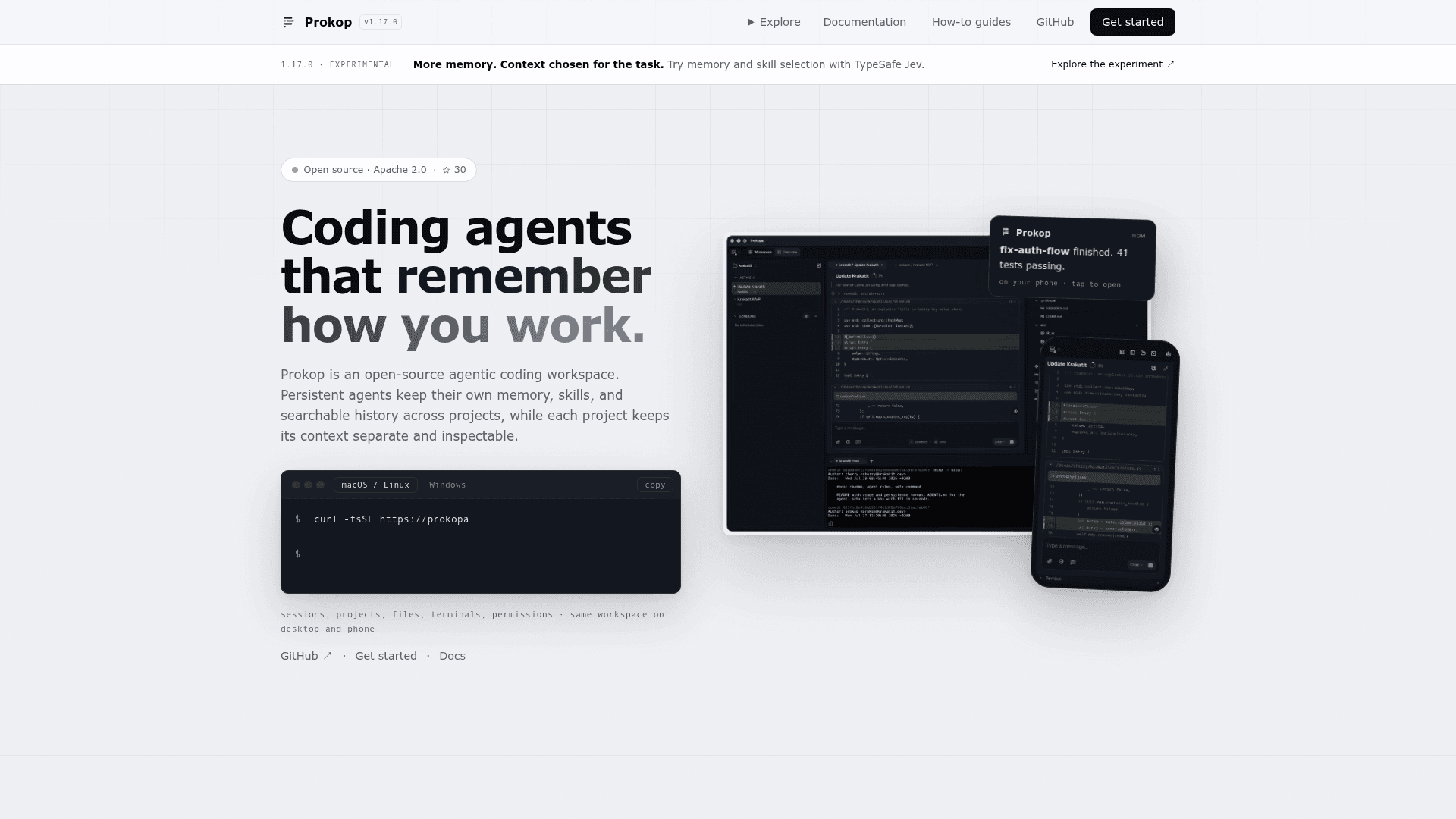
An open-source agentic coding workspace where persistent agents keep their own memory, skills, and searchable history across projects, accessible from desktop and mobile.
At a Glance
Full stack — server, client, tools, and scheduler — free and open source under Apache 2.0. No seats, no tiers, no feature gates. Pay only your model provider.
Engagement
Available On
Listed Sep 2026
About Prokop
Prokop is an open-source agentic coding workspace built by Daniel Bilek under the Apache 2.0 license. It runs as a local daemon on your machine, serving a full web client with sessions, projects, files, diffs, terminals, and permissions — all accessible from any browser, including a mobile-optimized PWA. The project is actively maintained and reached v1.17.0 as of September 2026.
What It Is
Prokop sits in the category of agentic coding environments, but its defining angle is continuity across sessions and devices. Most coding agents are capable inside a single session; Prokop focuses on the work between sessions — giving agents persistent memory, reusable skills, and searchable history so each new task starts from accumulated context rather than a blank slate. The full stack (server, client, tools, scheduler) is Apache 2.0 and runs entirely on infrastructure you control, with no required account and no telemetry.
How Continuity Works
Prokop separates two kinds of knowledge:
- Agent memory — preferences and reusable ways of working that follow the agent across projects (e.g., "Start code reviews with a short summary").
- Project memory — repo-specific conventions, commands, and decisions scoped to that workspace (e.g., "Use Bun for this repo").
Both are stored as plain files on disk, making them readable, editable, versionable, and deletable. Session search lets you retrieve past reasoning without re-deriving it. Skills capture repeatable procedures (like a release checklist) that the agent can invoke again. Opt-in automatic learning reviews eligible conversations and updates knowledge files without requiring a reflection prompt or scheduled job.
Workspace and Interface
The Prokop interface is a single focused surface covering:
- Session board — up to six live session panes side by side, with no window management overhead
- Workspaces — multiple projects with fast switching and a cross-workspace Overview
- Files and Git — file editing, worktree management, branch creation and switching, commit history, diffs, commit/pull/push/rebase
- Terminals — persistent terminals for long-running tasks
- Permissions — every tool call is visible before approval; scopes are revocable; auto-approval boundaries are configurable per session or workspace
- Schedules — recurring agent tasks with custom prompts and timing
Mobile and Remote Access
The client is a mobile-optimized PWA served directly by the Prokop daemon. It provides the same sessions, agents, history, and permission approvals as the desktop view, reorganized for one surface at a time. Push notifications fire when long runs finish. Remote access uses networking you choose (such as Tailscale); Prokop ships built-in TLS support for HTTPS when needed for PWA installation from another device.
Browser Extension
Prokop Browser is a Chrome extension that connects the running Prokop server to your browser tabs. Through it, the agent can read visible page content, navigate to URLs, manage tabs, and interact with pages (click, type, select, scroll). It requires a running Prokop server and the browser tools capability enabled for the agent.
Update: Server v1.17.0
The latest release (v1.17.0, published September 17, 2026) introduces an experimental context-selection feature called TypeSafe Jev integration. When enabled, it selects relevant memories and skills for each agent response rather than loading all context. The feature is opt-in, off by default, and requires a TypeSafe API key. The project is described by its author as actively evolving and used for real daily work, though not presented as enterprise-ready or production-hardened.
Tradeoffs to Know
- The daemon survives closing the browser or terminal but not host sleep, reboot, power loss, or process failure.
- Remote access requires user-managed networking; there is no built-in relay.
- Direct provider integrations cover OpenAI, OpenRouter, DeepSeek, MiniMax, Zhipu, and Zhipu Coding, plus Codex subscription auth. Anthropic and Google models are reachable only through OpenRouter.
- Prokop is maintained by one developer and is not positioned as an enterprise product.
Community Discussions
Be the first to start a conversation about Prokop
Share your experience with Prokop, ask questions, or help others learn from your insights.
Pricing
Open Source
Full stack — server, client, tools, and scheduler — free and open source under Apache 2.0. No seats, no tiers, no feature gates. Pay only your model provider.
- Full server and client source code (Apache 2.0)
- Persistent agents with memory and skills
- Session board with up to six live panes
- Files, diffs, Git, and terminals
- Scheduled agent tasks
Capabilities
Key Features
- Persistent agent memory across sessions and projects
- Reusable skills for repeatable procedures
- Searchable session history
- Opt-in automatic learning from conversations
- Session board with up to six live panes
- Multi-workspace Overview
- File editor with diffs
- Git integration (worktrees, branches, commit, pull, push, rebase)
- Persistent terminals
- Visible tool call permissions with revocable scopes
- Scheduled recurring agent tasks
- Mobile-optimized PWA client
- Chrome browser extension (Prokop Browser)
- MCP tool extensibility
- No telemetry, no required account
- Apache 2.0 open-source license
- Local daemon with SQLite database
- Plain-file memory and skills storage
- Subagents and workflows
- Experimental context selection (TypeSafe Jev)