
Prompt Master
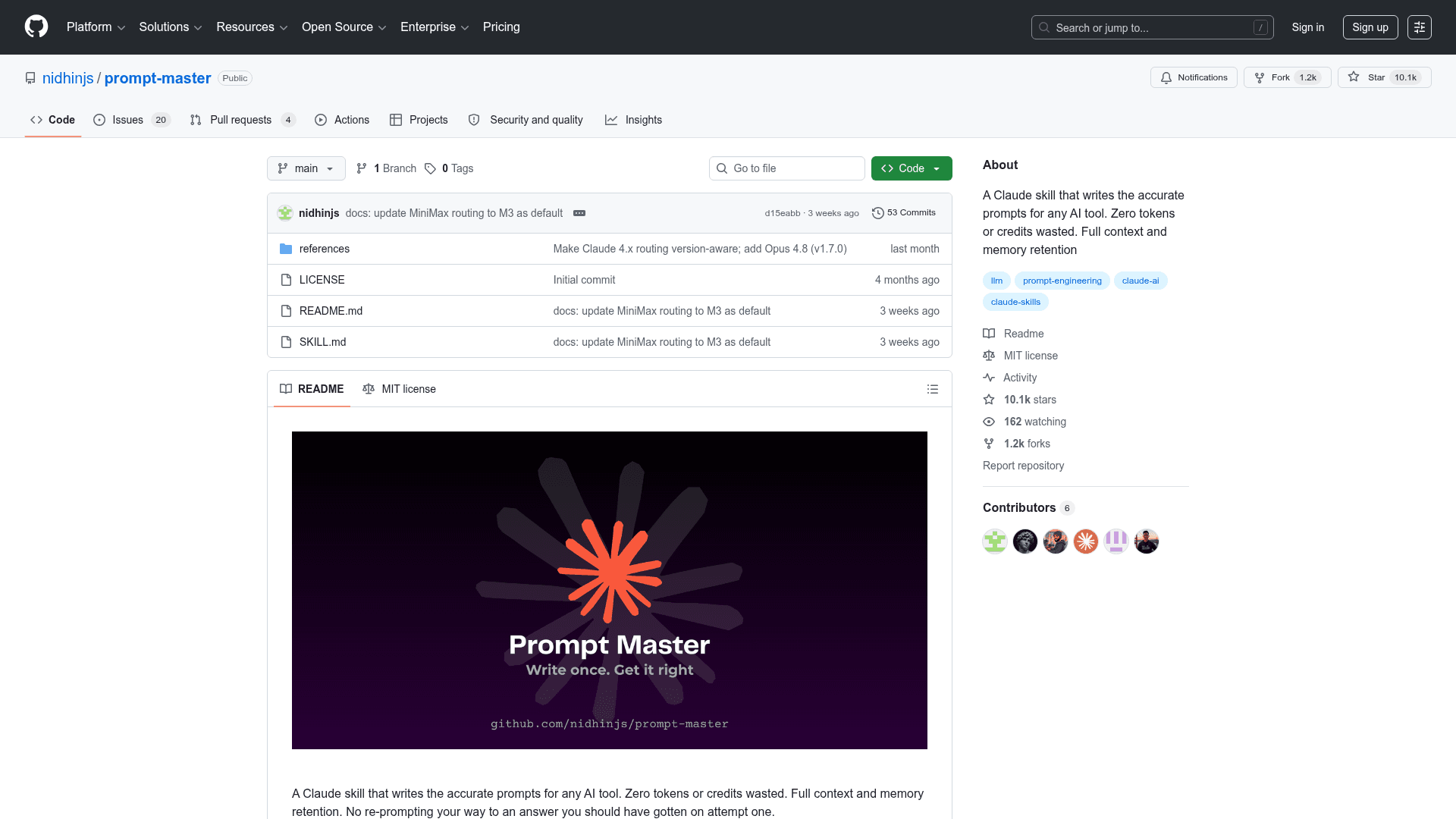
A Claude skill that writes accurate, token-efficient prompts for 30+ AI tools including Claude, ChatGPT, Midjourney, Cursor, and more — with full context and memory retention.
At a Glance
Fully free and open-source under the MIT license. Download and install as a Claude skill.
Engagement
Available On
Alternatives
Listed Jul 2026
About Prompt Master
Prompt Master is an open-source Claude skill created by Nidhin Joseph Nelson that automatically generates optimized prompts for over 30 AI tools. It is available on GitHub under the MIT license and is installed directly into Claude.ai as a skill or into Claude Code's skills directory. The project has accumulated over 10,000 stars on GitHub since its initial release.
What It Is
Prompt Master is a prompt engineering automation layer that runs inside Claude. Rather than asking users to manually craft prompts, it accepts a natural-language description of what you want to accomplish, detects the target AI tool, extracts intent across nine dimensions, and outputs a single clean, copyable prompt optimized for that specific tool. It targets the core problem of wasted API calls caused by vague or poorly structured prompts — the README describes this as "3 wasted API calls" per task multiplied across dozens of daily prompts.
How the Pipeline Works
Every request runs through a structured seven-step pipeline:
- Tool detection — silently identifies which AI system the prompt is for (Claude, Cursor, Midjourney, Zapier, etc.)
- Intent extraction — pulls out task, input, output, constraints, context, audience, memory, success criteria, and examples
- Clarifying questions — asks at most 3 targeted questions when critical information is missing
- Framework routing — selects one of 12 prompt templates automatically without surfacing the choice to the user
- Technique application — applies only five "safe" techniques: role assignment, few-shot examples, XML structural tags, grounding anchors, and chain-of-thought (explicitly excluded from o1/o3-class models)
- Token efficiency audit — strips every word that doesn't change the output
- Delivery — outputs one clean prompt block with a one-line strategy note
Tool Coverage and Profiles
The skill ships with specific profiles for 30+ tools across categories including reasoning LLMs (Claude, ChatGPT, Gemini, DeepSeek-R1, MiniMax), agentic coding tools (Claude Code, Cursor, Windsurf, Cline, GitHub Copilot, Devin), full-stack generators (Bolt, v0, Lovable, Figma Make), image AI (Midjourney, DALL-E 3, Stable Diffusion, ComfyUI), video AI (Sora, Runway, Kling), voice AI (ElevenLabs), and workflow automation (Zapier, Make, n8n). For tools not in the list, a Universal Fingerprint mode uses four questions to generate a quality prompt for any unknown AI system.
The 12 Templates and 35 Anti-Patterns
Prompt Master auto-selects from 12 prompt architectures including RTF, CO-STAR, RISEN, CRISPE, Chain of Thought, Few-Shot, File-Scope, ReAct with stop conditions, Visual Descriptor, Reference Image Editing, ComfyUI node-split, and a Prompt Decompiler mode. It also detects and corrects 35 named "credit-killing patterns" organized into five categories: task patterns (e.g., vague task verbs, missing success criteria), context patterns (assumed prior knowledge, hallucination invites), format patterns (missing output format, prose prompts for image AI), scope patterns (no file path for IDE AI, no stop conditions for agents), and agentic patterns (no starting state, unlocked filesystem).
Memory Block System
For multi-turn sessions, Prompt Master extracts prior decisions — stack choices, naming conventions, architecture constraints, auth decisions — and prepends a structured Memory Block to each new prompt. The README identifies this as "the single biggest fix for long sessions," addressing the common failure mode where an AI contradicts earlier decisions because context was not re-provided.
Update: Version 1.7.0
The most recent release is v1.7.0, pushed in June 2026. It adds Opus 4.8 compatibility, makes Claude 4.x routing version-aware across the 4.6/4.7/4.8 model line, adds an Opus 4.8 profile as the current default, and de-hardcodes the effort-level note so it is managed by the harness. Earlier notable releases include v1.6.0 (Opus 4.7 support, Template M for task briefs), v1.5.0 (expanded tool routing, agentic and 3D model AI routing), v1.4.0 (reference image editing detection, ComfyUI support, Prompt Decompiler mode), and v1.3.0 (silent routing replacing user-facing framework selection, PAC2026 positional structure).
Community Discussions
Be the first to start a conversation about Prompt Master
Share your experience with Prompt Master, ask questions, or help others learn from your insights.
Pricing
Open Source
Fully free and open-source under the MIT license. Download and install as a Claude skill.
- Full prompt generation pipeline for 30+ AI tools
- 12 auto-selected prompt templates
- 35 anti-pattern detection and correction
- Memory Block system
- Token efficiency audit
Capabilities
Key Features
- Automatic target tool detection for 30+ AI systems
- 9-dimension intent extraction pipeline
- 12 auto-selected prompt templates (RTF, CO-STAR, RISEN, CRISPE, etc.)
- 35 credit-killing anti-pattern detection and correction
- Memory Block system for multi-turn session context retention
- Token efficiency audit strips non-load-bearing words
- Max 3 clarifying questions when critical info is missing
- Universal Fingerprint mode for unknown AI tools
- 5 safe prompt techniques (role assignment, few-shot, XML tags, grounding anchors, CoT)
- Prompt Decompiler mode for adapting existing prompts
- Reference image editing detection (edit vs generate)
- Silent framework routing — user sees only the final prompt
- Negative prompt generation for image AI tools
- Stop condition and checkpoint generation for agentic AI
- File-scope template for IDE AI tools (Cursor, Windsurf, Copilot)