
pstack
A collection of Agent Skills and engineering principles for rigorous AI-assisted coding, mirrored for use in Claude Code, Codex, Pi, Cursor and other agents.
At a Glance
About pstack
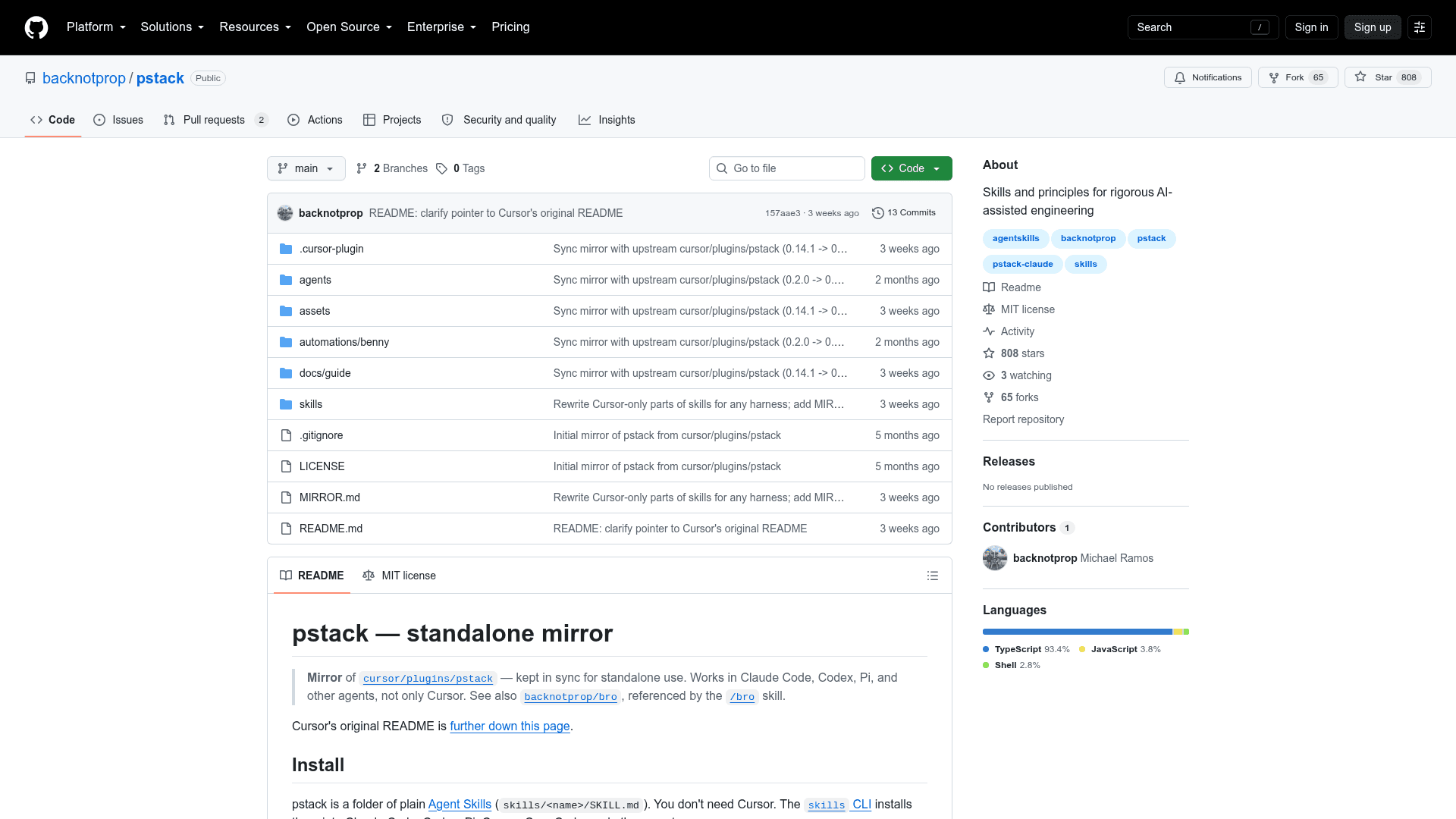
pstack is a folder of plain Agent Skills (skills//SKILL.md) for rigorous AI-assisted engineering. This repository is a standalone mirror of cursor/plugins/pstack, and the README says the skills are the author's own, written by poteto, who describes working at Meta, Netflix, and Cursor. The mirror is MIT licensed and aims to work in Claude Code, Codex, Pi, and other agents, not only Cursor.
What It Is
pstack is a set of skills and principles that guide coding agents toward higher-quality, less sloppy output. The README states the goal is not to maximize lines of code but to help you write less, higher-quality code. Skills are installed as plain Agent Skills folders, and the mirror rewrote many Cursor-specific skills to work in any harness.
How poteto-mode routes work
The main entry point is the poteto-mode skill, which the README describes as a sticky mode. When invoked, it matches the task to one of twenty-three playbooks, opens a todo list copied from the playbook steps, routes to other skills as needed, and writes replies framed for the consumer and maintainer. The README lists playbooks for investigation, bug fix, perf, hillclimb, runtime forensics, feature, refactoring, prototype, visual parity, babysitting PRs, shipping, autonomous runs, orchestration, and opening a PR, among others.
Skills and principles
Beyond the mode skill, the README lists situational skills such as how, why, architect, arena, swarm, interrogate, tdd, unslop, no-comments, technical-writing, reflect, teach, and automate-me. It also lists twenty-three one-principle skills grouped as core, architecture, verification, delegation, and meta, covering ideas such as deleting before adding, proving that work runs, fixing root causes, and guarding the context window. Some skills depend on others, and the README tables which to install together.
Install and configuration
The mirror installs with the skills CLI using npx skills add backnotprop/pstack, which lets you pick skills and target agents. The upstream Cursor path uses /add-plugin pstack. The /setup-pstack skill lets users choose a reasoning budget and map roles such as code and judgment to models, and /automate-me drafts a personal -mode skill from the user's own transcripts.
Automations and tradeoffs
The repository also ships a dormant benny automation pack that triages Slack issue reports and reproduces and fixes confirmed bugs. The README notes that some referenced items are not bundled, including deslop, control-cli, and control-ui from the cursor-team-kit plugin. It also says the author does not believe in planning skills and relies on Cursor's plan mode instead.
Community Discussions
Be the first to start a conversation about pstack
Share your experience with pstack, ask questions, or help others learn from your insights.
Pricing
Open Source (MIT)
pstack is a free, MIT-licensed collection of Agent Skills for rigorous AI-assisted engineering.
- Plain Agent Skills (skills/<name>/SKILL.md)
- Works in Claude Code, Codex, Pi, Cursor, OpenCode, and other agents
- Install via npx skills add backnotprop/pstack
- Free to use, modify, and distribute under the MIT License
Capabilities
Key Features
- Plain Agent Skills format (skills/<name>/SKILL.md)
- poteto-mode sticky entry skill that routes to playbooks
- Twenty-three task playbooks (bug fix, perf, feature, refactoring, shipping, babysit, and more)
- Twenty-three single-principle skills
- Multi-model workflows via arena, swarm, and interrogate skills
- /setup-pstack for choosing models per role
- /automate-me to draft a personal mode skill
- poteto-agent and Comment Sicko subagents
- Dormant benny automation pack for Slack bug triage