
QuantDinger
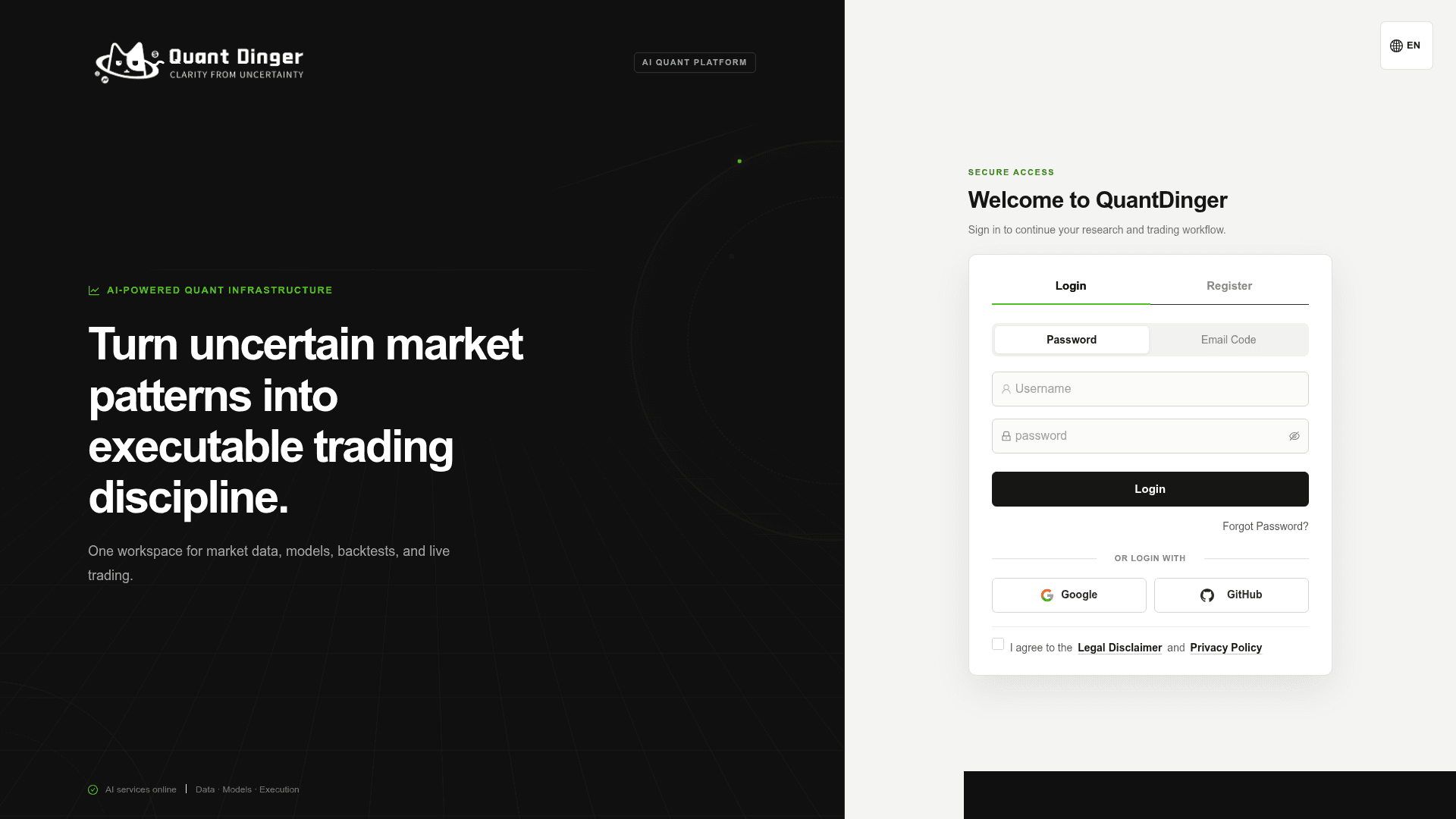
Open-source, self-hosted AI trading platform for building Python strategies, backtesting, and running paper or live trading with monitoring.
At a Glance
About QuantDinger
QuantDinger is an open-source AI Trading OS from Open Byte Inc. It takes trading ideas through Python strategies, backtests, paper trading, live execution, and monitoring in a self-hosted stack. The latest listed release is v5.5.4.
What It Is
QuantDinger is aimed at independent traders, Python strategy authors, and small teams. Market data, strategy code, broker credentials, and deployment stay under the operator's control. It combines multi-provider AI market research, Python indicators and Strategy API V2 development, server-side backtesting and experiments, and paper and live execution across crypto exchanges and traditional brokers. Access is through web, mobile H5, a human API, an Agent Gateway, and an MCP server.
Strategy Research and Validation
Strategy evolution searches declared tunable parameters using random, grid, or TPE optimization. It applies bar-count walk-forward validation and a final blind holdout, and reports composite scoring, PBO, Deflated Sharpe, block-bootstrap Monte Carlo, and transaction-cost stress tests. The README states these results compare parameter robustness and do not forecast returns. Signal-only virtual accounts turn notification-mode signals into internal virtual orders, positions, PnL, and an equity curve without connecting to a broker.
JEV Pre-Trade Decision Gate
An optional AI Decision Filter can sit in front of live entry orders. QuantDinger sends order, strategy, exposure, and budget context to TypeSafe Jev, which returns typed choices, probabilities, and confidence recorded in an auditable decision timeline. Exits, stop-loss, take-profit, and emergency actions bypass the filter. Provider failure fails open, and grid, DCA, and martingale runtimes are excluded in this first version.
Architecture and Deployment
The v5 backend separates the HTTP API from trading workers, a scheduler, Celery jobs, and migrations, using PostgreSQL, Redis, and Kafka. Installation is by one-command installer or from a source checkout with Docker Compose. A production overlay and an optional Prometheus, Grafana, and Alertmanager observability overlay are available.
Agents, Integrations, and Safety
The Agent Gateway and MCP server let clients such as Cursor, Claude Code, and Codex call approved tools without receiving broker credentials. Agent trading is paper-only by default. Supported venues include Binance, OKX, Bitget, Bybit, Gate, HTX, IBKR, and Alpaca. AI providers include OpenRouter, OpenAI-compatible APIs, Google, DeepSeek, Grok, and MiniMax. The project warns that live trading can submit real orders and that it does not provide investment advice.
Community Discussions
Be the first to start a conversation about QuantDinger
Share your experience with QuantDinger, ask questions, or help others learn from your insights.
Pricing
Open Source (Self-hosted)
Self-hosted backend core under Apache License 2.0; web frontend and mobile clients are under separate source-available licenses.
- Backend source code licensed under Apache License 2.0
- Self-hosted AI Trading OS: Python strategies, backtests, paper/live trading, monitoring
- Web frontend and mobile client source are under separate source-available licenses
- Trademark, branding and watermark use governed separately (Apache 2.0 grants no trademark rights)
- Commercial licensing, frontend source access and branding authorization available separately
Capabilities
Key Features
- AI market research and analysis
- Python indicators and Strategy API V2
- Server-side backtesting and experiments
- Strategy evolution with walk-forward validation and robustness tests
- Signal-only virtual accounts
- Paper and live trading
- JEV-powered AI pre-trade decision filter
- Agent Gateway and MCP server
- Self-hosted Docker Compose deployment
- Optional Prometheus, Grafana, and Alertmanager observability
- Encrypted broker credentials and scoped agent tokens