
QuestDB
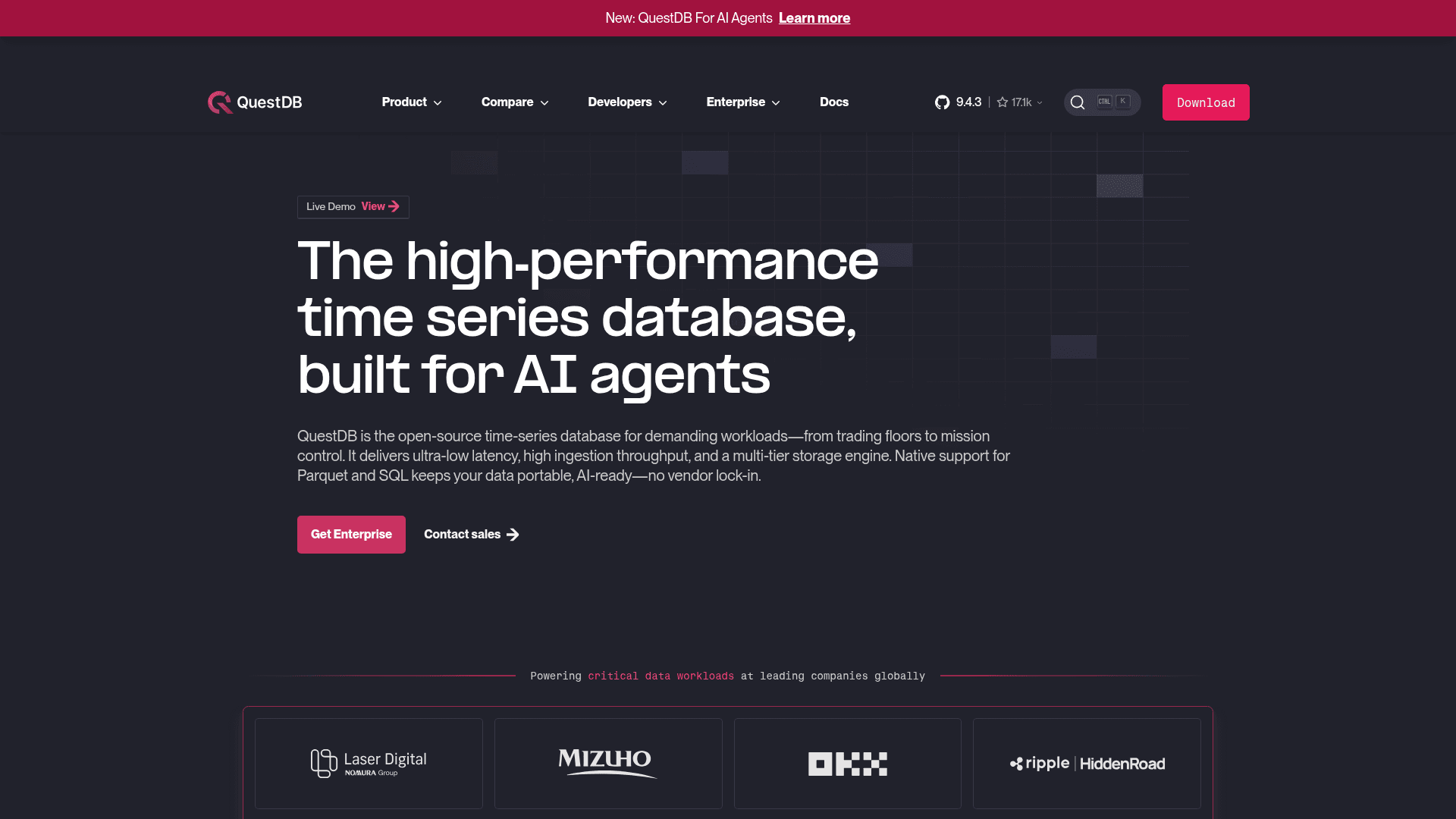
QuestDB is an open-source, high-performance time-series database built for demanding workloads, offering ultra-low latency ingestion, SIMD-accelerated SQL queries, and a multi-tier storage engine with native Parquet support.
At a Glance
Full open-source QuestDB engine under Apache 2.0 license, self-managed deployment for evaluation, prototyping, and pilots.
Engagement
Available On
Alternatives
Listed Jun 2026
About QuestDB
QuestDB is an open-source time-series database engineered for low latency and high throughput, developed by a London- and New York-based team with deep roots in electronic trading infrastructure. The core engine is implemented in zero-GC Java and C++, with additional Rust components in the Enterprise edition. It was originally started as a side project in 2014 by co-founder Vlad Ilyushchenko to address time-series performance limits encountered on trading desks at HSBC, UBS, RBC, and BP, and was open-sourced under the Apache 2.0 license at the end of 2019.
What It Is
QuestDB is a column-oriented, time-partitioned database purpose-built for time-series workloads. It extends standard SQL with time-series operators — SAMPLE BY, LATEST ON, ASOF JOIN, WINDOW JOIN, and HORIZON JOIN — and delivers vectorized (SIMD) query execution with memory-mapped files for cache-efficient, predictable tail latency. The system supports a multi-tier storage architecture: a write-ahead log (WAL) for durable hot ingest, a native columnar tier for real-time SQL, and automatic offload to Apache Parquet on object storage for cold history. A single SQL surface spans all three tiers, and data stored in Parquet is directly readable by external tools such as Pandas, Polars, and Spark without export.
Storage Architecture and AI Readiness
QuestDB's three-tier storage model is central to its design. Incoming data is appended to the WAL with ultra-low latency and made durable before processing. It is then time-ordered and de-duplicated into a native columnar format for real-time analytical queries. Older partitions are automatically tiered to object storage (Amazon S3, Azure Blob, GCS, NFS, HDFS) in Apache Parquet format. The query planner spans all tiers seamlessly, so engineers and AI agents can issue a single SQL statement against both live and historical data. The homepage states that LLMs and AI coding agents already speak SQL and read Parquet, making QuestDB natively compatible with AI-driven data pipelines without proprietary clients.
Time-Series SQL Primitives
QuestDB extends standard SQL with primitives designed for financial and sensor workloads:
- SAMPLE BY — downsamples data at regular intervals for VWAP, ad-hoc bars, and time-series analytics
- ASOF JOIN — matches each row to the most recent event by timestamp, the basis for trade-quote enrichment
- HORIZON JOIN — looks forward by fixed offsets to measure price impact after each trade (markouts/TCA)
- LATEST ON — retrieves the latest value per partition key
- N-dimensional arrays — compact 2D arrays for order-book snapshots with vectorized depth and imbalance analytics
- Materialized views — precomputed OHLCV candles and intraday aggregates with sub-millisecond reads
Target Audiences and Use Cases
The website identifies several primary verticals:
- Capital markets — tick data, pre- and post-trade analytics, order-book replay, TCA, and an open Parquet data lake for quants
- Crypto — continuous multi-exchange ingestion, order-book analytics, and mark-to-market for market makers
- Aerospace — high-rate telemetry ingestion from aircraft, rockets, and engines with ASOF JOIN-based anomaly analysis
- Retail banking — real-time fraud detection and authorization scoring with high-cardinality indexing
- Energy — SCADA, MQTT, and grid telemetry ingestion with a modern replacement for legacy historians
Integrations and Deployment
QuestDB exposes data via a REST API, PostgreSQL wire protocol (PGWire), and InfluxDB Line Protocol. First-party ingestion clients are available for Python, .NET, C/C++, Go, Java, Node.js, and Rust. Native integrations include Grafana, Kafka, Redpanda, Apache Flink, Telegraf, Pandas, Polars, Apache Spark, Superset, MindsDB, and PowerBI. Deployment options include Docker, Kubernetes Helm charts, AWS, Azure, GCP, DigitalOcean, macOS (Homebrew), Windows, and Linux binaries.
Update: Version 9.4.3
The latest release is version 9.4.3, published on June 15, 2026, according to the GitHub repository. The project shows active development with the last code push on June 18, 2026. The GitHub repository lists 17,081 stars and over 170 open-source contributors. The homepage highlights a recently announced "QuestDB For AI Agents" capability, including an installable agent skill that enables AI coding agents to go from prompt to production with streaming ingestion, materialized views, and real-time analytics. The enterprise roadmap notes multi-primary writes for continuous availability as an upcoming feature.
Community Discussions
Be the first to start a conversation about QuestDB
Share your experience with QuestDB, ask questions, or help others learn from your insights.
Pricing
Open Source
Full open-source QuestDB engine under Apache 2.0 license, self-managed deployment for evaluation, prototyping, and pilots.
- High-performance core engine
- Single instance deployment
- Basic authentication
- Community support via Slack, GitHub, and forums
- Binaries, containers, and source code available
Enterprise
Production-grade QuestDB with high availability, enterprise security, tiered storage, and SLA-backed creator support.
- High availability with replication and auto failover
- Multi-AZ resilience
- RBAC including column-level access control
- TLS encryption across all protocols
- SSO via OAuth 2.0/OIDC/Azure Entra ID
- Unlimited native users, groups, and service accounts
- Horizontal scaling to N-replicas
- Tiered storage with cloud object stores (S3, Azure Blob, GCS, Oracle Cloud Storage)
- Automated incremental snapshots to object storage
- Point-in-time recovery (PITR)
- On-demand recall of historical data
- Self-managed or BYOC deployment
- SLA-backed direct access to QuestDB engineers
- Customer-priority hotfixes and security patches
- Early access to new features and enterprise enhancements
- 99.9% uptime SLA
Capabilities
Key Features
- Ultra-low latency time-series ingestion via WAL
- SIMD-accelerated vectorized SQL query execution
- Time-series SQL extensions: SAMPLE BY, LATEST ON, ASOF JOIN, WINDOW JOIN, HORIZON JOIN
- Multi-tier storage: WAL → native columnar → Parquet on object storage
- Streaming materialized views for precomputed OHLCV candles
- N-dimensional arrays for order-book analytics
- PostgreSQL wire protocol (PGWire) compatibility
- InfluxDB Line Protocol ingestion support
- REST API for queries and CSV import
- Native Parquet read/write with no export required
- Web console for interactive SQL and data management
- Data deduplication and out-of-order data handling
- High availability with replication and automatic failover (Enterprise)
- Role-based access control (RBAC) with column-level security (Enterprise)
- TLS encryption across all protocols (Enterprise)
- SSO via OAuth 2.0/OIDC/Azure Entra ID (Enterprise)
- Automated incremental snapshots to object storage (Enterprise)
- Point-in-time recovery (Enterprise)
- Bring Your Own Cloud (BYOC) deployment option
- AI agent skill for automated data pipelines and analytics