
REA (Rust)
A Rust port of REA, a local-only reverse-engineering tool with shared CLI and MCP workflows and a native Ghidra worker.
At a Glance
Self-hosted, local-only Rust reverse-engineering tool (CLI/MCP) under the MIT License. Build from source; not yet shipped as a release artifact.
Engagement
Available On
Alternatives
Listed Oct 2026
About REA (Rust)
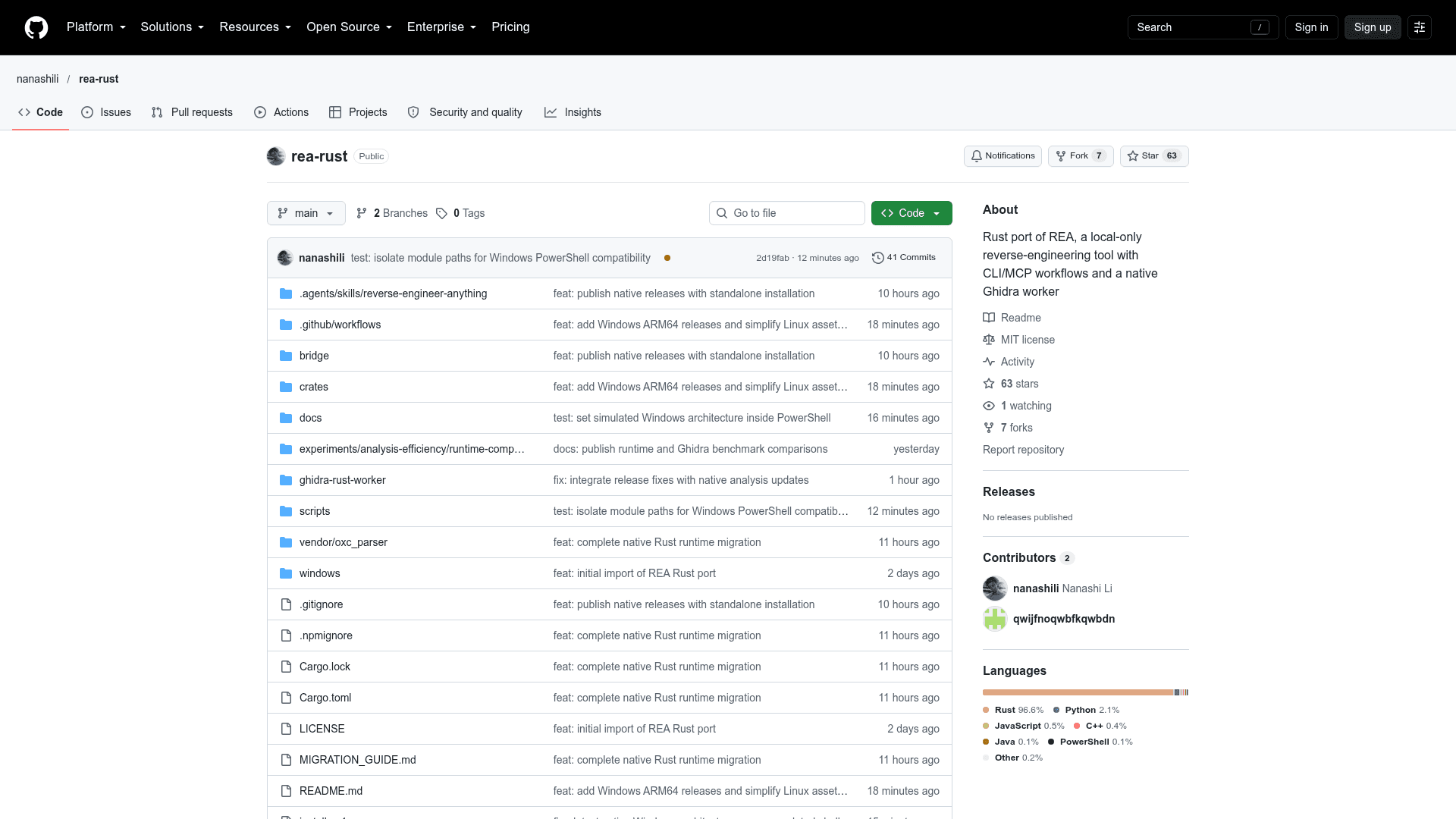
REA (Rust) is a rebuild of the original REA reverse-engineering tool, published on GitHub by nanashili. It ships as a single native binary with no Node.js runtime or TypeScript fallback, and it keeps REA's tool contracts, Evidence model and session semantics. The same handlers are exposed through a CLI and an MCP interface.
What It Is
REA is a local-only reverse-engineering toolkit for investigating compiled programs, with analysis workflows that agents and developers can call over MCP or from the command line. This port replaces the original Node.js/TypeScript runtime with Rust. According to the README, 195 of 209 frozen MCP tools have native handlers. The remaining tools stay advertised and return typed capability-unavailable results.
Native Ghidra Worker
Ghidra analysis runs in a Rust worker that replaces the Java Ghidra bridge, so no JVM is required. The README reports an observed run on a 124 MB UnityPlayer.dylib with 178,573 functions. Opening took 7.5 s, the full procedure inventory took 32.8 s, and sampled peak memory was 459 MiB. It also reports decompiling Unity.app (193,191 functions) in about 25 minutes. In the README's comparison, Java Ghidra decompiled all three requested functions of a larger Go formatter while Rust returned none because of an import-name collision.
Ported Workflows and Open Items
Ported areas include the Rust Ghidra provider, managed static analysis, artifact, Android, capture, ledger, binary and enhanced workflows, offline web capture/fuse/script tools, JavaScript graph comparison and process-capture comparison. Still open are live browser/CDP scenarios, PTY process capture, Frida, GDB/Rizin sessions and JavaScript application reconstruction.
Current Status
The README states the project has not yet shipped as a release artifact. Only macOS arm64 has been exercised, and Windows/Linux packaging and verification are outstanding. It is built from source with Cargo.
Performance Claims
The README's own benchmarks on an Apple M1 Pro report faster startup and lower peak memory for Rust than for the TypeScript build, for example 351 MiB versus 99 MiB on a Go command. Repeated Go metadata checks were slower in Rust. These are the author's measurements.
Community Discussions
Be the first to start a conversation about REA (Rust)
Share your experience with REA (Rust), ask questions, or help others learn from your insights.
Pricing
Open Source (MIT)
Self-hosted, local-only Rust reverse-engineering tool (CLI/MCP) under the MIT License. Build from source; not yet shipped as a release artifact.
- MIT License (OSI-approved)
- Local-only reverse-engineering tool with shared CLI and MCP workflows
- Native Ghidra worker, no JVM required
- 195 of 209 frozen MCP tools have native handlers
- Build from source with cargo; only macOS arm64 exercised so far
Capabilities
Key Features
- Single native binary with no Node.js or TypeScript fallback
- Shared CLI and MCP workflows over the same handlers
- 195 of 209 frozen MCP tools with native handlers
- Native Rust Ghidra worker without a JVM
- Static analysis, Android, capture, ledger and binary workflows
- Offline web capture/fuse/script tools
- JavaScript graph and process-capture comparison
- Evidence model with session semantics
- Local-only operation