
RO-Crate
A community specification for packaging research data with metadata using JSON-LD, enabling reproducible and citable research objects.
At a Glance
About RO-Crate
RO-Crate is an open community specification for packaging research data together with their metadata in a lightweight, interoperable format. Built on JSON-LD and Schema.org, it provides a practical approach to making research outputs machine-actionable, reproducible, and citable. The project is coordinated by the RO-Crate team and hosted under the ResearchObject GitHub organization, with contributions from institutions including the University of Technology Sydney and the University of Manchester.
What It Is
RO-Crate defines a standard way to bundle research data, code, workflows, and associated metadata into a self-describing "crate" — essentially a directory with a structured ro-crate-metadata.json file. The specification draws on linked-data principles (JSON-LD) and Schema.org vocabularies to describe entities such as datasets, authors, instruments, and provenance. The goal is to lower the barrier for researchers and data managers to produce FAIR (Findable, Accessible, Interoperable, Reusable) data packages without requiring deep semantic web expertise.
How It Works
An RO-Crate is a directory containing a root metadata file (ro-crate-metadata.json) that describes the contents using JSON-LD. The metadata file references files, directories, and external resources, annotating them with contextual information such as authorship, licensing, creation dates, and relationships. Profiles and extensions allow communities to specialize the format for specific domains — for example, Workflow RO-Crates package executable computational workflows with documentation aligned to the Bioschemas ComputationalWorkflow profile.
Adoption and Use Cases
The specification page lists several active deployments and integrations:
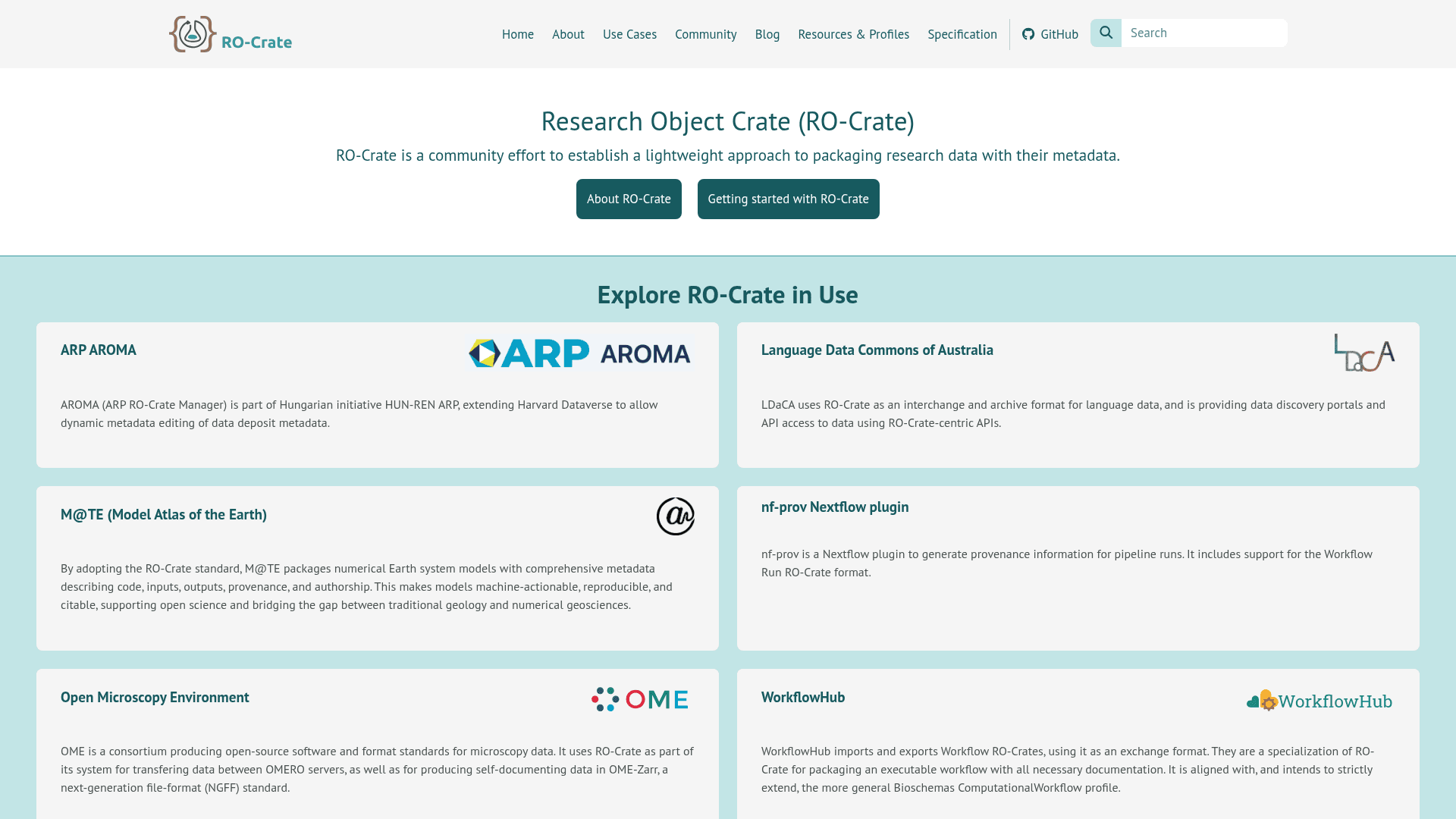
- WorkflowHub imports and exports Workflow RO-Crates as an exchange format for computational workflows.
- Language Data Commons of Australia (LDaCA) uses RO-Crate as an interchange and archive format for language data, with RO-Crate-centric APIs.
- Open Microscopy Environment (OME) uses RO-Crate for transferring data between OMERO servers and for self-documenting OME-Zarr data.
- M@TE (Model Atlas of the Earth) packages numerical Earth system models with comprehensive metadata for reproducibility and citation.
- nf-prov is a Nextflow plugin that generates provenance information for pipeline runs using the Workflow Run RO-Crate format.
- ARP AROMA extends Harvard Dataverse with dynamic RO-Crate metadata editing as part of the Hungarian HUN-REN ARP initiative.
Update: RO-Crate 1.2.0
Version 1.2.0 was published on April 28, 2025, representing the latest stable release of the specification. The repository remains actively maintained, with the last push recorded in May 2026 and 123 open issues reflecting ongoing community engagement. The project has accumulated 141 stars and 48 forks on GitHub since its creation in February 2019.
Who It Is For
RO-Crate targets a broad audience in the research data management ecosystem: researchers who want to make their outputs citable and reproducible, data managers building institutional repositories, workflow platform developers needing a portable exchange format, and domain communities (life sciences, geosciences, linguistics, microscopy) establishing shared metadata conventions. The specification website organizes guidance by domain, task, and role to help different audiences find relevant resources.
Community Discussions
Be the first to start a conversation about RO-Crate
Share your experience with RO-Crate, ask questions, or help others learn from your insights.
Pricing
Open Source
Free to use, modify, and distribute under the Apache License 2.0.
- Full specification access
- JSON-LD context files
- Community support via GitHub
- Apache License 2.0
Capabilities
Key Features
- JSON-LD based metadata packaging
- Schema.org vocabulary integration
- Workflow RO-Crate profile for computational workflows
- Domain-specific profiles and extensions
- Machine-actionable research data packaging
- Provenance and authorship annotation
- FAIR data principles support
- Linked data compatibility
- Community-maintained specification
- Interoperable exchange format