
RoboLab
A simulation benchmarking platform for evaluating generalist robot manipulation policies, built on NVIDIA Isaac Lab.
At a Glance
RoboLab framework released under the Apache License 2.0; free to use, modify and distribute. Requires user-supplied NVIDIA RTX GPU hardware and the Isaac Sim/Isaac Lab stack.
Engagement
Available On
Listed Oct 2026
About RoboLab
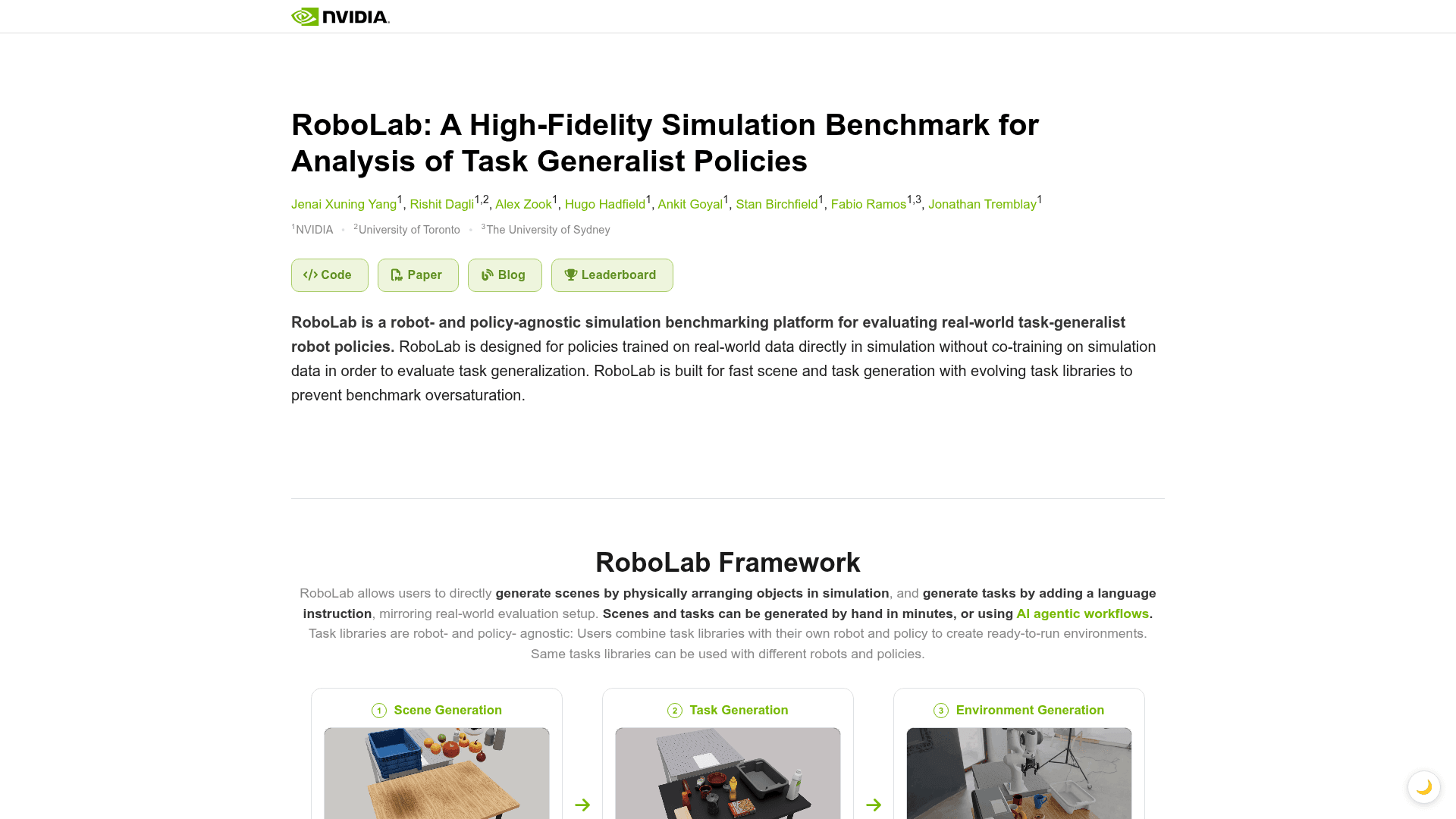
RoboLab is an NVIDIA Research simulation benchmark for evaluating task-generalist robot manipulation policies. It is built on NVIDIA Isaac Lab and ships 120 manipulation tasks with language instructions and automated success detection. The code is open source under Apache 2.0, with the latest release listed as v0.3.1.
What It Is
RoboLab is a robot- and policy-agnostic benchmarking platform. According to the project page, it is designed for policies trained on real-world data that are evaluated directly in simulation, without co-training on simulation data, to measure task generalization. Tasks are not tied to a specific robot embodiment, so any Isaac Lab-compatible robot can be used.
How the Workflow Operates
Users build scenes by physically arranging objects in simulation, then create tasks by attaching a language instruction to a scene. Environments are generated by specifying the robot, policy, action and observation configs, and scene variations. Policies run through a server-client architecture: the model runs as a standalone server and RoboLab connects through a lightweight inference client. Pi0.5 via OpenPI is the documented quick-start example. Episodes can run in parallel across multiple environments, and scene variations cover lighting, camera pose, backgrounds, textures, and shadows.
AI-Assisted Scene and Task Generation
The /robolab-scenegen and /robolab-taskgen Claude Code skills generate USD scenes and task files from natural-language descriptions. The scene generator picks from a library of 312 objects and uses a predicate solver for collision-free layouts. The task generator produces default, vague, and specific instruction variants.
Benchmark and Analysis
The RoboLab benchmark covers three competency axes: visual, relational, and procedural. A self-contained web dashboard lets users browse scenes and tasks, replay episode videos, compare results across experiments, and inspect failure events. The project page also describes a sensitivity analysis using Neural Posterior Estimation to quantify which environment parameters most affect policy success.
Setup Path
Installation uses uv and system ffmpeg, with a choice of IsaacSim 5.0 / IsaacLab 2.2.0 (default) or IsaacSim 5.1 / IsaacLab 2.3.2.post1. Python 3.11 and Ubuntu 22.04+ are required. An NVIDIA RTX GPU is required, with 48GB+ VRAM recommended, and the documentation lists about 8 GB of disk space.
Community Discussions
Be the first to start a conversation about RoboLab
Share your experience with RoboLab, ask questions, or help others learn from your insights.
Pricing
Open Source (Apache-2.0)
RoboLab framework released under the Apache License 2.0; free to use, modify and distribute. Requires user-supplied NVIDIA RTX GPU hardware and the Isaac Sim/Isaac Lab stack.
- Apache License 2.0 for the RoboLab framework
- RoboLab-120 benchmark tasks
- Bring your own robot and policy
- Results dashboard
- AI-enabled scene and task generation via Claude Code skills (external Claude subscription not included)
Capabilities
Key Features
- 120 benchmark manipulation tasks with language instructions
- Automated success/failure detection via composable predicates
- Robot- and policy-agnostic task libraries
- Server-client policy architecture
- Multi-environment parallel evaluation
- AI-driven scene generation (/robolab-scenegen) and task generation (/robolab-taskgen)
- Scene variations for lighting, camera pose, backgrounds, textures, and shadows
- Interactive results dashboard with episode video replay and cross-experiment comparison
- Recorded episode replay
- Sensitivity analysis with Neural Posterior Estimation