
RubyLLM
A single Ruby framework for building AI applications across all major providers including OpenAI, Anthropic, Gemini, Bedrock, and more.
At a Glance
About RubyLLM
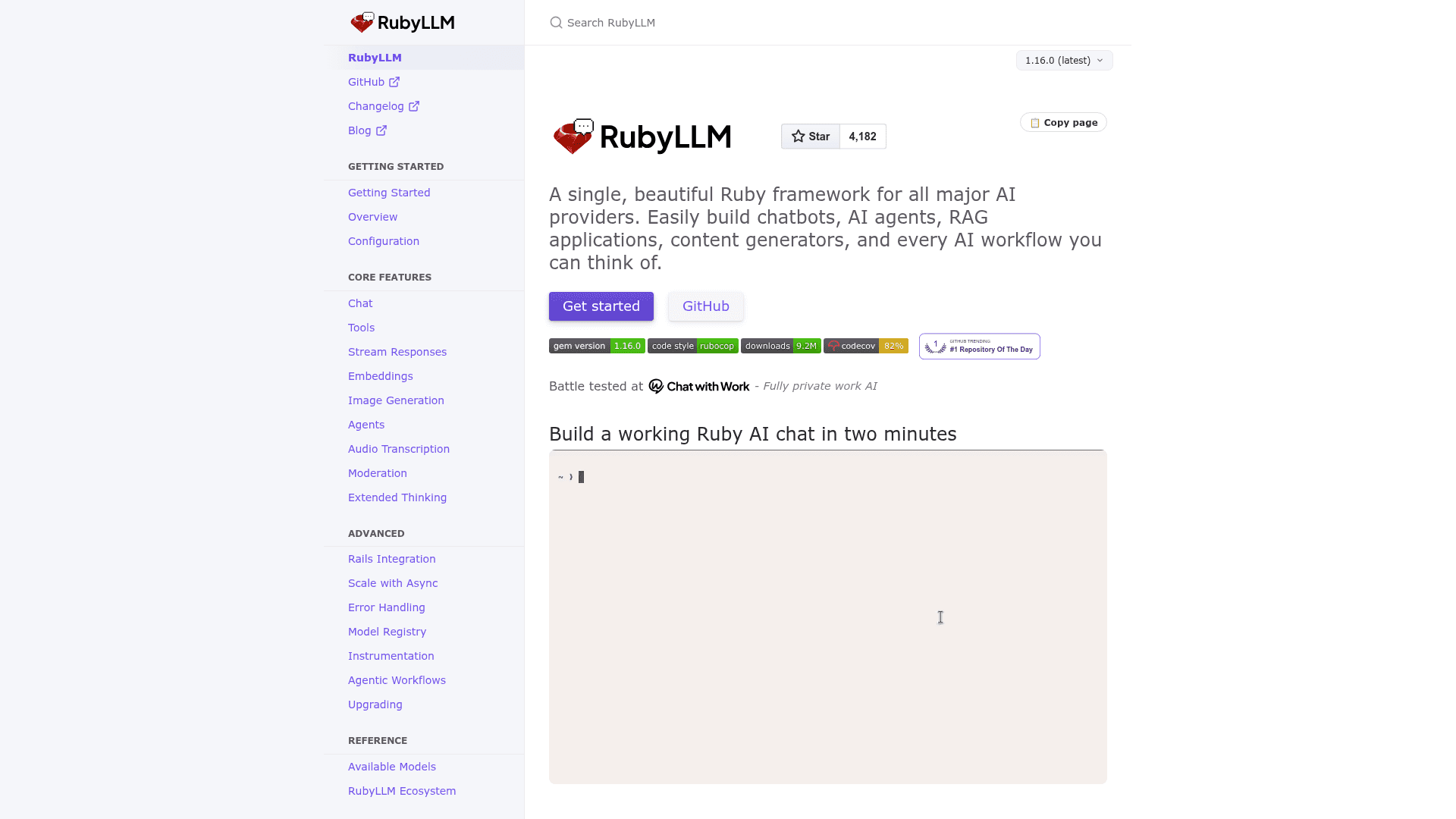
RubyLLM is an open-source Ruby gem maintained by Carmine Paolino that provides a single, unified interface for interacting with all major AI providers. Released under the MIT License and available on RubyGems, it is described by its author as "battle tested" at Chat with Work, a fully private work AI product. The project has accumulated over 4,000 GitHub stars since its creation in January 2025.
What It Is
RubyLLM is an AI development library for Ruby that abstracts away the differences between AI provider APIs — OpenAI, Anthropic, Gemini, VertexAI, Bedrock, DeepSeek, Mistral, Ollama, OpenRouter, Perplexity, GPUStack, xAI, and any OpenAI-compatible API — behind one consistent Ruby interface. Developers use it to build chatbots, AI agents, RAG applications, content generators, and multimodal workflows without writing provider-specific client code. The library intentionally keeps its dependency footprint minimal: just Faraday, Zeitwerk, and Marcel.
Core Capabilities
RubyLLM covers a broad surface area of AI tasks through a clean, expressive API:
- Chat: Conversational AI via
RubyLLM.chatwith full message history - Vision: Analyze images, videos, PDFs, CSVs, and arbitrary file types
- Audio: Transcribe speech with
RubyLLM.transcribeand generate it withRubyLLM.speak - Image generation: Create images with
RubyLLM.paint - Embeddings: Generate vector embeddings with
RubyLLM.embed - Moderation: Content safety checks with
RubyLLM.moderate - Tools: Let AI call arbitrary Ruby methods via
RubyLLM::Tool - Agents: Reusable assistants with instructions and tools via
RubyLLM::Agent - Structured output: JSON schema enforcement via
RubyLLM::Schema - Streaming: Real-time response chunks via Ruby blocks
- Extended thinking: Control, view, and persist model deliberation steps
- Citations: Normalized source citations from documents, search, and grounding
- Batches: Provider-side batch processing via
RubyLLM.batch - Model registry: 800+ models with capability detection
Rails Integration
RubyLLM ships a first-class Rails integration that goes beyond a simple wrapper. Running bin/rails generate ruby_llm:install and bin/rails db:migrate sets up ActiveRecord-backed chat persistence. The acts_as_chat concern turns any model into a persistent conversation. An optional ruby_llm:chat_ui generator scaffolds a ready-to-use chat interface at /chats. The ruby_llm:load_models task (introduced in v1.13) syncs the model registry to the database.
Architecture and Deployment Model
RubyLLM is a Ruby gem installed via Bundler (gem 'ruby_llm'). It runs in any Ruby environment — standalone scripts, Rack apps, Rails monoliths, or background job workers. Async support uses fiber-based concurrency for scaling concurrent AI calls without threads. There is no hosted service or SaaS layer; all API calls go directly from the application to the chosen AI provider using the developer's own API keys.
Update: Version 1.16.0
The latest stable release is 1.16.0, published on June 9, 2026. A 2.0 development branch is actively maintained and accessible at rubyllm.com/next, signaling a major version in progress. The repository was last pushed to on June 23, 2026, and shows active issue tracking with 65 open issues and 466 forks, indicating a healthy open-source contributor base.
Community Discussions
Be the first to start a conversation about RubyLLM
Share your experience with RubyLLM, ask questions, or help others learn from your insights.
Pricing
Open Source
Free and open-source Ruby gem available under the MIT License.
- Full source code access
- MIT License
- All features included
- Community support via GitHub
Capabilities
Key Features
- Chat with conversational AI
- Vision: analyze images, videos, and documents
- Audio transcription and speech synthesis
- Image generation
- Embeddings generation
- Content moderation
- Tool calling (let AI call Ruby methods)
- Agents with instructions and tools
- Structured output via JSON schemas
- Streaming responses
- Rails ActiveRecord integration with acts_as_chat
- Fiber-based async concurrency
- Model registry with 800+ models
- Extended thinking support
- Citations from documents and search
- Provider-side batch processing
- Support for 13+ AI providers
- OpenAI-compatible API support