RunWield
RunWield is a local, plan-by-default coding harness that plans, validates and records AI agent code changes.
At a Glance
Source-available (not OSI open source) RunWield, free to use for personal, educational, research, internal, or commercial purposes under the RunWield Free Use License.
Engagement
Available On
Alternatives
Listed Oct 2026
About RunWield
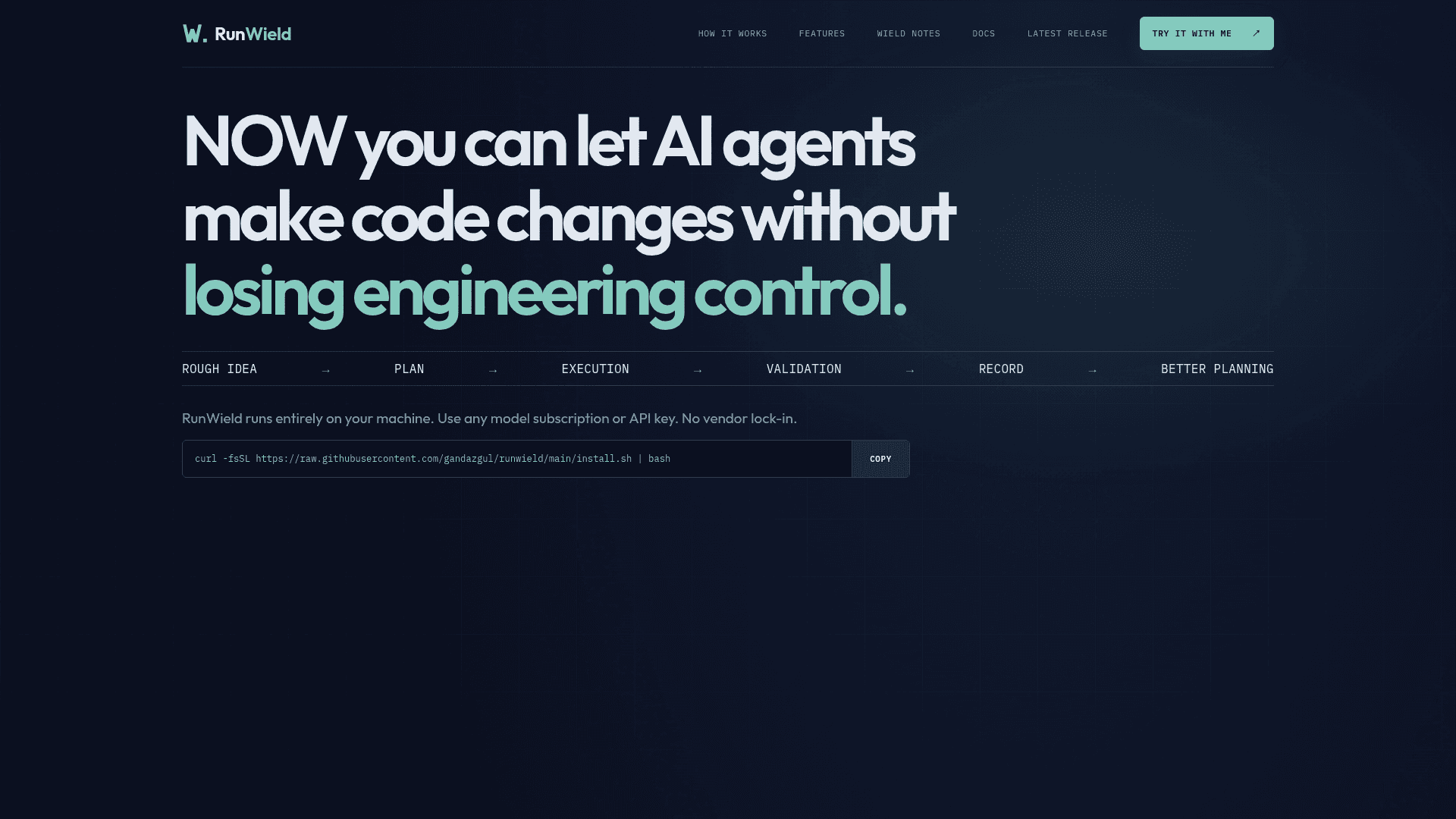
RunWield is a plan-by-default coding harness for AI coding agents that runs entirely on the user's machine. It turns rough ideas into reviewable Plans, executes them with specialist agents, validates the results with checks and independent AI review, and records decisions for future planning. It works with any model subscription or API key.
What It Is
RunWield is a terminal-based harness (installed as the wld binary on macOS or Linux) that sits between a developer and AI coding models. A Router distinguishes questions, ideation, operations, quick fixes, planned changes, and large projects, then hands off to specialist agents: Guide, Ideator, Planner, Architect, and Slicer. Plans, project context, memory, and Work Records live alongside the project, and model requests go to the provider the user selects.
Plan, execute, validate
Plans can be reviewed in the browser, annotated inline, discussed with Architect, shared with reviewers, and approved before implementation. Agents can work autonomously or in Pair mode with checkpoint discussions, and planned changes can run in separate Git worktrees. Large efforts become Epics that Slicer breaks into dependent Plans, reviewed together as a Sequence on a dedicated Epic branch.
Validation runs project checks (tests, types, lint, formatting) with automatic repair, then an independent LLM reviewer compares the implementation to the Plan. A human review step offers a side-by-side diff, line annotations, and Guided Review, and feedback goes to a repair agent.
Memory and Work Records
Completed Plans leave Markdown Work Records describing what changed, why, deviations, and lessons. Running /init builds project context and durable memories, and Mnemoteca recalls project and global knowledge. PRDs and ADRs keep product intent and architectural decisions near the code.
Models, tools, and clients
Users can connect subscription providers or API keys, assign models per agent, and use Claude Code CLI or Antigravity CLI as execution backends. Cymbal provides code intelligence, MCP servers extend tools, and skills and prompt templates customize behavior. RunWield can be driven from the terminal, browser Workspace, JetBrains AI Chat, Air plugin, or Discord via the OpenAB gateway, and it speaks Agent Client Protocol. The site lists Connect for external coding hosts, starting with Claude Code, as upcoming roadmap work.
Community Discussions
Be the first to start a conversation about RunWield
Share your experience with RunWield, ask questions, or help others learn from your insights.
Pricing
Free Use
Source-available (not OSI open source) RunWield, free to use for personal, educational, research, internal, or commercial purposes under the RunWield Free Use License.
- Use for personal, educational, research, internal, or commercial purposes
- Download, install, run, and evaluate
- Inspect the source code
- Make local changes for private use
- No distribution of modified versions; no publishing, selling, sublicensing, or hosting derivative works
Capabilities
Key Features
- Plan-by-default workflow with browser Plan Review and inline annotations
- Specialist agents: Router, Guide, Ideator, Planner, Architect, Slicer
- Epics and Sequences for large efforts
- Mechanical validation with automatic repair
- Independent LLM review against the Plan
- Guided human code review with diff annotation
- Work Records and project memory in Markdown
- Git worktree execution
- Any model via subscription or API key with per-agent overrides
- MCP servers, skills, and prompt templates
- Terminal and browser Workspace with Sessions
- JetBrains, ACP, and Discord (OpenAB) access
- Image generation backends
- Optional local workflow metrics