
RuoYi AI
Open-source full-stack AI assistant platform with multi-provider model management, RAG knowledge bases, MCP tools, visual workflows, and multi-agent orchestration.
At a Glance
Self-hosted core platform under the MIT License.
Engagement
Available On
Alternatives
Listed Oct 2026
About RuoYi AI
RuoYi AI is an open-source, MIT-licensed AI assistant platform maintained by ageerle and the RuoYi AI community. It combines a Java backend built on Spring Boot and LangChain4j with an admin panel and a user-facing frontend. The latest listed release is v3.1.0, and the documentation site is available in Chinese and English.
What It Is
RuoYi AI is a self-hostable platform for building AI assistants and agent applications. It unifies model management, knowledge bases, tool integration, and workflow design in one system, so teams can configure providers and capabilities from an admin panel and expose them through a user frontend.
Core Capabilities
The documentation describes these modules:
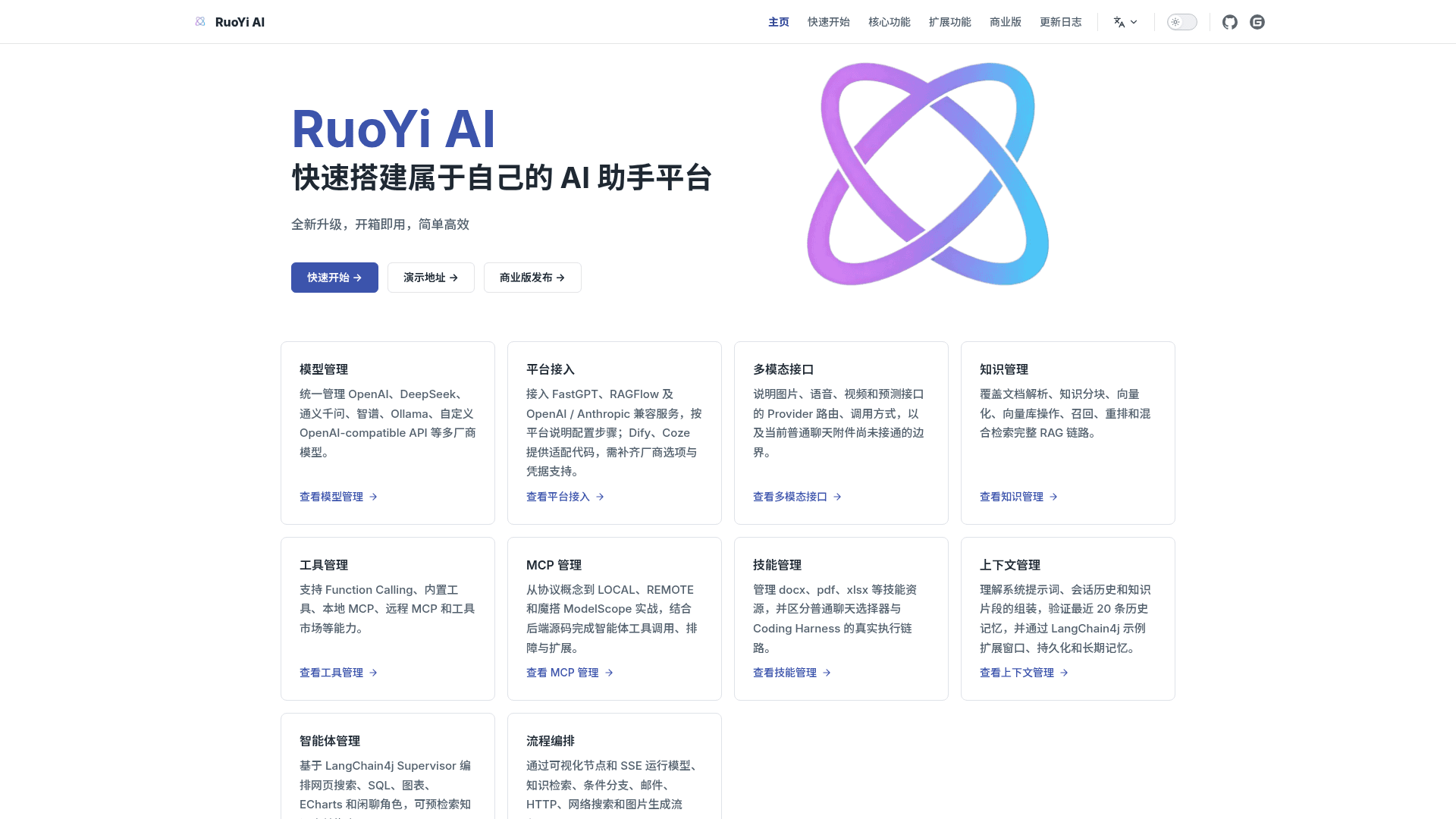
- Model management covers OpenAI, DeepSeek, Qwen, Zhipu, Ollama, and custom OpenAI-compatible APIs. Platform integrations include FastGPT and RAGFlow, with Dify and Coze adapter code that needs additional provider options and credential support.
- Knowledge management covers the RAG chain: document parsing, chunking, vectorization, vector store operations, retrieval, reranking, and hybrid search. Supported vector databases are Milvus, Weaviate, and Qdrant.
- Tool management supports function calling, built-in tools, local and remote MCP, and a tool market. Skills such as docx, pdf, and xlsx are managed separately.
- Agents use a LangChain4j Supervisor to orchestrate web search, SQL, chart, ECharts, and chat roles, with optional knowledge pre-retrieval and MCP binding.
- Workflow orchestration uses visual nodes and SSE execution for model calls, knowledge retrieval, conditional branches, email, HTTP, web search, and image generation.
- Multimodal interfaces route image, voice, video, and prediction calls by provider. The docs note that ordinary chat attachments are not yet connected.
Deployment Model
The project ships Docker Compose files that start the backend, admin panel, user frontend, and dependencies together from prebuilt images, or a step-by-step source build. The stack uses MySQL 8.0, Redis, a vector database, and MinIO object storage, with Sa-Token and JWT for security. The README advises changing default database and storage passwords for production use. A commercial edition is also referenced on the project site.
Community Discussions
Be the first to start a conversation about RuoYi AI
Share your experience with RuoYi AI, ask questions, or help others learn from your insights.
Pricing
Open Source (MIT)
Self-hosted core platform under the MIT License.
- MIT License
- Model management
- Knowledge management / RAG
- MCP tool management
- Visual workflow orchestration
Capabilities
Key Features
- Multi-provider model management with OpenAI-compatible APIs
- FastGPT and RAGFlow platform integration
- RAG with document parsing, chunking, reranking and hybrid search
- Vector database support for Milvus, Weaviate and Qdrant
- Function calling, local and remote MCP, and tool market
- Skills management
- LangChain4j Supervisor multi-agent orchestration
- Visual drag-and-drop workflow designer with SSE execution
- Multimodal image, voice and video provider routing
- Docker Compose deployment
- Admin panel and user frontend