
Salad
Orchestration cloud that runs containers and OpenAI-compatible LLM inference across distributed idle GPUs, reserved hardware, or an organization's own fleet.
At a Glance
Engagement
Available On
Alternatives
Listed Oct 2026
About Salad
Salad Technologies, Inc. builds an orchestration cloud that schedules containerized GPU workloads onto distributed, idle GPUs. Users can deploy Docker containers through Salad Container Engine, call an OpenAI-compatible AI Gateway, or run the stack privately on their own hardware. The company was founded in 2018 and says its network spans 190+ countries.
What It Is
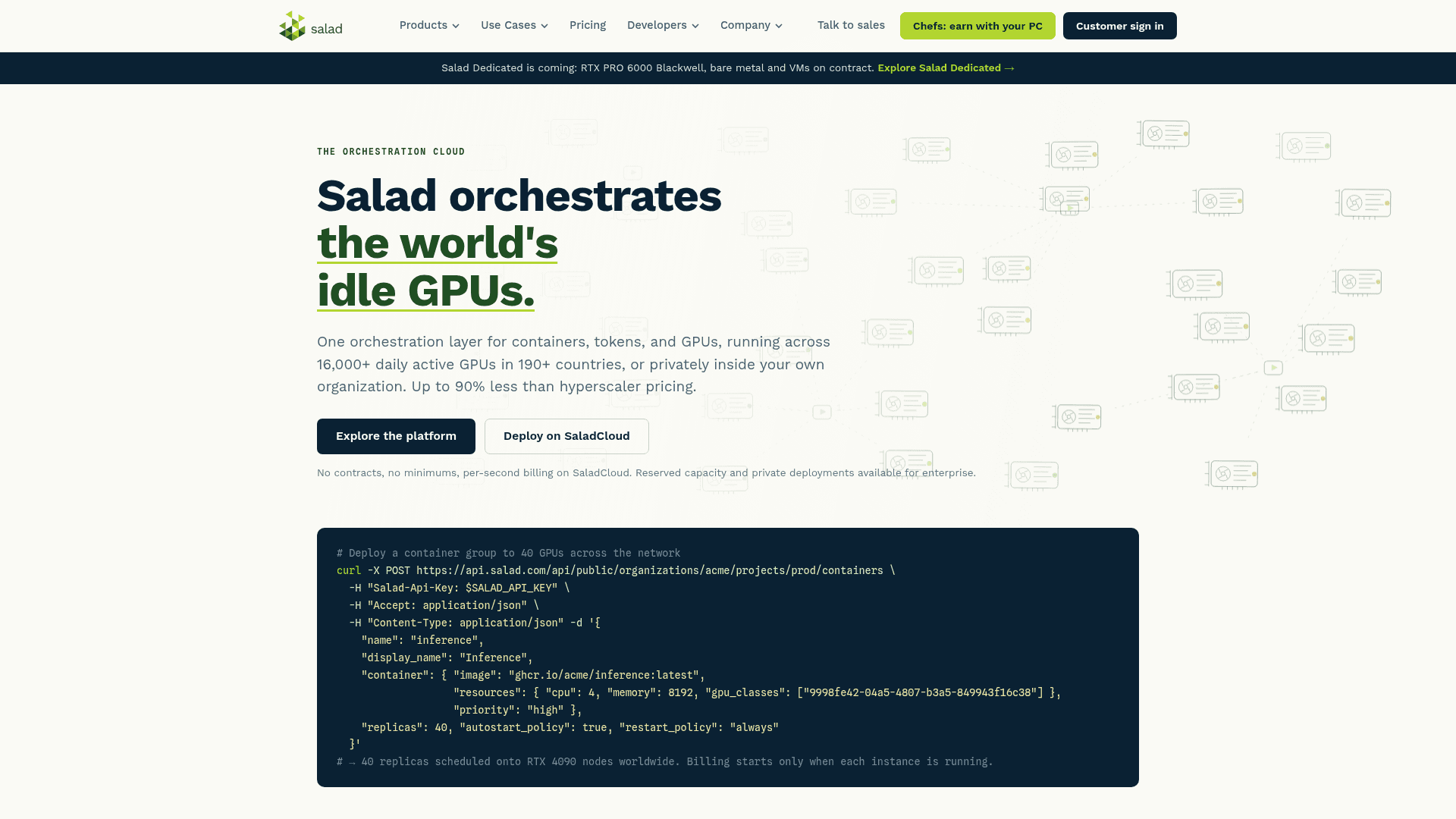
Salad is a GPU compute platform with two sides. Salad Chefs run a desktop app and earn rewards when their PCs are idle. Businesses deploy containers onto that network through Salad Container Engine and are billed per second. Container Engine schedules, monitors, and reallocates Docker workloads across selected GPU pools, and it moves work to another node of the same class when a node goes offline.
Deployment Options
- Community Cloud: interruptible consumer GPUs (RTX 3060 to RTX 5090) with priority pricing tiers.
- Salad Dedicated: reserved bare metal servers and VMs on contract, starting with RTX PRO 6000 Blackwell.
- Private Cloud: Salad's orchestration stack run inside an organization to pool idle GPUs in its own workstations and servers into a private, OpenAI-compatible token service.
- AI Gateway: a managed OpenAI-compatible endpoint for open-weight models, with tool calling.
Developer Workflow
Developers provide a Docker image, hardware requirements, and a replica count through the REST API or portal. SDKs are listed for Python, JavaScript/TypeScript, Go, and Java, plus an OpenAPI spec. Documented patterns include Container Gateway for real-time inference, Job Queues and the open-source Kelpie API for long-running tasks, and a Virtual Kubelet for scheduling Kubernetes pods. Recipes offer one-click deployments of Flux, SDXL, YOLOv8, Llama, and Mistral. A Transcription API and a residential-IP Gateway Service are also offered.
Security and Fit
Salad states that containers run inside a hypervisor-isolated Linux VM with encryption in transit and at rest, and that it holds SOC 2 Type I. It says workloads needing sub-10-millisecond latency, multi-GPU NVLink training, or strict data-residency guarantees are not a fit for Community Cloud, and points those to Dedicated or Private Cloud.
Community Discussions
Be the first to start a conversation about Salad
Share your experience with Salad, ask questions, or help others learn from your insights.
Pricing
GPU Instances - RTX 5090 (32 GB)
Pay-as-you-go per GPU-hour, billed per second while running; vCPU and RAM included. Price shown is the High priority rate.
- High $0.500/GPU/hr
- Medium $0.417/GPU/hr
- Low $0.333/GPU/hr
- Lowest $0.250/GPU/hr ($182.50/mo at 730 hours)
- vCPU and RAM included
- Allocation, download, and cold start are free
GPU Instances - RTX 4090 (24 GB)
Pay-as-you-go per GPU-hour, billed per second while running; vCPU and RAM included. Price shown is the High priority rate.
- High $0.330/GPU/hr
- Medium $0.273/GPU/hr
- Low $0.217/GPU/hr
- Lowest $0.160/GPU/hr ($116.80/mo at 730 hours)
- vCPU and RAM included
CPU Instances
CPU-only container groups, billed per vCPU-hour and per GB of RAM per hour.
- $0.005 per vCPU-hour
- $0.001 per GB of RAM per hour
- General purpose 1 GB / 1 vCPU $0.006/hr
- CPU-optimized 2 GB / 1 vCPU $0.007/hr
- Memory-optimized 8 GB / 1 vCPU $0.013/hr
- Additional GPU classes available from $0.015 per GPU-hour at Lowest priority
Contact sales
Volume discounts for deployments above 100 GPUs, long-running jobs, or committed spend.
- Priced below list
- Volume discounts above 100 GPUs
Capabilities
Key Features
- Salad Container Engine for scheduling Docker workloads across distributed GPUs
- OpenAI-compatible AI Gateway with tool calling
- Community Cloud of interruptible consumer GPUs with priority tiers
- Salad Dedicated reserved bare metal and VMs
- Private Cloud to pool an organization's idle GPUs
- Automatic reallocation of workloads when nodes go offline
- Job Queues and Container Gateway
- Virtual Kubelet for Kubernetes pods
- Transcription API
- Recipes for one-click model deployments
- Hypervisor isolation and node trust rating
- Region constraints for workloads