Salt Security
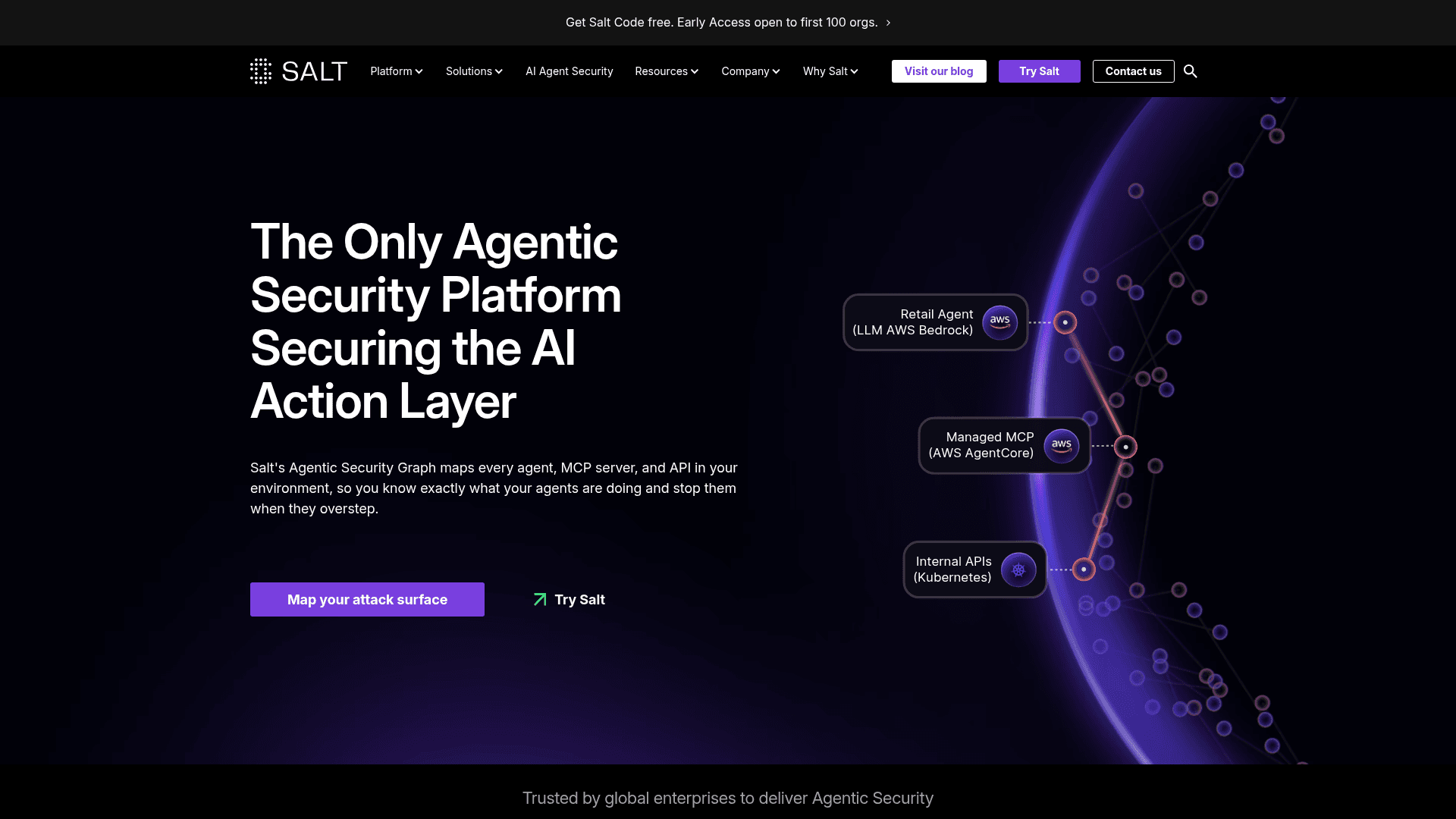
Salt Security is an Agentic Security Platform that maps every AI agent, MCP server, and API in your environment to discover, govern, and protect the full agentic stack at runtime.
At a Glance
About Salt Security
Salt Security, founded in 2018 by Roey Eliyahu and Michael Nicosia, delivers what the company describes as the industry's only AI-infused Agentic Security Platform. Headquartered in Palo Alto, CA with an office in Tel Aviv, Salt focuses on securing the "action layer" — the interconnected mesh of APIs, MCP servers, and AI agents that power modern enterprise applications. The platform is available to enterprise customers via demo request, with early access to Salt Code open to the first 100 organizations.
What It Is
Salt Security is a cloud-native API and agentic AI security platform built to discover, govern, and protect the full lifecycle of AI agent activity. Rather than focusing solely on model-layer security, Salt targets the three pillars of the agentic stack: LLMs (the decision layer), MCP servers (the tool/action layer), and APIs (the execution layer). The platform's core concept is the Agentic Security Graph — a contextual map of every agent, MCP server, and API operating across an enterprise environment, including shadow and zombie APIs that are unknown to security teams.
Platform Architecture and Components
Salt's platform is composed of several modular products that work together:
- Salt Surface — External exposure mapping and API attack surface assessment
- Salt Connect — Visibility into APIs running inside cloud environments (AWS, GCP, Azure)
- Salt Code — Policy enforcement inside AI coding agents (e.g., GitHub Actions)
- Salt Collect — Live traffic analysis and data collection
- Salt Protect — Real-time blocking of logic-based and behavioral API threats
- Pepper AI — The AI engine that generates and contextualizes the Agentic Security Graph
The platform uses patented behavioral analysis to detect API-specific threats, fraud patterns, and low-and-slow attacks. Salt claims its detection can identify attacker intent weeks before traditional tools trigger alerts, without requiring proxies, sidecars, or performance impact on APIs or AI workflows.
Agentic AI Security Focus
Salt positions itself at the intersection of API security and agentic AI risk. The company argues that most AI security tools stop at the model layer, while real-world attackers exploit the APIs that agents act through. Salt's Agentic Security Graph contextualizes risk across the entire environment — distinguishing agents that can cause significant damage from those that cannot. Key agentic security capabilities include:
- Automatic discovery of AI agents across enterprise environments
- MCP server inventory and configuration risk analysis
- Detection of excessive permissions granted to agents
- Identification of hardcoded tokens and credentials in agentic workflows
- Runtime monitoring of agent-driven API calls and MCP tool usage
Integrations and Stack Compatibility
Salt integrates with a broad set of enterprise security and cloud tools, including CrowdStrike (API and endpoint correlation), AWS, Microsoft Azure (Sentinel integration), Google Cloud Platform, Kong (API gateway), and HCL. The platform is designed to enrich SIEM alerts, create Jira tickets for remediation, and block attacks at the firewall layer — fitting into existing security operations workflows without requiring architectural changes.
Compliance and Governance
Salt's posture management capabilities map API configurations to regulatory frameworks including PCI DSS, GDPR, NIST, and SOC 2. The platform's Policy Hub enables governance enforcement at scale, and Salt publishes dedicated resources on EU AI Act compliance. Continuous posture analysis surfaces misconfigurations, authentication and authorization weaknesses, and risky MCP configurations before they can be exploited.
Salt Labs Research Team
Salt operates Salt Labs, which the company describes as the first and only API-dedicated global security research organization. The team publishes vulnerability disclosures following responsible disclosure practices, contributing findings to the broader security community. Salt also publishes an annual State of API Security Report and an Agentic AI Survey report tracking industry trends.
Community Discussions
Be the first to start a conversation about Salt Security
Share your experience with Salt Security, ask questions, or help others learn from your insights.
Pricing
Salt Code Early Access
Free early access to Salt Code for the first 100 organizations — enforces policies inside AI coding agents.
- Policy enforcement inside AI coding agents
- Early access program
- Limited to first 100 organizations
Enterprise
Full Agentic Security Platform for enterprise organizations — includes discovery, posture management, and runtime protection across agents, MCP servers, and APIs.
- Agentic Security Graph
- Salt Surface (attack surface mapping)
- Salt Connect (cloud API visibility)
- Salt Code (AI coding agent policy enforcement)
- Salt Collect (live traffic analysis)
- Salt Protect (runtime attack blocking)
- API posture and compliance management
- Behavioral threat detection
- CrowdStrike, AWS, Azure, GCP integrations
- Zero-proxy deployment
Capabilities
Key Features
- Agentic Security Graph mapping agents, MCP servers, and APIs
- Automatic discovery of shadow and zombie APIs
- API posture management and compliance mapping (PCI DSS, GDPR, NIST, SOC 2)
- Patented behavioral analysis for API threat detection
- Runtime protection against logic-based and behavioral attacks
- MCP server inventory and risk analysis
- AI agent permission and credential risk detection
- Salt Code: policy enforcement inside AI coding agents
- Salt Collect: live API traffic analysis
- Salt Protect: real-time attack blocking
- Salt Surface: external attack surface mapping
- Salt Connect: cloud API visibility (AWS, GCP, Azure)
- EU AI Act compliance resources
- Zero-proxy, zero-sidecar deployment model
- Policy Hub for governance at scale
Integrations
Demo Video