Scenario
An open-source agent testing framework that simulates realistic user conversations to test AI agents end-to-end across any framework, with support for Python, TypeScript, and Go.
At a Glance
The Scenario SDK is free and open source under Apache 2.0, available on PyPI and npm.
Engagement
Available On
Listed Aug 2026
About Scenario
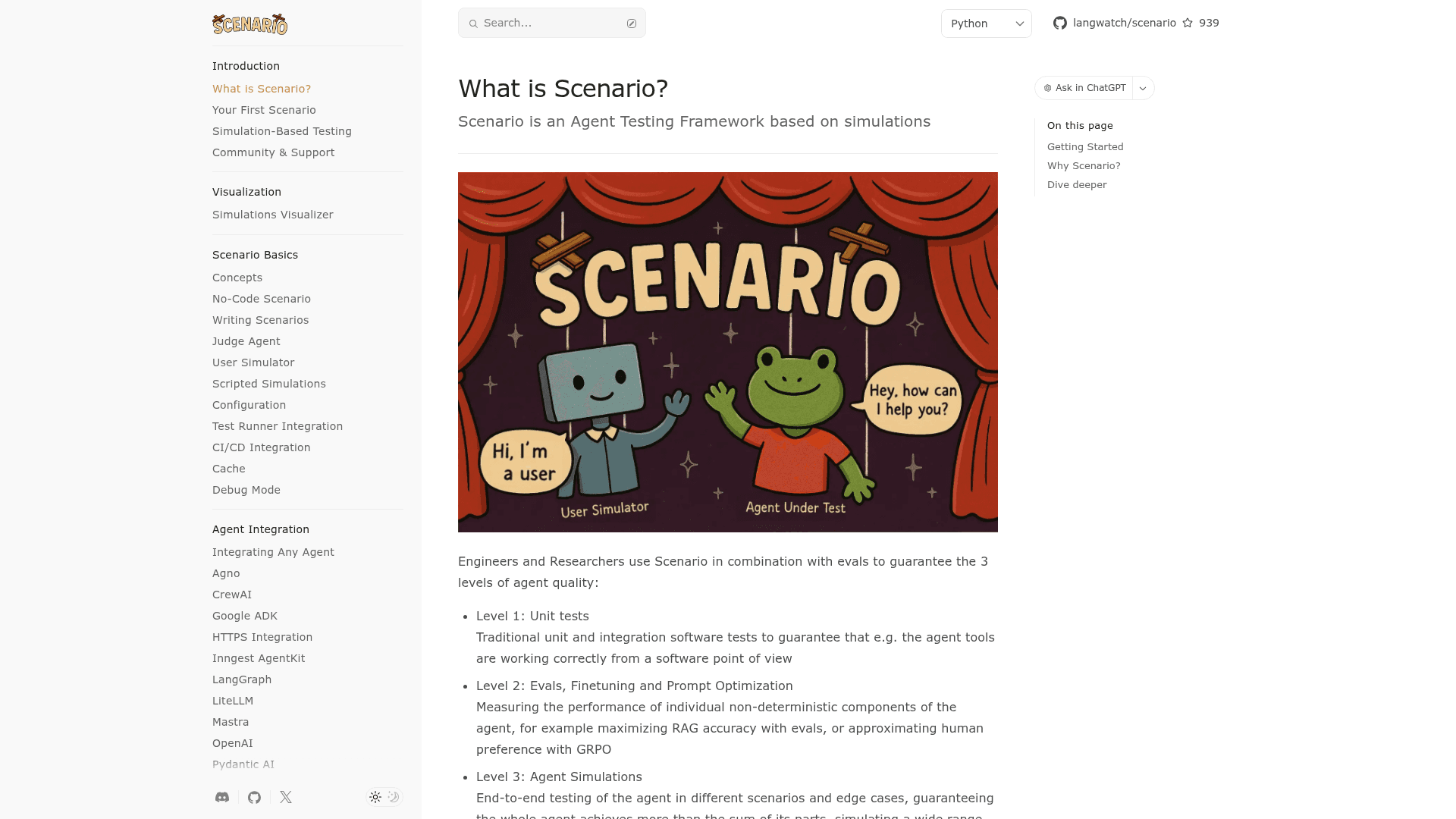
Scenario is an open-source agent testing framework built by LangWatch that uses simulation-based testing to validate AI agent behavior end-to-end. Released under the Apache 2.0 license, it is available in Python, TypeScript, and Go, and integrates with any agent framework through a single call() method adapter interface.
What It Is
Scenario fills the "Level 3" layer of agent quality assurance — end-to-end simulation testing — sitting above traditional unit tests and LLM evals. Rather than testing individual components in isolation, Scenario runs a simulated user against a real agent across multi-turn conversations, then uses a Judge Agent to evaluate whether the agent met defined success criteria. The framework is designed to be agnostic: it works alongside any LLM eval library and any agent framework, requiring no proprietary dataset to get started.
How the Simulation Loop Works
A Scenario test defines a natural-language description of a situation, assigns agents (the system under test, a UserSimulatorAgent, and optionally a JudgeAgent), and optionally provides a script list that controls the conversation flow. Each script step is an arbitrary function receiving the current ScenarioState, so teams can:
- Let the user simulator generate realistic messages automatically
- Hardcode specific user or agent turns for deterministic coverage
- Assert tool calls at precise points in the conversation
- Inject custom evals from external libraries mid-conversation
- Use
scenario.proceed(turns=N)to run N turns on autopilot - Trigger
scenario.judge()to request a verdict at any point
Without a script, the simulator runs fully on autopilot until the judge issues a pass/fail verdict or the maximum turn count is reached.
Agent Integration and Framework Support
Scenario integrates with agents by wrapping them in an AgentAdapter that exposes a single call() method. The documentation lists first-class integration guides for: LangGraph, CrewAI, Pydantic AI, Agno, Google ADK, Inngest AgentKit, LiteLLM, Mastra, OpenAI SDK, Vercel AI SDK, and Claude Code. Remote agents can be tested over HTTPS, streaming, Server-Sent Events, and stateful thread-ID protocols. Multimodal inputs (images, files) are also supported.
Voice Agent Testing
Scenario treats voice as a first-class citizen using the same scenario.run() entrypoint and script DSL. Shipped platform adapters include ElevenLabs (hosted Conversational AI), OpenAI Realtime, Twilio Media Streams, Pipecat WebSocket, and Gemini Live. The voice surface adds scenario.audio() for injecting recorded clips, scenario.background_noise() for noise injection, scenario.interrupt() for interruption testing, and result.latency with TTFB, p50, and p95 metrics.
Red Teaming
Scenario ships a RedTeamAgent as a drop-in replacement for the user simulator. It runs multi-turn adversarial attacks using the Crescendo escalation strategy, with per-turn scoring, refusal detection, and backtracking, all within the same scenario.run() loop and CI pipeline. This makes it straightforward to surface safety and security vulnerabilities in agents without a separate toolchain.
Update: python/v1.0.0
The repository reached its v1.0.0 milestone for the Python package on July 24, 2026. The project was created in April 2025 and has been actively developed, with the last push recorded on August 3, 2026. The GitHub repository had accumulated 939 stars and 71 forks at the time of indexing. The open-source SDK (Python + TypeScript) is available on PyPI as langwatch-scenario and on npm as @langwatch/scenario. LangWatch also offers a cloud visualization platform that connects to Scenario via an API key for real-time simulation replay and team collaboration, with its own separate pricing tiers.
Community Discussions
Be the first to start a conversation about Scenario
Share your experience with Scenario, ask questions, or help others learn from your insights.
Pricing
Open Source
The Scenario SDK is free and open source under Apache 2.0, available on PyPI and npm.
- Full Scenario SDK in Python, TypeScript, and Go
- Simulation-based agent testing
- User simulator and judge agent
- CI/CD integration
- Voice agent testing
Developer
Free LangWatch cloud plan for individuals getting started with agent testing and observability.
- 50k events / month
- 14-day data access
- 2 users
- 3 scenarios, 3 simulations, 3 custom evals
- Community support (GitHub & Discord)
Growth
For teams shipping agents to production, with unlimited simulations and private support.
- Everything in Developer, plus:
- 200k events included, then $6 / 100k
- 30-day retention included (extend at $4 / GB)
- Unlimited lite-users
- Unlimited simulations, evals, prompts
- Private Slack / Teams support
- Volume discounts above 20 users
Enterprise
For regulated teams that need control, compliance, and on-prem deployment.
- Hybrid, self-hosted or on-prem
- Custom data retention
- Custom SSO / RBAC
- Audit logs & SLAs
- ISO 27001 reports, InfoSec & legal review
- Custom Terms, DPA
- Forward Deployed Engineer
- Billing via AWS / Google Marketplace
Capabilities
Key Features
- Simulation-based agent testing
- LLM-powered user simulator
- Judge agent with configurable success criteria
- Multi-turn conversation testing
- Scripted and autopilot simulation modes
- Tool-call verification across long dialogues
- Framework-agnostic adapter (one call() method)
- Python, TypeScript, and Go support
- CI/CD integration (pytest, vitest, jest)
- Voice agent testing (ElevenLabs, OpenAI Realtime, Twilio, Pipecat, Gemini Live)
- Red teaming with Crescendo escalation strategy
- Debug mode with step-through and intervention
- Deterministic caching for reproducible tests
- Async-native parallelism
- Simulation visualizer for real-time debugging
- Multimodal support (images, files)
- Remote agent testing (HTTPS, streaming, SSE, stateful)
- Custom judge and custom observability
- Latency metrics (TTFB, p50, p95) for voice agents
Integrations
Demo Video