
Sentry MCP
An MCP server that connects Sentry's error monitoring API directly to LLMs and coding agents, enabling natural language debugging of production issues, stack traces, and application performance data.
At a Glance
Free and open-source MCP server for Sentry. Use the hosted remote service at mcp.sentry.dev or self-host via stdio transport.
Engagement
Available On
Alternatives
Listed Aug 2026
About Sentry MCP
Sentry MCP is an open-source Model Context Protocol server built and maintained by Sentry (Functional Software, Inc.) that bridges Sentry's error monitoring and observability platform with LLM-powered coding agents. Currently in beta, it is deployed as a remote MCP service at mcp.sentry.dev and is designed primarily for human-in-the-loop developer workflows rather than general-purpose automation.
What It Is
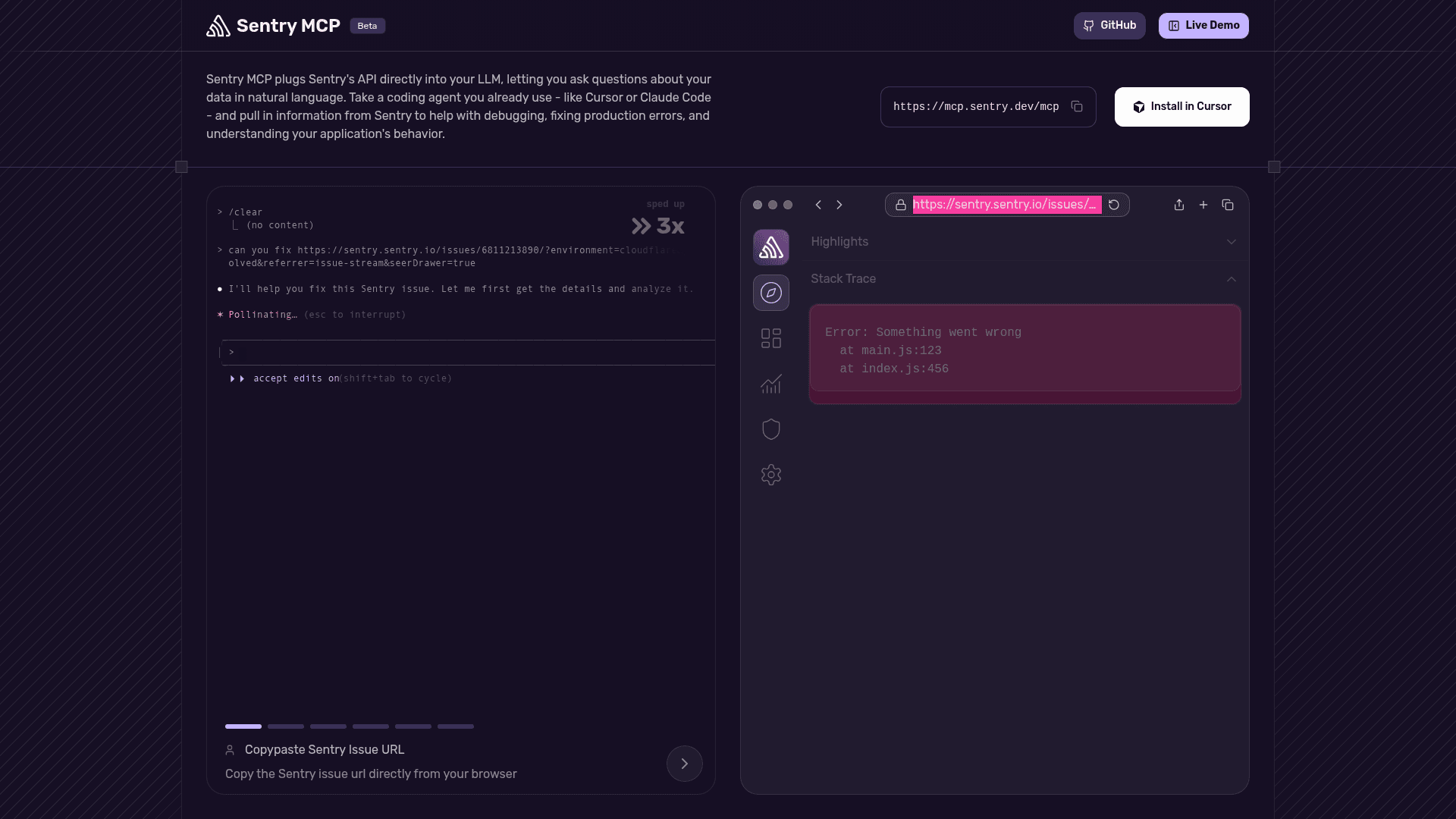
Sentry MCP acts as middleware between Sentry's upstream API and AI coding assistants such as Cursor, Claude Code, Codex, Amp, Gemini CLI, OpenCode, Warp, Windsurf, and Zed. Developers can paste a Sentry issue URL directly into their coding agent and ask it to investigate or fix the problem — the MCP server fetches issue details, invokes Seer (Sentry's AI root-cause analysis engine) to analyze stack traces, and returns structured context that the LLM uses to propose and apply code fixes. The project is written in TypeScript, hosted on GitHub under the getsentry organization, and has accumulated over 800 stars since its creation in March 2025.
Core Capabilities
The server exposes a set of MCP tools organized around three main workflows:
- Fix Bugs — Fetch issue details, analyze stack traces with Seer, and let the coding agent apply a fix directly to the codebase, then validate with automated tests.
- Instrument Your App — Query traces, metrics, and errors to understand application behavior and guide instrumentation decisions.
- Search Things — Use AI-powered natural language search (backed by OpenAI, Anthropic, Azure OpenAI, or OpenRouter) to translate queries into Sentry's query syntax and find issues, events, or spans across projects.
AI-powered search tools (search_events, search_issues, etc.) require a configured LLM provider; all other tools function without one.
Deployment Model
Sentry MCP supports two transport modes:
- Remote (Streamable HTTP/SSE) — The production service at
https://mcp.sentry.dev/mcpuses OAuth for authentication and runs on Cloudflare Workers. This is the recommended path for most users and requires no local setup beyond adding the server URL to a supported coding agent. - Stdio — A local
npx @sentry/mcp-server@latestcommand supports self-hosted Sentry deployments. Users supply a Sentry User Auth Token with scopes for org, project, team, and event access. Self-hosted instances can disable specific skills (e.g.,--disable-skills=seer) when features like Seer are unavailable.
Path constraints on the remote URL (/:organization or /:organization/:project) let teams scope the MCP session to a specific org or project, automatically hiding irrelevant tools.
Integration Surface
The server integrates with a wide range of AI coding environments through standard MCP configuration:
- Claude Code (including as a Claude Code plugin via
claude plugin marketplace add getsentry/sentry-mcp) - Cursor, VSCode, Windsurf, Zed
- Codex, Amp, Gemini CLI, OpenCode, Warp
A live demo on the homepage lets users connect their Sentry account via OAuth and test MCP tool calls against real project data in a browser chat interface.
Update: Version 0.37.0
The latest release is 0.37.0, published on July 2, 2026. The repository shows active development with the last push on July 31, 2026. Recent commits visible in the homepage demo include schema improvements for trace responses — specifically adding a TraceIssueSchema to handle standalone error objects returned alongside span data in Sentry's trace API, and filtering logic to correctly separate span and issue items during trace processing. The README notes that auto-detection of LLM providers based on API keys is deprecated and will be removed in a future release, with EMBEDDED_AGENT_PROVIDER now required when multiple provider keys are set.
Community Discussions
Be the first to start a conversation about Sentry MCP
Share your experience with Sentry MCP, ask questions, or help others learn from your insights.
Pricing
Open Source
Free and open-source MCP server for Sentry. Use the hosted remote service at mcp.sentry.dev or self-host via stdio transport.
- Remote MCP server at mcp.sentry.dev
- OAuth authentication
- Stdio transport for self-hosted Sentry
- Integration with Cursor, Claude Code, VSCode, and more
- AI-powered issue search (requires own LLM API key)
Capabilities
Key Features
- Natural language querying of Sentry issues and errors
- AI-powered root cause analysis via Seer integration
- Stack trace analysis and automated fix suggestions
- Trace and span inspection
- AI-powered natural language search for events and issues
- OAuth authentication for remote transport
- Stdio transport for self-hosted Sentry deployments
- Path constraints to scope sessions to org or project
- Claude Code plugin support with subagent delegation
- Support for OpenAI, Anthropic, Azure OpenAI, and OpenRouter LLM providers
- Live browser demo with real Sentry data
- Skill disabling for self-hosted instances missing features