
SGLang-Omni
Open-source multi-stage serving framework for omni, speech (TTS/ASR), music and multimodal models with OpenAI-compatible APIs.
At a Glance
About SGLang-Omni
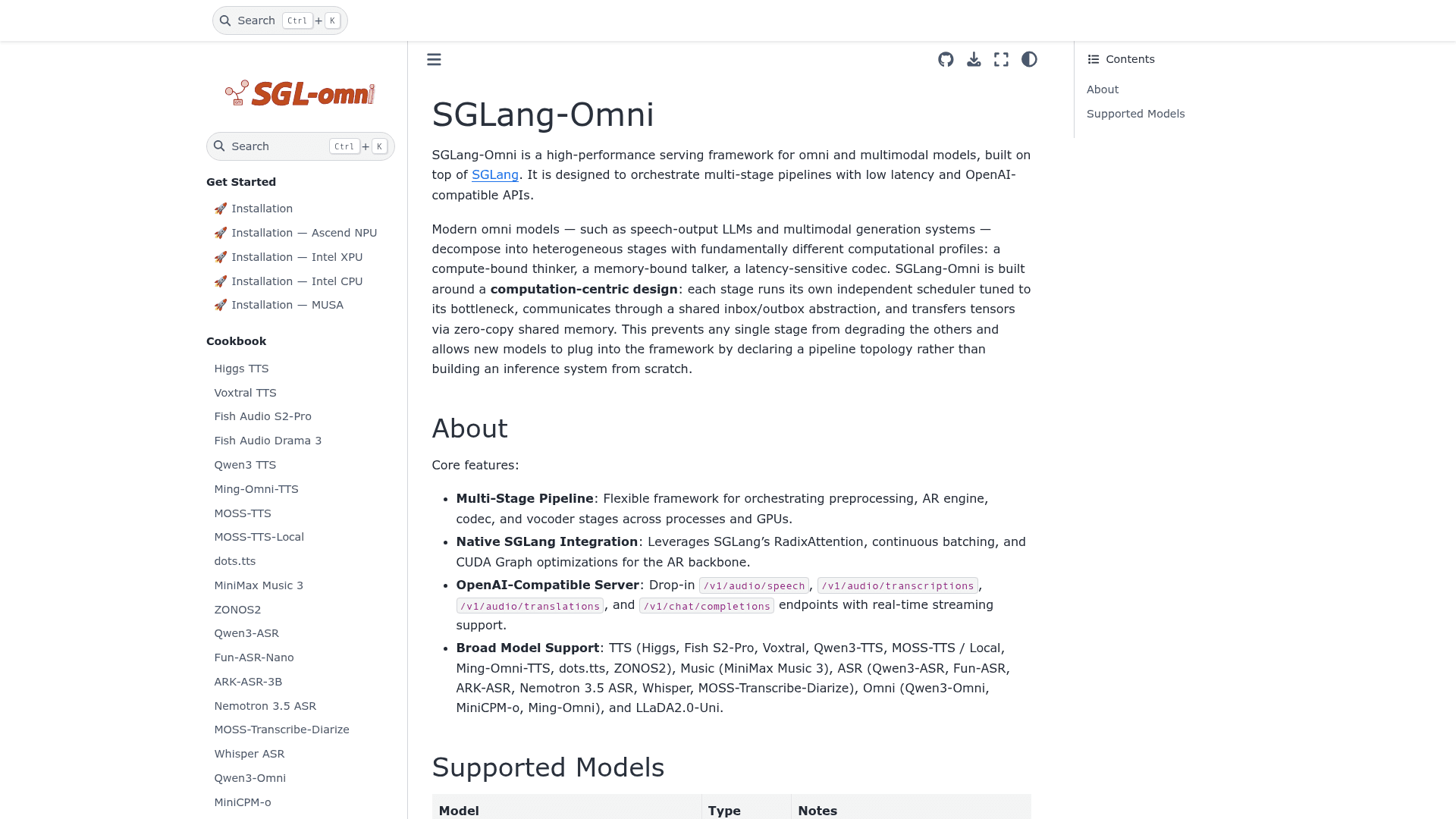
SGLang-Omni is an open-source serving runtime from the SGLang-Omni Team, built on top of SGLang, for omni, speech, and text-to-speech models. It splits generation into heterogeneous pipeline stages and exposes OpenAI-compatible endpoints for chat, speech, and transcription. The latest listed release is v0.1.8, available on PyPI.
What It Is
SGLang-Omni is a multi-stage serving runtime for models whose generation decomposes into stages with different compute profiles, such as preprocessing, encoders, autoregressive engines, talkers, decoders, and vocoders. It owns the pipeline topology, stage lifecycle, inter-stage transport, and model-family integration layer, while composing with SGLang for autoregressive scheduling and model execution where applicable. New models plug in by declaring a pipeline topology.
How the Pipeline Works
Each stage runs behind a scheduler matched to its workload, from SGLang-backed autoregressive scheduling to lightweight preprocessing and streaming vocoder loops. A control plane coordinates requests, while a relay data plane moves tensor payloads across shared-memory, NCCL, NIXL, and Mooncake backends. The docs also cover process topology, replicas, GPU sharing, and same-GPU data parallelism with CUDA MPS.
API Surface and Model Coverage
The server provides OpenAI-compatible /v1/audio/speech, /v1/audio/transcriptions, /v1/audio/translations, and /v1/chat/completions endpoints with streaming, batch speech, and uploaded voices. Documented models include TTS (Higgs Audio, Fish Audio S2-Pro and Drama 3, Voxtral, Qwen3-TTS, MOSS-TTS, ZONOS2 and others), music (MiniMax Music 3), ASR (Qwen3-ASR, Fun-ASR, Whisper, MOSS-Transcribe-Diarize and others), omni models (Qwen3-Omni, MiniCPM-o, Ming-Omni), and LLaDA2.0-Uni. A Rust-based router provides a multi-worker front door with health, readiness, and capability discovery.
Hardware and Setup
NVIDIA CUDA is the default backend with full model coverage. Apple Silicon (Qwen3-ASR via MLX or Torch MPS) and Intel XPU are marked experimental, and install guides exist for Ascend NPU, Intel CPU, and MUSA. Installation is documented via pip/uv from PyPI or an install script on macOS.
Community Discussions
Be the first to start a conversation about SGLang-Omni
Share your experience with SGLang-Omni, ask questions, or help others learn from your insights.
Pricing
Open Source
Self-hosted SGLang-Omni serving runtime released under the Apache License 2.0.
- Apache License 2.0 (Apache-2.0)
- Multi-stage serving runtime for omni, speech, and TTS models
- OpenAI-compatible endpoints for multimodal chat, speech generation, and transcription
- SGLang-Omni Router for multi-worker serving
Capabilities
Key Features
- Multi-stage pipeline runtime with per-stage schedulers
- Native SGLang integration (RadixAttention, continuous batching, CUDA Graph)
- OpenAI-compatible speech, transcription, translation, and chat endpoints
- Streaming speech and uploaded voices
- Voice cloning TTS model support
- ASR with speaker diarization and timestamps
- Text-to-music generation
- Relay data plane over shared memory, NCCL, NIXL, and Mooncake
- Rust multi-worker router
- Request-level profiler and benchmark runbooks
- Experimental Apple Silicon and Intel XPU support