
Shadowclone
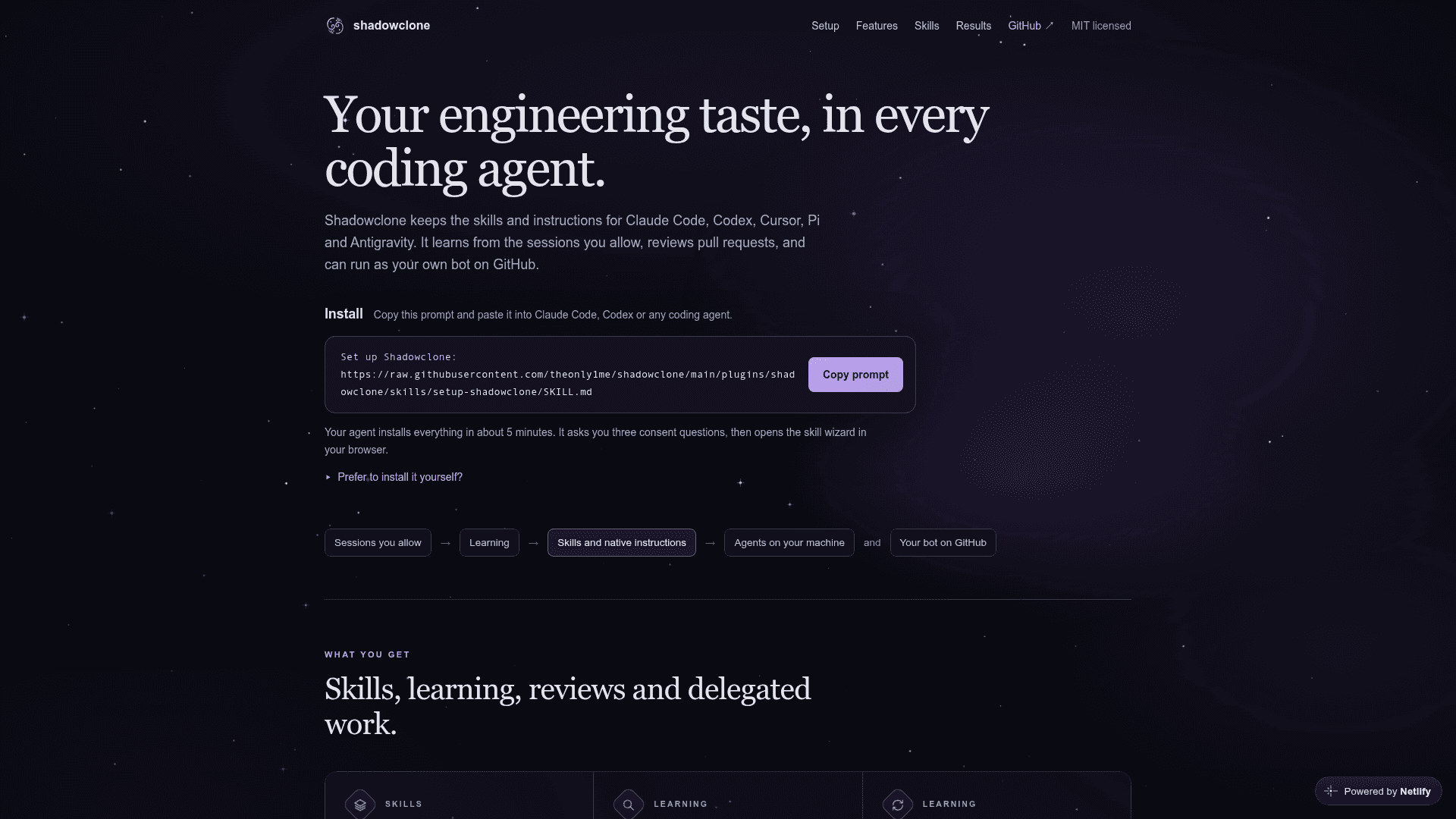
Open-source tool that keeps one set of engineering skills and instructions in sync across coding agents, learns from allowed sessions, reviews pull requests, and runs a GitHub bot.
At a Glance
Shadowclone CLI and plugins are MIT licensed and free to use, modify and distribute. Model work uses your own agent CLI and subscription or keys, which are external costs.
Engagement
Available On
Listed Nov 2026
About Shadowclone
Shadowclone is an MIT-licensed tool that maintains a single set of skills and instructions for coding agents such as Claude Code, Codex, Cursor, Pi, Antigravity and OpenCode. It can learn new preferences from sessions the user allows, review pull requests locally or on GitHub, and run clones or a GitHub Actions bot that work with the user's skills. The latest release listed on GitHub is v0.0.45.
What It Is
Shadowclone equips the coding agents a developer already uses rather than acting as a separate agent. Skills and short native guidance are delivered to each supported agent, so engineering preferences stay consistent without copying rules between tools. Rules remain readable, editable and reversible.
Setup is done by pasting a prompt into a coding agent, which installs the CLI and plugin, asks three consent questions, and opens a browser-based skill wizard. A manual install uses the npm package @shadowclone/cli.
How Learning and Builds Work
Shadowclone reads only the sessions that you allow, redacts text, and turns reusable instructions into skills. According to the README, one session can yield an explicit rule, while an inferred pattern needs three independent sessions. Background learning can discard rules already covered, apply durable ones, or defer them, and each change can be reviewed and undone.
The wizard lets users equip bundled workflow skills for planning, debugging, implementation, verification and review. Builds can be personal, private to one repository, or shared and committed by a team.
Reviews, Clones and the GitHub Bot
A local review command combines repository standards, mechanical checks and code analysis, with findings quoting evidence checked against the source. A guided review produces an HTML guide with diffs, behavior traces and a reading order across multiple PRs.
Clones run Claude Code or Codex in Docker on the user's own machine and open draft pull requests that stop when CI is green. A GitHub Actions bot can work on issues, open PRs and review, using the user's provider credentials; the user decides when to merge.
Privacy and Evaluation
The project states it has no collection service and no telemetry, every learning source is off by default, and tool results and thinking blocks never enter learning. The vendor's own evaluation on 24 synthetic tasks reports learning scoring above existing user skills on all four tested models; it measures preference adherence, not task success or code quality.
Community Discussions
Be the first to start a conversation about Shadowclone
Share your experience with Shadowclone, ask questions, or help others learn from your insights.
Pricing
Open Source (MIT)
Shadowclone CLI and plugins are MIT licensed and free to use, modify and distribute. Model work uses your own agent CLI and subscription or keys, which are external costs.
- MIT licensed
- Skills and instructions synced across Claude Code, Codex, Cursor, Pi and Antigravity
- Learns from sessions you allow
- Local pull request reviews
- Cloud bot in GitHub Actions using your own Claude subscription or Codex credentials
Capabilities
Key Features
- One set of skills and instructions across Claude Code, Codex, Cursor, Pi, Antigravity and OpenCode
- Learning from consented sessions
- Background learning with review and undo
- Browser skill wizard with personal, private repository and shared builds
- 15 bundled workflow skills
- Local pull request review with evidence-checked findings
- Guided HTML pull request review
- Clones that open draft PRs from Docker on your own machine
- GitHub Actions bot for issues, PRs and reviews
- MCP server
- No telemetry, per-source consent and redaction