ShinkaEvolve
An open-source framework that combines LLMs with evolutionary algorithms to automate scientific code discovery and optimization.
At a Glance
Fully free and open-source under the Apache License 2.0. Install via PyPI or from source.
Engagement
Available On
Alternatives
Listed May 2026
About ShinkaEvolve
ShinkaEvolve is an open-source Python framework from Sakana AI that combines Large Language Models with evolutionary algorithms to drive automated scientific discovery. It maintains a population of programs that evolve over generations, using an ensemble of LLMs as intelligent mutation operators that suggest code improvements. The project was accepted at ICLR 2026 and is available on PyPI under the Apache 2.0 license.
What It Is
ShinkaEvolve sits at the intersection of LLM-guided code generation and evolutionary search. The core idea is to treat LLMs not as one-shot code generators but as mutation operators inside an evolutionary loop: a population of candidate programs is evaluated, scored, and iteratively improved across generations. The framework is inspired by Sakana AI's own AI Scientist and Darwin Goedel Machine projects, as well as DeepMind's AlphaEvolve. It is particularly well-suited for scientific tasks where a verifier exists and the goal is to optimize performance metrics while maintaining code correctness and readability.
Architecture and Core Concepts
The framework is built around a few key primitives:
- ShinkaEvolveRunner: The unified async runner that handles proposal/eval concurrency, prompt co-evolution, and resumable runs (replacing the earlier split
EvolutionRunner/AsyncEvolutionRunnerAPI). - Archive-based search: A global archive of successful solutions enables knowledge transfer between evolutionary islands, with configurable selection strategies (fitness, crowding, power-law, beam search).
- Multi-island evolution: Multiple isolated populations evolve in parallel, with configurable migration intervals and strategies to maintain diversity.
- LLM ensemble with dynamic selection: Multiple LLM models act as mutation operators, with UCB-based dynamic model selection to balance cost and performance.
- Patch types: Mutations can be applied as diffs, full rewrites, or crossover operations between programs.
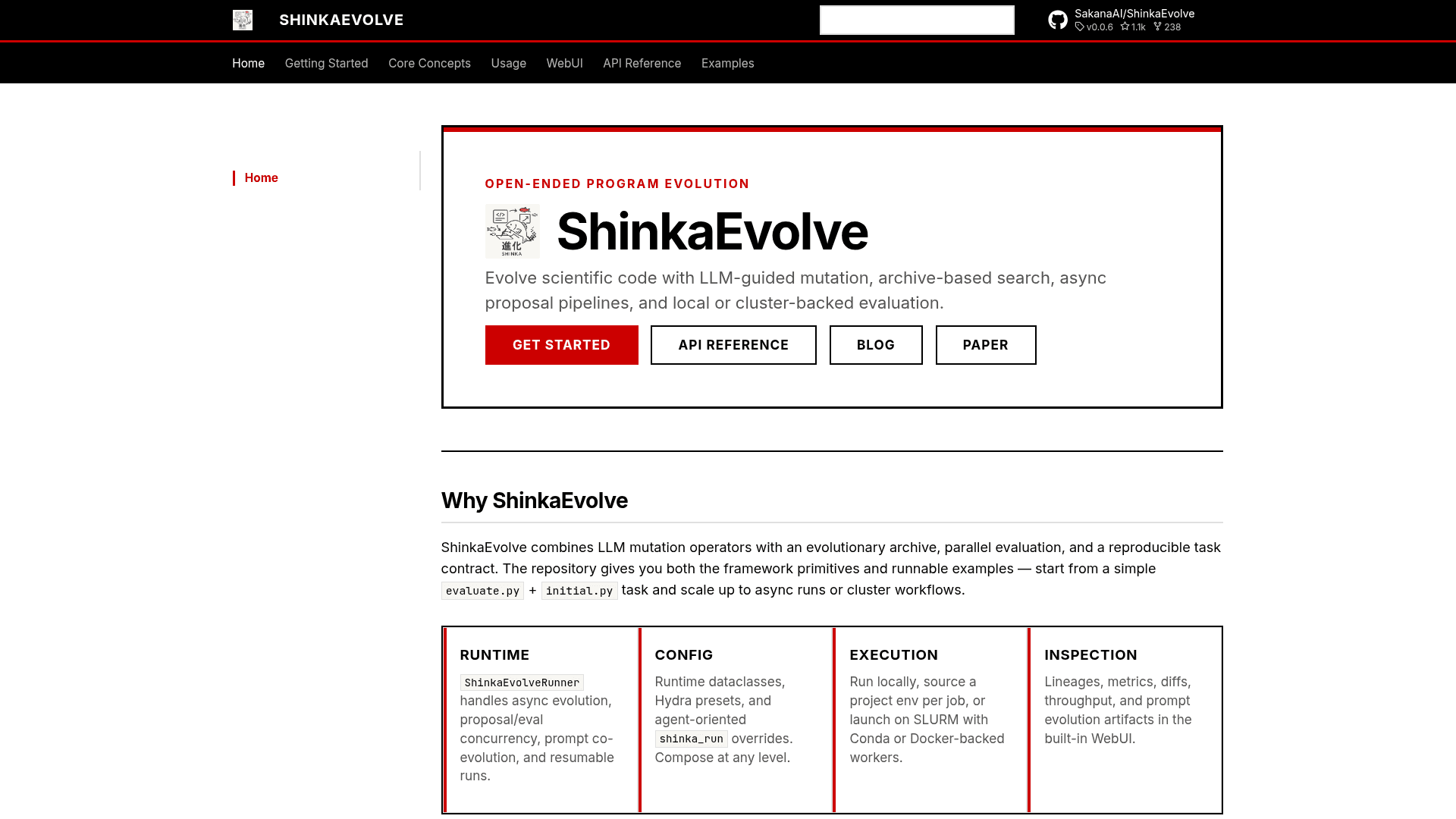
The task contract is minimal: users provide an evaluate.py script that scores candidate programs and an initial.py file marking evolvable code blocks with EVOLVE-BLOCK-START / EVOLVE-BLOCK-END annotations.
Three Entry Paths
ShinkaEvolve offers three ways to launch experiments:
- Hydra Launcher (
shinka_launch): Uses Hydra presets and compact override syntax for config-composed workflows, with built-in presets for tasks, databases, evolution budgets, and cluster backends. - Agent-Friendly CLI (
shinka_run): A task-directory launcher designed for agent workflows (Claude Code, Codex, etc.) that requires no Hydra config files and supports--setoverrides. - Python API: Direct
ShinkaEvolveRunnerconstruction for programmatic control, supporting local execution, Slurm with Conda, and Slurm with Docker backends.
Execution and Deployment
The framework supports parallel evaluation of candidates locally or on a Slurm cluster. Local runs can source a project virtualenv per job; cluster runs support both Conda environments and Docker-backed workers. An async evolution mode provides a reported 5–10x throughput speedup through concurrent proposal and evaluation pipelines. A built-in WebUI (shinka_visualize) provides real-time visualization of evolutionary lineages, genealogy trees, performance metrics, and prompt evolution artifacts.
Update: v0.0.6 and Recent Releases
The latest release is v0.0.6, published in May 2026. Recent changelog highlights include:
- May 2026: Added Headless CLI-backed mutation models for subscription-backed agent usage (e.g.,
headless/codex@gpt-5.5). - Apr 2026: Launched a full documentation website with guides for getting started, configuration, async evolution, local models, WebUI, and agentic workflows.
- Mar 2026: Refactored API with unified
ShinkaEvolveRunner; PyPI packageshinka-evolvenow available. - Feb 2026: Added agent skills (
shinka-setup,shinka-convert,shinka-run,shinka-inspect) installable vianpxfor use within Claude Code and Codex. - Jan 2026: Accepted at ICLR 2026 with a feature update release.
- Oct 2025: ShinkaEvolve supported Team Unagi in winning the ICFP 2025 Programming Contest, per Sakana AI's blog.
The project was created in September 2025 and has seen rapid iteration, with the GitHub repository accumulating over 1,100 stars and 237 forks as of the latest data.
Community Discussions
Be the first to start a conversation about ShinkaEvolve
Share your experience with ShinkaEvolve, ask questions, or help others learn from your insights.
Pricing
Open Source
Fully free and open-source under the Apache License 2.0. Install via PyPI or from source.
- Full framework access
- PyPI installation
- Local and Slurm execution
- WebUI monitoring
- Agent skills
Capabilities
Key Features
- LLM-guided code mutation operators
- Evolutionary archive-based search
- Multi-island population diversity
- Async proposal/evaluation pipelines (5-10x speedup)
- Hydra-based configuration system
- Agent-friendly CLI (shinka_run)
- Python API for programmatic control
- Local and Slurm cluster execution backends
- Docker and Conda environment support
- Interactive WebUI for real-time monitoring
- Prompt co-evolution loop
- UCB-based dynamic LLM model selection
- Support for local LLMs and embeddings
- Headless CLI-backed mutation models
- Agent skills for Claude Code and Codex
- Resumable evolution runs
- Multi-language support (Python, Julia, Fortran)
- Code embedding-based novelty detection