
SimpleEnglish
An agent skill that forces LLMs to write technical documentation in ASD-STE100 Simplified Technical English, eliminating AI writing slop with 53 aerospace-grade rules.
At a Glance
Fully free and open-source under the MIT License. No cost to use, modify, or distribute.
Engagement
Available On
Alternatives
Listed Aug 2026
About SimpleEnglish
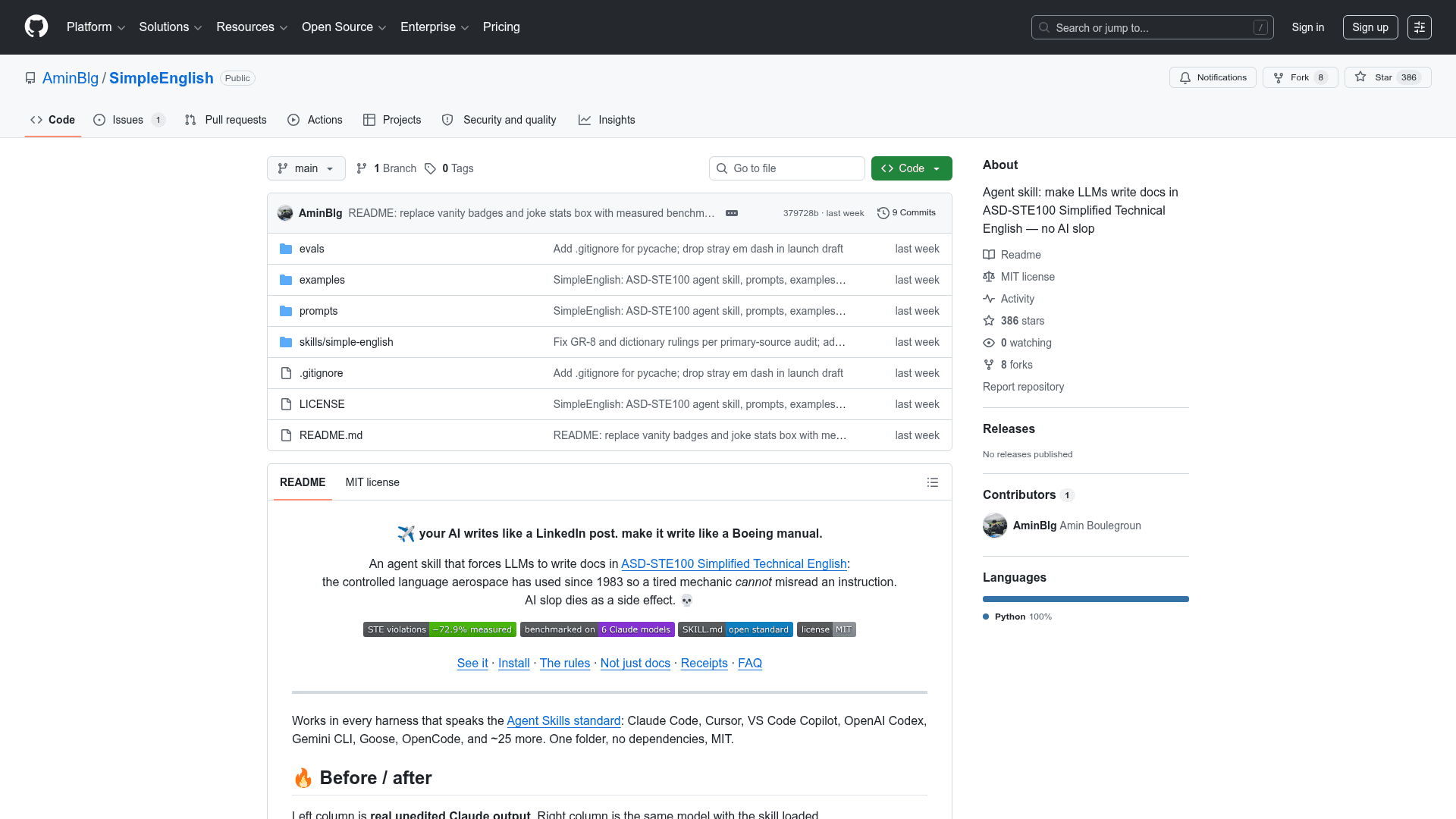
SimpleEnglish is an open-source agent skill by AminBlg that constrains LLMs to produce technical writing conforming to ASD-STE100 Simplified Technical English — the controlled language aerospace has used since 1983. It is MIT-licensed, has no dependencies, and installs via a single npx skills add command. The repository reports 379 stars and was created in July 2026.
What It Is
SimpleEnglish is an agent skill — a portable instruction set that plugs into any AI coding or chat agent that supports the Agent Skills standard. Its job is to replace vague, hedging, or verbose AI-generated prose with the kind of flat, unambiguous language found in aircraft maintenance manuals. The underlying standard, ASD-STE100, defines 53 numbered rules across 9 sections covering sentence length, verb forms, vocabulary consistency, voice, and modal usage. The skill paraphrases those rules and ships software-specific examples so agents apply them to READMEs, error messages, runbooks, and incident reports — not just aerospace manuals.
Measured Impact
The repository publishes benchmark results from 96 generations across 6 Claude models and 8 writing tasks. According to those results, the skill reduced STE violations per 100 words by an average of 72.9%, with every individual model showing improvement. Output token counts also fell on all six models, meaning the skill produces shorter text as a side effect. Mean sentence length dropped from 11.2 to 9.7 words. The evaluation used a deterministic regex linter with identical rules applied to both baseline and skill-on conditions; the methodology and raw results are in evals/results/RESULTS.md and can be reproduced with python3 evals/run_bench.py.
How the Rules Work
The 53 rules target the specific patterns that make AI-generated technical writing hard to act on:
- Max 20 words per instruction, 25 per description — kills run-on sentences
- One word, one meaning — eliminates check/verify/confirm/validate roulette
- Simple tenses only — "has been updated" becomes "we updated"
- No -ing verb forms — removes trailing ", making it easy to…" clauses
- Active voice — eliminates "it should be noted that"
- No should/would/may/might — bans hedging;
can,will, andmustsurvive - Condition before command — prevents readers from executing a step before seeing its guard clause
- One instruction per sentence — enforces steps that can be followed at 2 a.m.
The skill also ships use-case adaptations for error messages, runbooks, incident reports, release notes, AGENTS.md/system prompts, and translation preparation. It explicitly refuses to apply STE rules to marketing copy, blog voice, or brand writing.
Compatibility and Setup
The skill works in any agent harness that speaks the Agent Skills standard, including Claude Code, Cursor, VS Code Copilot, OpenAI Codex, Gemini CLI, Goose, OpenCode, and approximately 25 others according to the README. Installation is a single command: npx skills add AminBlg/SimpleEnglish. For environments without SKILL.md support, the repository provides a standalone system prompt in prompts/system-prompt.md and a ~60-token compact version for token-constrained contexts. Claude.ai paid plans support skills natively via Settings → Customize → Skills → Upload.
Tradeoffs to Know
The README is candid about scope limits. The skill does not produce ASD-certified output — ASD certifies no tool. Default mode applies structural rules plus the user's domain vocabulary; strict mode gets closer to full compliance, but word-level rulings require the official standard. The output will sound flat by design: the README compares it to Airbus manuals, not conversational prose. The project is not affiliated with or endorsed by ASD or STEMG, and ASD-STE100 is a registered trademark of ASD.
Community Discussions
Be the first to start a conversation about SimpleEnglish
Share your experience with SimpleEnglish, ask questions, or help others learn from your insights.
Pricing
Open Source
Fully free and open-source under the MIT License. No cost to use, modify, or distribute.
- Full ASD-STE100 rule set
- npx install
- System prompt fallback
- Benchmark suite included
- MIT licensed
Capabilities
Key Features
- ASD-STE100 Simplified Technical English enforcement
- 53 numbered rules across 9 sections
- 72.9% measured reduction in STE violations
- Works with Claude Code, Cursor, VS Code Copilot, OpenAI Codex, Gemini CLI, Goose, OpenCode, and ~25 more
- Single-command install via npx skills add
- No dependencies
- Use-case adaptations for error messages, runbooks, incident reports, release notes, and system prompts
- Standalone system prompt for non-SKILL.md environments
- ~60-token compact version for tight token budgets
- Reproducible benchmark suite (96 generations, 6 Claude models)
- MIT licensed
- Claude.ai native skill upload support