
skills-for-humanity
171 structured reasoning methodologies from history's most rigorous thinkers, packaged as Claude Code skills across 27 categories.
At a Glance
Fully free and open source under the MIT License. Install via npx with no cost.
Engagement
Available On
Alternatives
Listed May 2026
About skills-for-humanity
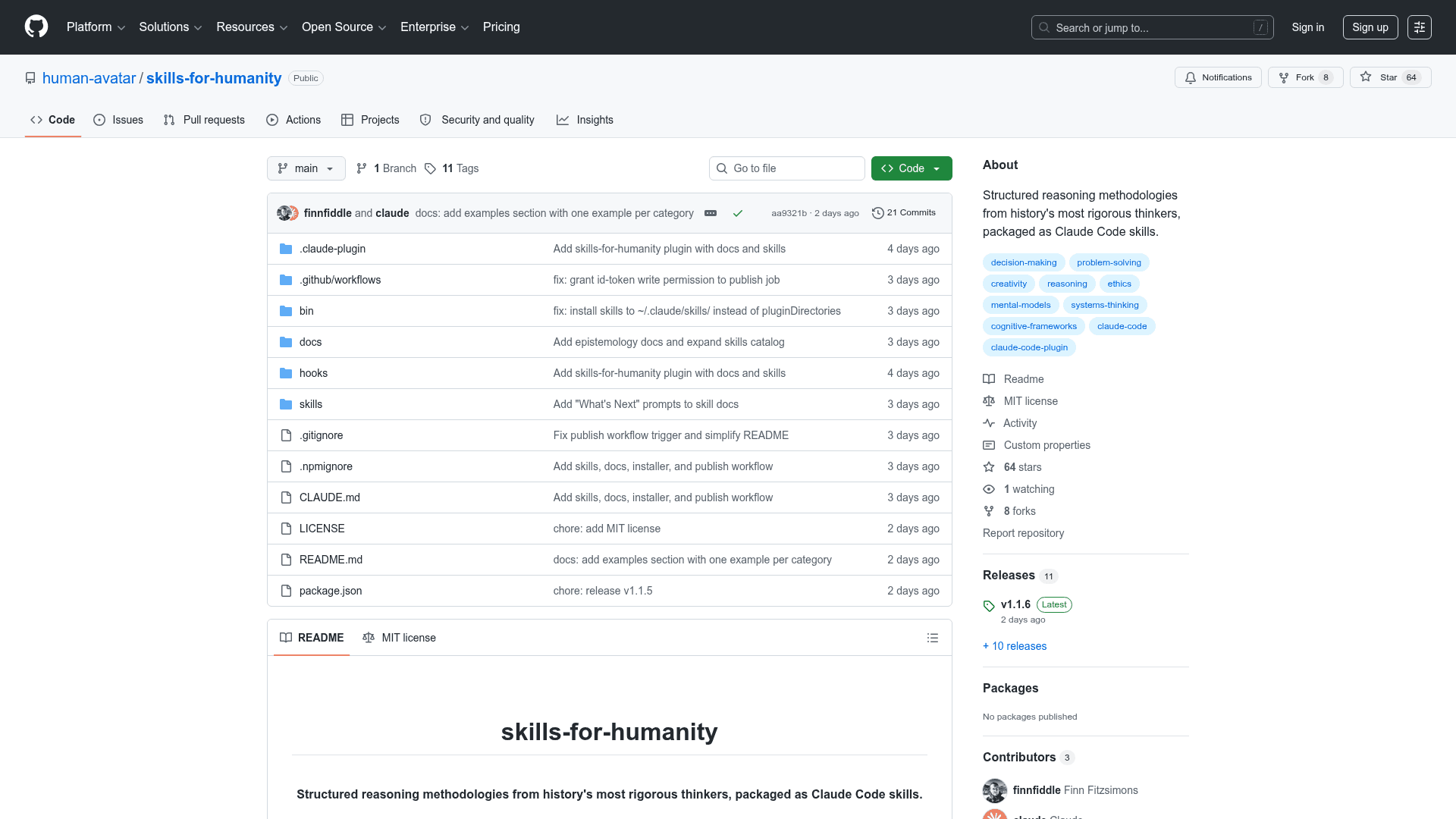
skills-for-humanity is an open-source npm package that delivers 171 structured reasoning skills for use inside Claude Code. Built by the human-avatar GitHub organization, it packages methodologies from thinkers like de Bono, Meadows, Altshuller, Goldratt, Tetlock, Kant, Aristotle, and Sun Tzu into runnable slash-commands. The project was created in May 2026 and reached v1.1.6 within days of launch.
What It Is
skills-for-humanity is a Claude Code plugin — a collection of slash-command skills that turn abstract reasoning frameworks into executable, step-by-step procedures. Each skill defines a problem type, a sequence of analytical moves, and a structured output format. The library is organized into 27 categories across five thinking domains: Think Sharper, Think Differently, Think About People, Think in Time & Systems, and See More Clearly. Users invoke skills via commands like /logic, /ethics, /strategy, or the universal /think entry point, which automatically routes to the most appropriate methodology based on the described situation.
How the Skill System Works
Every skill is described as "a complete procedure: a defined problem type, a sequence of moves, a structured output — not a concept to apply, but a method to run." Each skill pauses before executing and asks the user how deep they want to go. The /think command acts as a universal router, removing the need to know which specific skill fits a given problem. Skills are organized into entry-point commands (e.g., /logic, /creativity) that branch into specific sub-skills such as /logic-causality-mapping, /creativity-six-hats, or /strategy-positioning.
Key skill categories include:
- Logic & Reasoning: argument validation, causality mapping, consistency checks, constraint mapping, a five-advisor logic council
- Probability & Decision: base-rate anchoring, confidence calibration, expected value, premortem analysis, reversibility analysis
- Game Theory: equilibrium finding, mechanism design, coalition analysis, signaling, iterated games
- Ethics: multi-framework ethics council, bias checks, consent review, crisis triage, data audits
- Writing: line editing, rhetoric analysis, plot structure, voice consistency, executive summaries, technical documentation
- Strategy: drawn from Sun Tzu, Clausewitz, and Musashi — covering positioning, timing, terrain, deception, and alliance mapping
Intellectual Lineage
The project explicitly attributes its methodological lineage to named thinkers: Edward de Bono (lateral thinking, Six Hats, PMI, CAF), Donella Meadows (systems leverage points), Genrich Altshuller (TRIZ constraint inversion), Barbara Minto (pyramid principle), Eliyahu Goldratt (Theory of Constraints), Philip Tetlock (superforecasting calibration), Gary Klein (premortem analysis), John Stuart Mill, Immanuel Kant, Aristotle, Nel Noddings, John Rawls, Nash, Axelrod, Vickrey, and Shapley. This lineage grounds each skill in a specific intellectual tradition rather than generic AI prompting patterns.
Deployment Model
The package is installed via npx @human-avatar/skills-for-humanity and requires a restart of Claude Code after installation. Running the same command again updates the skills. No configuration is required beyond having Claude Code available. The skills are stored locally and invoked as slash-commands within the Claude Code environment. The project is published to npm under the @human-avatar scope.
Update: v1.1.6
The latest release is v1.1.6, published on May 26, 2026 — three days after the repository was created on May 23, 2026. The rapid versioning cadence (reaching 1.1.6 within the first week) suggests active early development. The repository had 55 stars and 4 forks at the time of the last recorded update, with zero open issues. The primary language is JavaScript and the project is licensed under MIT.
Community Discussions
Be the first to start a conversation about skills-for-humanity
Share your experience with skills-for-humanity, ask questions, or help others learn from your insights.
Pricing
Open Source
Fully free and open source under the MIT License. Install via npx with no cost.
- 171 reasoning skills across 27 categories
- MIT License — free to use, modify, and distribute
- Install and update via npx
- Claude Code compatible
Capabilities
Key Features
- 171 structured reasoning skills across 27 categories
- Universal /think router that auto-selects the right methodology
- Slash-command interface for Claude Code
- Skills from logic, probability, decision, game theory, epistemology, investigation, creativity, ethics, writing, systems, strategy, and more
- Multi-advisor council skills for logic and ethics
- Edward de Bono lateral thinking and Six Hats methods
- Theory of Constraints and systems leverage point analysis
- Premortem, reversibility, and criteria-weighting decision tools
- Game theory skills including equilibrium, mechanism design, and coalition analysis
- Writing skills covering rhetoric, line editing, plot structure, and voice consistency
- Historical reasoning and precedent analysis
- Installs via npx with no configuration required
- MIT licensed and open source