
SkillSpector
Open-source security scanner for AI agent skills that detects vulnerabilities, malicious patterns, and security risks before installation using static analysis and optional LLM evaluation.
At a Glance
Fully free and open-source under Apache License 2.0. No usage limits.
Engagement
Available On
Alternatives
Listed Jun 2026
About SkillSpector
SkillSpector is an open-source CLI tool published by NVIDIA that scans AI agent skills for security vulnerabilities before they are installed. It targets skills used by agents like Claude Code, Codex CLI, and Gemini CLI, which execute with implicit trust and minimal vetting. The project is licensed under Apache 2.0 and hosted on GitHub, where it has accumulated over 500 stars since its March 2026 release.
What It Is
SkillSpector is a security scanner purpose-built for AI agent skill packages. It addresses a gap identified in research: the repository README cites a study ("Agent Skills in the Wild," Liu et al., 2026) that analyzed 42,447 skills from major marketplaces and found that 26.1% contain at least one vulnerability and 5.2% show likely malicious intent. SkillSpector gives developers and security teams a way to audit skills before deployment, producing a 0–100 risk score with severity labels (LOW, MEDIUM, HIGH, CRITICAL) and actionable recommendations.
Detection Coverage
The scanner covers 64 vulnerability patterns across 16 categories, including:
- Prompt injection (5 patterns): instruction overrides, hidden directives, exfiltration commands, behavior manipulation, harmful content
- Data exfiltration (4 patterns): external transmission, environment variable harvesting, file system enumeration, context leakage
- Supply chain (6 patterns): unpinned dependencies, external script fetching, obfuscated code, known CVEs via live OSV.dev lookup, abandoned packages, typosquatting
- Behavioral AST (8 patterns): dangerous Python calls such as
exec(),eval(),subprocess,os.system, and dynamic imports - Taint tracking (5 patterns): data flow from sources to sinks, including credential exfiltration chains and external input to code execution
- YARA signatures (4 patterns): malware, webshell, cryptominer, and exploit tool matches
- MCP-specific patterns (8 patterns): least-privilege violations and tool poisoning via hidden instructions, Unicode deception, and parameter injection
Two-Stage Analysis Pipeline
SkillSpector uses a two-stage detection approach:
- Static analysis — Fast regex-based pattern matching across 11 analyzers, AST-based behavioral detection, and live CVE lookups via the OSV.dev API (no API key required, with automatic offline fallback and in-memory caching).
- LLM semantic evaluation (optional) — Evaluates context and intent, filters false positives, and generates human-readable explanations. The README states this stage improves precision to approximately 87%. The LLM prompt includes anti-jailbreak protections to prevent malicious skills from manipulating the analysis itself.
Supported LLM providers include OpenAI, Anthropic, and NVIDIA's build.nvidia.com inference gateway, as well as any OpenAI-compatible local server such as Ollama, vLLM, or llama.cpp.
Input Formats and Output Options
SkillSpector accepts Git repositories (by URL), local directories, zip archives, and single files. Output can be rendered as:
- Terminal — human-readable formatted report
- JSON — machine-readable for programmatic consumption
- Markdown — for documentation workflows
- SARIF — for CI/CD pipeline integration and IDE tooling
This SARIF support makes it straightforward to embed SkillSpector into existing DevSecOps pipelines alongside other static analysis tools.
Python API and Extensibility
Beyond the CLI, SkillSpector exposes a Python API built on LangGraph, allowing the scanner to be invoked programmatically within agent workflows or custom tooling. The development guide documents the architecture, package layout, and how to extend the analyzer pipeline with new patterns. The project uses uv or pip for dependency management and ships a Makefile with targets for installation, testing, linting, and formatting.
Update: Initial Open-Source Release (v0.1.0)
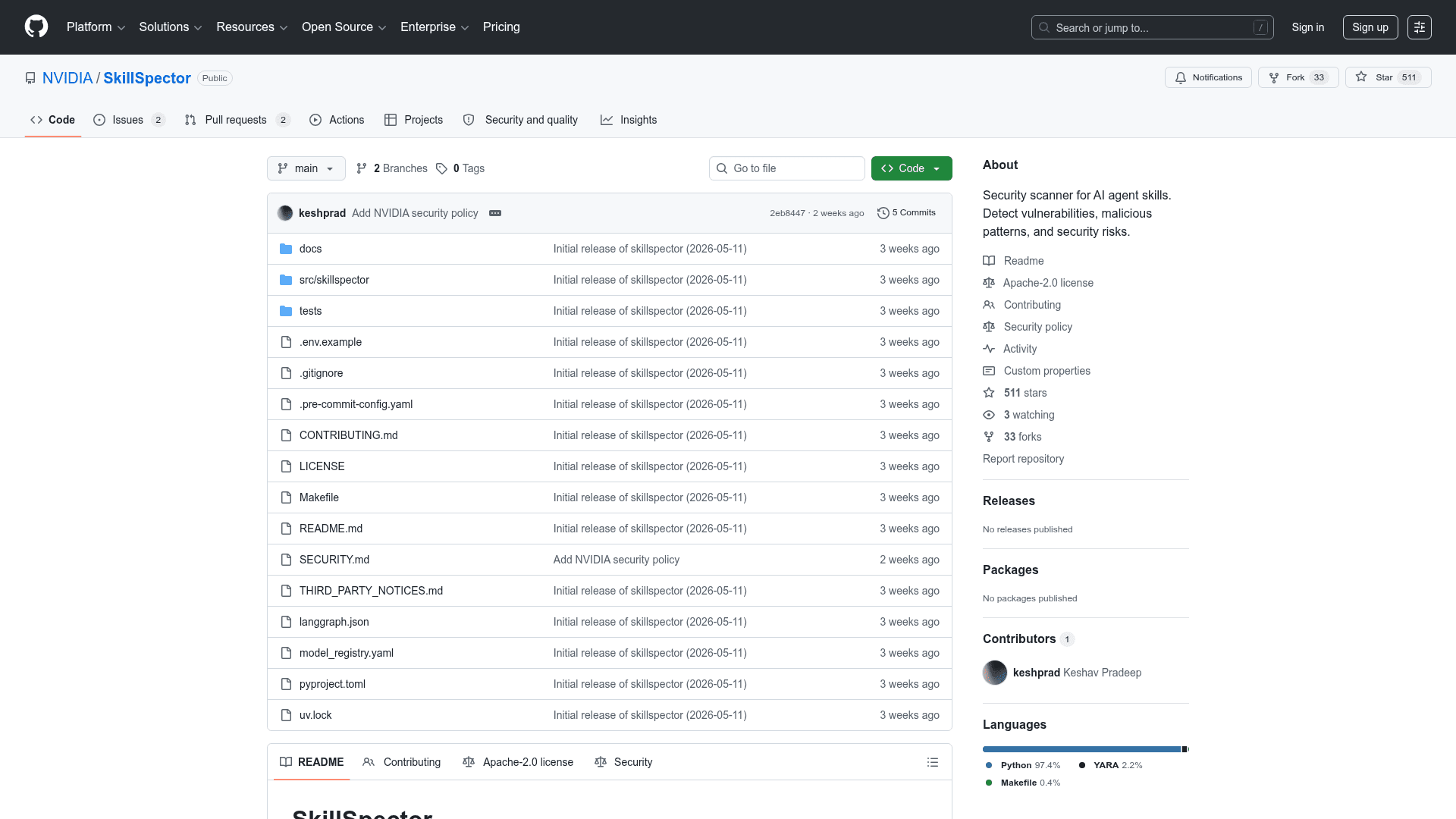
The repository was created on March 21, 2026, and last pushed on May 18, 2026, with the most recent metadata update on May 31, 2026. The example terminal output in the README shows version v0.1.0. With 501 stars and 33 forks shortly after release, the project has attracted early community interest. The README references an OSS_RELEASE.md document describing how to produce a public OSS branch, suggesting an internal-to-public release workflow.
Community Discussions
Be the first to start a conversation about SkillSpector
Share your experience with SkillSpector, ask questions, or help others learn from your insights.
Pricing
Open Source
Fully free and open-source under Apache License 2.0. No usage limits.
- 64 vulnerability patterns across 16 categories
- Static analysis pipeline
- Optional LLM semantic analysis
- Live OSV.dev CVE lookups
- Terminal, JSON, Markdown, and SARIF output
Capabilities
Key Features
- 64 vulnerability patterns across 16 categories
- Multi-format input: Git repos, URLs, zip files, directories, single files
- Two-stage analysis: static analysis + optional LLM semantic evaluation
- Live CVE lookups via OSV.dev with automatic offline fallback
- AST-based behavioral analysis for dangerous Python calls
- Taint tracking for data flow from sources to sinks
- YARA signature matching for malware, webshells, cryptominers
- MCP least-privilege and tool poisoning detection
- Risk scoring 0-100 with severity labels and recommendations
- Output formats: terminal, JSON, Markdown, SARIF
- Python API via LangGraph for programmatic integration
- Support for OpenAI, Anthropic, NVIDIA, and local LLM providers
- Anti-jailbreak protections in LLM analysis prompt
- In-memory caching of OSV.dev results for 1 hour