
smartly
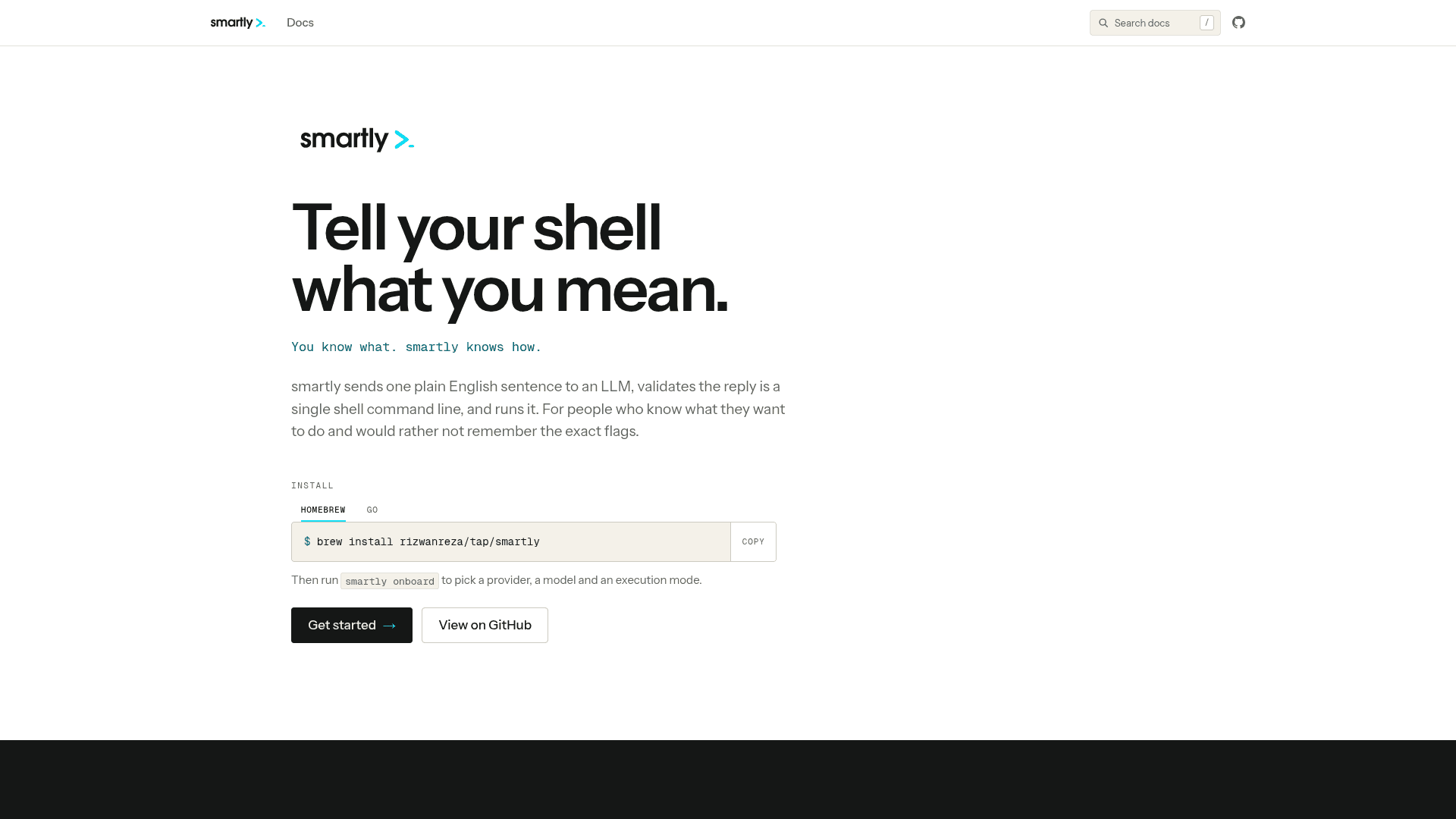
A command-line tool that turns a plain English sentence into a single shell command using an LLM and runs it.
At a Glance
MIT-licensed smartly CLI, free to use; LLM provider costs are external (bring your own API key or existing CLI login).
Engagement
Available On
Listed Oct 2026
About smartly
smartly is an open-source command-line tool by Rizwan Reza that sends one plain English sentence to an LLM, validates that the reply is a single shell command line, and runs it. It targets macOS and Linux with bash or zsh, and the latest listed release is v0.2.0.
What It Is
smartly is a natural-language shell assistant for people who know what they want to do but would rather not remember exact flags. The interface is smartly <request in plain English>, for example turning "show hidden files sorted by size" into ls -lahS. It returns one command line per invocation; pipes, && and redirects are allowed, but multi-step scripts are not.
How It Builds Commands
By default it sends the request together with a capped directory listing and git branch, status and worktree information, so references like "all worktrees except main" resolve against what exists. It detects whether tools such as sed, date and stat are GNU or BSD and writes matching flags. Context levels are none, light (default) and full; full adds recent shell history and should be enabled deliberately because that history is sent to the LLM provider.
Execution Modes and Safety
Auto-run is the default, including for destructive commands. Alternatives are confirm, which asks [y/N] every time, and confirm-destructive, which uses a local static classifier and asks on anything not recognised as safe. The documentation describes this classifier as a best-effort seatbelt rather than a sandbox. --dry-run prints the command without running it, and --learn explains the command piece by piece without running it. Every generate-and-run invocation is appended to a JSONL log that stores requests and commands verbatim.
Providers and Setup
Four providers are supported: anthropic (default, via API key), openai (any OpenAI-compatible endpoint, including local vLLM, Ollama or LM Studio), and claude-cli and codex-cli, which use an existing logged-in CLI session. Install with Homebrew or go install, then optionally run smartly onboard to choose a provider, model and execution mode. Shell integration via smartly init lets generated cd or export commands affect the current shell. Windows and PowerShell are not supported yet.
Community Discussions
Be the first to start a conversation about smartly
Share your experience with smartly, ask questions, or help others learn from your insights.
Pricing
Open Source
MIT-licensed smartly CLI, free to use; LLM provider costs are external (bring your own API key or existing CLI login).
- Turns one plain English sentence into a single shell command
- Execution modes: auto (default), confirm, confirm-destructive, --dry-run
- --learn mode explains the command piece by piece
- Providers: anthropic and openai (own API key), claude-cli and codex-cli (existing logged-in subscription session)
- Supports any OpenAI-compatible endpoint, including local vLLM, Ollama or LM Studio
Capabilities
Key Features
- Turns plain English into a single shell command
- Detects GNU vs BSD userland differences
- Directory and git context awareness
- Execution modes: auto, confirm, confirm-destructive, dry-run
- Learn mode explaining each flag and pipe
- Multiple providers including API keys or existing CLI sessions
- OpenAI-compatible endpoint support
- Interactive onboarding command
- Shell integration for bash and zsh
- Append-only JSONL request log with risk classification