Socket
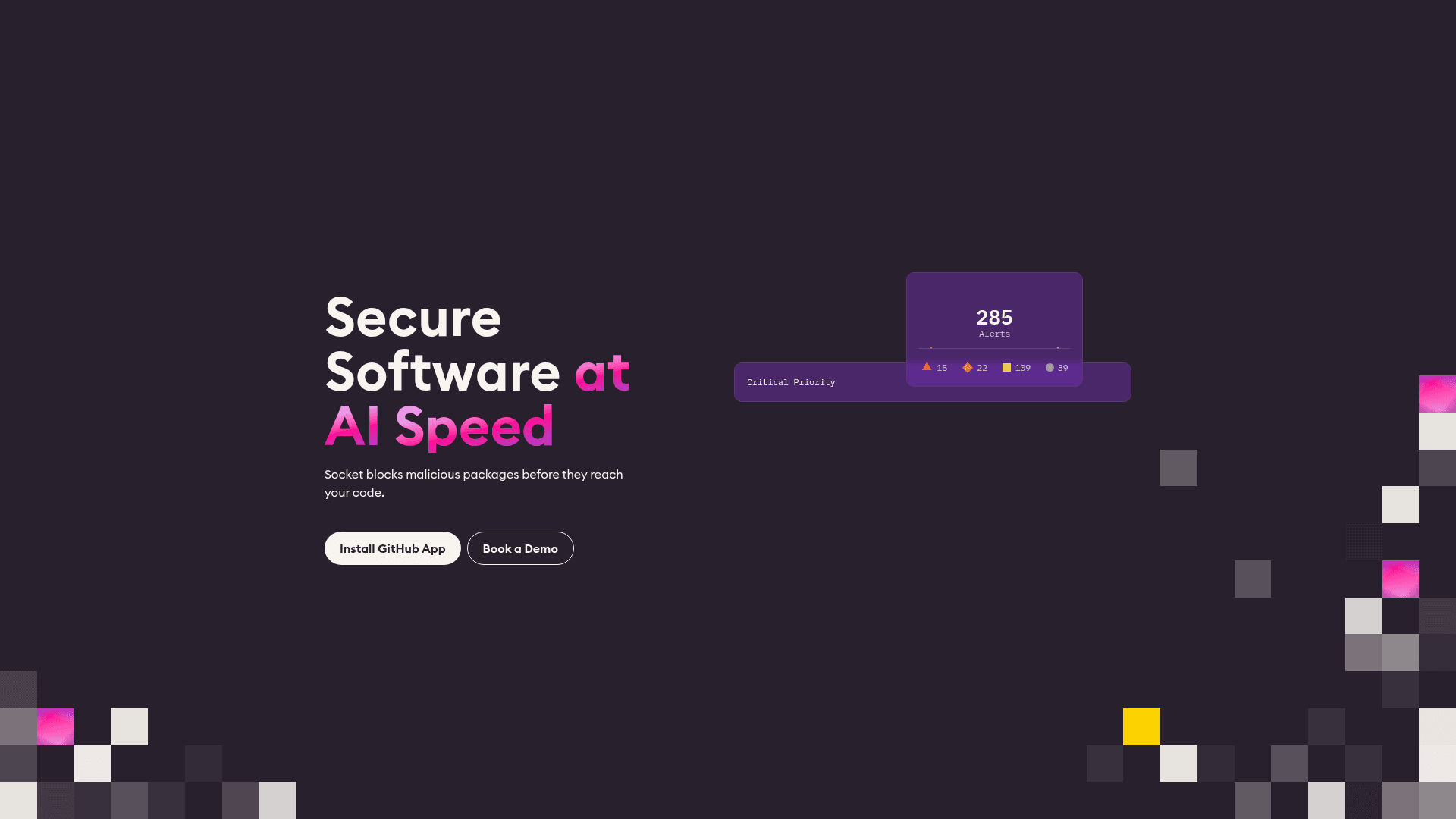
Socket blocks malicious open source packages before they reach your code by proactively analyzing dependency behavior across all major registries.
At a Glance
About Socket
Socket is a software supply chain security platform founded in 2021 by Feross Aboukhadijeh, a prolific open source maintainer whose projects see over a billion downloads monthly. The platform proactively detects and blocks malicious packages in real time, integrating directly into developer workflows rather than relying on reactive CVE databases. Socket is SOC 2 Type II certified and has raised $125M, according to the company's own announcements.
What It Is
Socket is a developer-first supply chain security tool that scans every open source package and update for malicious behavior across all major registries — npm, PyPI, RubyGems, and more. Instead of waiting for a CVE to be published, Socket analyzes the actual behavior of dependencies: what network calls they make, what files they access, whether they contain install scripts, and whether they exhibit signs of typosquatting or known malware patterns. The platform surfaces these signals as actionable alerts directly in pull requests, the CLI, and the IDE, so developers can catch threats before they merge.
Core Product Surface
Socket ships as a suite of integrated tools that work together across the development lifecycle:
- Socket for GitHub — a GitHub App that comments on PRs with risk alerts for new or updated dependencies, with configurable block/warn policies
- Socket Firewall — a CLI-level proxy (
sfw) that intercepts package installs and blocks malicious packages at install time, supporting self-hosted or client/server deployment - Socket CLI — command-line scanning for local and CI environments
- Socket Reachability — precomputed reachability analysis that, according to Socket, cuts 60% of CVE false positives automatically; the Enterprise tier adds full application function-level reachability claimed to eliminate up to 90% of irrelevant CVEs
- Socket Certified Patches — human-reviewed, one-click patches for CVEs, including combined multi-CVE patches and automatic patch PRs
- Socket Web Extension — browser extension for reviewing package security on registry pages
- Socket Dependency Search — security scoring for millions of open source packages across registries
- Socket ExtensionGuard — scanning for browser and IDE extensions
Integrations and Platform Coverage
Socket integrates across the modern development stack. Source control integrations include GitHub on all paid tiers, with GitLab, Bitbucket, Azure DevOps, and self-hosted SCM available on Enterprise. Package manager support spans 10+ languages including JavaScript/TypeScript, Python, Go, and Ruby. Ticketing and messaging integrations include Slack alerts for new malware or vulnerabilities. SIEM integrations are available on paid tiers. The platform also supports SBOM import/export, SSO/SAML, SCIM provisioning, webhook automation, compliance integrations (e.g., Vanta), MCP server, and AI code agent integrations.
Adoption and Recognition
According to Socket's own published metrics, the platform protects over 1.5 million code repositories, secures more than 11.6 million commits per month, and blocks over 10,000 attacks per week across more than 27,000 organizations. Socket publishes case studies naming Anthropic, Vercel, MetaMask, Drata, and Replit as customers. The company states it has been recognized on the Fortune Cyber 60 list and is part of OpenAI's Trusted Access for Cyber program alongside Semgrep, Calif, and Trail of Bits.
Update: Launch Week — Repository Access Permissions and Custom Roles
Socket's most recent announced feature, highlighted at the top of the site during a "Launch Week," is the introduction of Repository Access Permissions and Custom Roles. This expands the platform's access control capabilities, allowing organizations to define granular permissions at the repository level and assign custom roles to team members — a feature particularly relevant for larger enterprise deployments managing many repositories and contributors.
Why It Stands Out
Traditional SCA tools are reactive: they alert on known CVEs after the fact. Socket's approach is behavioral — it detects zero-day supply chain attacks by analyzing what a package actually does, not just what version it is. The company was founded by open source maintainers who built the JavaScript ecosystem tooling that Socket now helps secure, giving the team direct insight into how supply chain attacks are constructed and how developers actually work.
Community Discussions
Be the first to start a conversation about Socket
Share your experience with Socket, ask questions, or help others learn from your insights.
Pricing
Free
For individual developers and small teams looking to stay secure as they build.
- Unlimited developers & repos
- 1,000 scans per month
- 3 members, 1 repository label
- Detect 70+ risk types (malware, vulnerabilities, license, etc.)
- Block malicious dependencies automatically
Team
For growing teams ready to streamline security with smart automation and reachability analysis to cut noise.
- All Free features
- 5,000 scans per month
- 10 members, 3 repository labels
- Precomputed reachability analysis cuts 60% of CVE false positives
- Priority scoring
- Slack alerts for new malware or vulnerabilities
- 5,000 API quota per hour
- 5 API tokens
- 30 days scan retention
- 1,000,000 dependencies analytics
- Unlimited attack campaigns
- 60 threat feed items
Business
For organizations that need enterprise-grade automation, compliance, and integrations — no sales call required.
- All Team features
- Unlimited members, unlimited repository labels
- Unlimited scans & API quota
- Compliance integrations (e.g., Vanta)
- SBOM import/export
- SSO/SAML & webhook automation
- Scan GitHub Actions and AI models
- 90 days scan retention
- Unlimited API tokens
- 90 threat feed items
Enterprise
For large organizations that need full application function-level reachability and enterprise controls.
- All Business features
- Full application function-level reachability (up to 90% CVE noise reduction)
- GitLab, Bitbucket, Azure DevOps, and self-hosted repo integrations
- SCIM provisioning, audit logs, IP restrictions
- Private Slack channel, migration help, named account manager
- 10+ firewall ecosystems
- Advanced license compliance
- 365 days scan retention
- 1,000 threat feed items
- Priority support with uptime SLA
Capabilities
Key Features
- Malicious package detection across all major registries
- Socket for GitHub PR integration with block/warn policies
- Socket Firewall — blocks malicious packages at install time
- Socket Reachability — cuts CVE false positives by filtering unreachable code
- Full application function-level reachability (Enterprise)
- Socket Certified Patches — human-reviewed one-click CVE patches
- Automatic patch PRs
- Socket CLI for local and CI scanning
- Socket Web Extension for registry browsing
- Socket Dependency Search with security scoring
- Socket ExtensionGuard — scans browser and IDE extensions
- SBOM import/export
- SSO/SAML and SCIM provisioning
- Webhook automation
- Compliance integrations (e.g., Vanta)
- SIEM integrations
- Slack alerts for new malware or vulnerabilities
- AI analysis flagging hidden dependency behavior
- Scan GitHub Actions and AI models
- MCP server integration
- AI code agent integrations
- Monorepo support
- Custom security and license policies per repository label
- Audit logs and historical analytics
- SOC 2 Type II compliance