
Solid
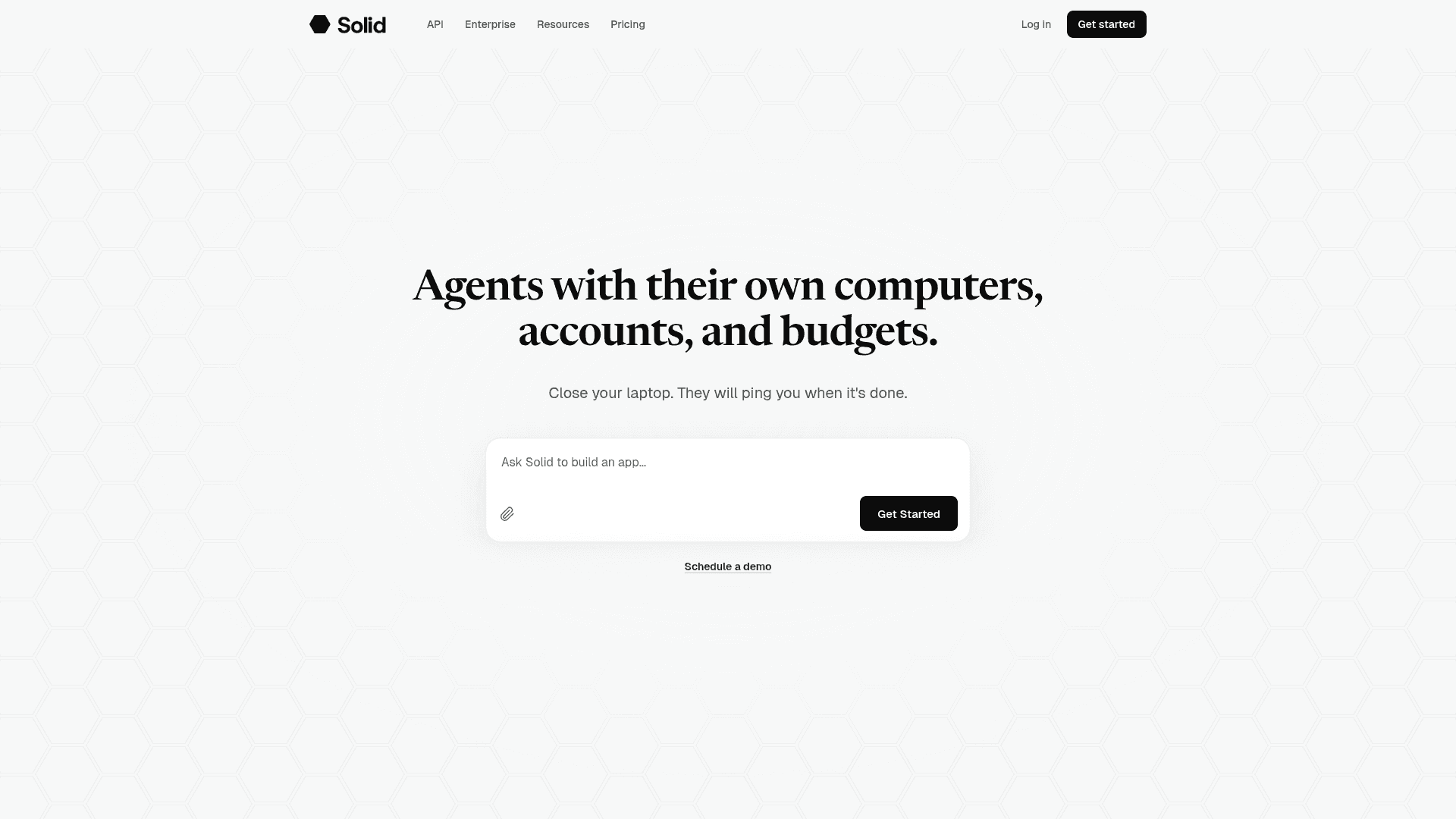
Solid deploys autonomous AI agents with their own computers, accounts, and budgets to complete long-running tasks end-to-end without constant human oversight.
At a Glance
Start with $20 in balance to try Solid before choosing a monthly subscription.
Engagement
Available On
Listed Oct 2026
About Solid
Solid is an autonomous agent platform that gives AI agents their own devices (Windows, macOS, Linux, iPhone, Android), accounts (Google, Apple), and spending budgets to complete complex, multi-step jobs from start to finish. Users describe a goal in plain language, set approval rules, and close their laptop — agents handle the rest and message back when the work is done. The platform is available as a web product and via API for teams that want to embed agents inside their own products.
What It Is
Solid sits in the autonomous AI agent category, distinct from simple chatbots or single-step automation tools. Rather than requiring prebuilt connectors or step-by-step orchestration, Solid's agents determine which tools a job needs, handle setup and authentication, build missing integrations, and self-correct when something breaks. The result is delivered as a finished artifact — a hosted link, a CRM update, a pull request — rather than a list of instructions for the user to execute.
How the Autonomy Spectrum Works
Solid describes three layers of agent capability that distinguish it from simpler automation:
- Self-sufficient — Agents choose tools, sign up for services, and pay within approved budgets. They can operate any tool a person can use: APIs, websites, desktop software, or phone apps.
- Self-healing — When a tool fails or a setup breaks, agents investigate, repair, and verify the job can continue. If they remain blocked, they explain what needs human input.
- Self-improving — Agents retain lessons from corrections and apply them to future jobs, building a shared context across the team's work.
- Self-scaling — Agents can spin up additional Solid agents or coordinate external agents (such as Codex or Claude Code), divide work, and return one checked result.
Example Workflows
The homepage illustrates five concrete use cases that show the range of jobs Solid's agents can handle:
- Custom sales demos — Convert customer meeting notes into a hosted, tested demo app and return the link.
- LinkedIn lead generation — Research accounts against an ideal customer profile, draft outreach for approval, follow up, book meetings, and update the CRM.
- AI product evaluations — Build and run evals after every release, simulate users completing key tasks, judge outcomes, and send a report.
- Production bug resolution — Investigate an alert, reproduce the issue, write and test a fix, open a pull request for engineer approval, and verify recovery.
- Customer support resolution — Trace a stalled ticket across systems, apply a policy-compliant fix, and confirm resolution with the customer.
Deployment Model and Control
Solid offers three deployment options: Solid Cloud, a private VPC, and on-premises (availability depends on setup). Enterprise customers can configure access controls, spending budgets, approval workflows, and policies across a workspace. The API tier lets teams ship always-on agents inside their own products, with persistent context and long-running job support under developer-defined controls.
Agents are described as "meta-agents" — they can see and manage their own tools, devices, and spending, so users can ask at any time what a job cost, what is still running, and whether spending could be reduced.
Why It Matters
The platform's core proposition is that agents do not require prebuilt connectors or user expertise in the tools involved. According to the Solid website, if a person can use a tool, a Solid agent can too — whether that means calling an API, operating a website, running desktop software, or using a phone app. This positions Solid against connector-list automation platforms and against agent frameworks that require developers to wire up each integration manually.
Community Discussions
Be the first to start a conversation about Solid
Share your experience with Solid, ask questions, or help others learn from your insights.
Pricing
Free Trial
Start with $20 in balance to try Solid before choosing a monthly subscription.
- $20 account balance to use on AI, machines, and purchases
Starter
For getting started with a focused task, a simple app, or a small workflow.
- $40 monthly balance for AI usage, machines, and agent purchases
- Focused tasks and simple apps
- Budget and approval rules
Pro
For regular work, active app building, and more room to test and iterate.
- $160 monthly balance for AI usage, machines, and agent purchases
- Regular work and active app building
- More room to test and iterate
- Budget and approval rules
Max
For heavier workloads, larger apps, and several projects running at once.
- $640 monthly balance for AI usage, machines, and agent purchases
- Heavier workloads and larger apps
- Several projects running simultaneously
- Budget and approval rules
Enterprise
Custom pricing for teams. Includes workspace-level access controls, budgets, policies, approvals, and choice of Solid Cloud, private VPC, or on-premises deployment.
- Workspace-level access controls
- Custom budgets and approval policies
- Solid Cloud, private VPC, or on-premises deployment
- API access for embedding agents in products
- Team and enterprise support
Capabilities
Key Features
- Autonomous agents with their own computers and phones
- Self-sufficient tool selection and setup without prebuilt connectors
- Self-healing: agents investigate and repair broken setups
- Self-improving: agents retain lessons from corrections across jobs
- Self-scaling: agents coordinate other agents (Codex, Claude Code, etc.)
- Agents have their own Google and Apple accounts
- Agents can sign up for services and make purchases within approved budgets
- Approval rules and spending controls set by the user
- Long-running background jobs with async completion notifications
- API for embedding agents in third-party products
- Enterprise deployment: Solid Cloud, private VPC, or on-premises
- Meta-agent spending transparency: ask what a job cost at any time
- Supports Linux, Windows, macOS, iPhone, and Android machines
- Example workflows: sales demos, lead gen, AI evals, bug resolution, support