
Supabase Evals
An open-source evaluation framework that benchmarks how well AI agents perform across the Supabase developer journey, from building and deploying to investigating and resolving production issues.
At a Glance
Freely available under the Apache License 2.0. Clone, run, and contribute to the eval framework at no cost.
Engagement
Available On
Alternatives
Listed Aug 2026
About Supabase Evals
Supabase Evals is an open-source benchmarking framework published by Supabase under the Apache License 2.0. It measures how effectively AI coding agents — such as Claude Code, OpenAI Codex, and OpenCode — can complete real Supabase developer tasks in realistic, stateful environments. The project lives at github.com/supabase/evals and its results are published publicly at supabase.com/evals.
What It Is
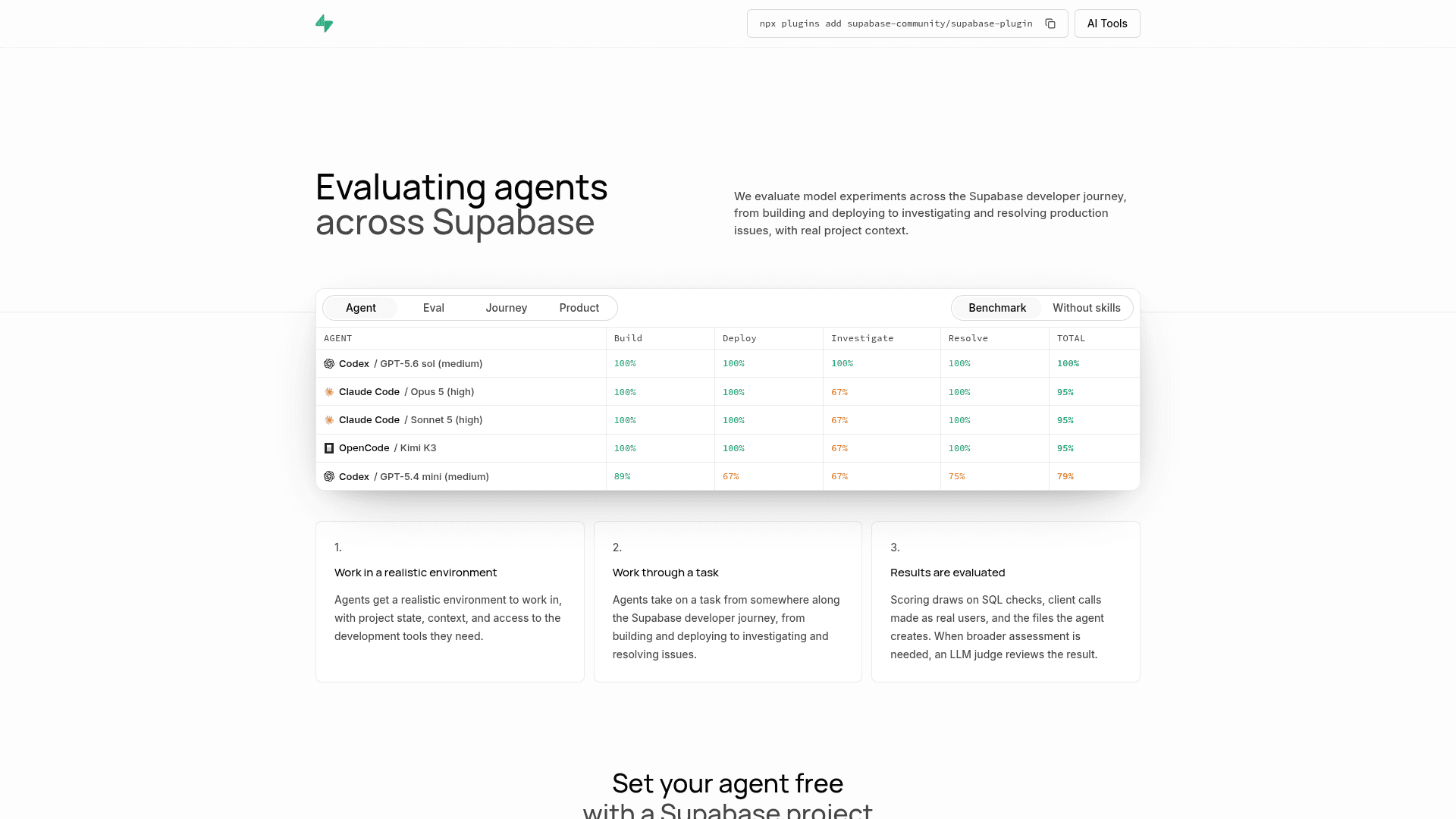
Supabase Evals is an agent evaluation harness purpose-built for the Supabase platform. Rather than testing generic coding ability, it evaluates agents across the specific stages of the Supabase developer journey: Build, Deploy, Investigate, and Resolve. Each eval scenario provides agents with a realistic project environment — including database state, observability logs, and deployed edge functions — and scores their output using SQL checks, real client calls, file inspection, and optionally an LLM judge for broader assessment.
How the Eval Framework Works
The framework is organized around three core concepts:
- Evals — individual scenarios under
evals/<id>/, each containing aPROMPT.mdtask description, anEVAL.tsscorer, and optional starting state split between aremote/directory (the hosted project's database, logs, and functions) and alocal/directory (the agent's working files). - Experiments — named agent/runtime/model configurations defined in
experiments/<name>.ts, such asclaude-code-sonnet-5orcodex-gpt5. - Runtimes — two modes are supported: a tools eval mode where the agent operates against an MCP/tool surface backed by
platform-lite(a lightweight Supabase Management API-compatible layer), and a local-stack eval mode where the agent runs inside a Docker sandbox with the real Supabase CLI installed.
Scoring draws on SQL checks against the project state, real client calls made as simulated users, and inspection of files the agent creates. When broader judgment is needed, an LLM judge reviews the result.
Skills and Progressive Disclosure
Experiments can be configured with skills sourced from the supabase/agent-skills submodule. Skills are loaded lazily using progressive disclosure: only each skill's name and description appear in the system prompt, and the agent pulls full instructions on demand. In local-stack mode, skills are installed into the workspace via Vercel's skills CLI; in tools mode, a load_skill tool returns the full instructions when called. This design lets experiments test agents both with and without domain-specific Supabase knowledge, enabling head-to-head comparisons labeled "With skills" vs. "Without skills" on the public leaderboard.
Architecture and Deployment Model
The framework uses pnpm as its package manager and TypeScript as its primary language. Key packages include @supabase-evals/sandbox for Docker-based local-stack orchestration and @supabase/mcp-server-supabase for MCP tool surfaces. The platform-lite runtime exposes a Supabase Management API-compatible HTTP surface backed by @supabase/lite, allowing real MCP tools to run against a lightweight project without a full hosted environment. Results are written to local JSON files and can be exported for viewing in a bundled web app (pnpm web).
Local-stack evals require a running Docker daemon. Each attempt boots a fresh sandbox container that mounts the host Docker socket, so supabase start spawns the local stack as sibling containers with host networking. Supabase's default host ports (54321–54329) must be free before running.
Current Status and Leaderboard
The repository was created in April 2026 and was last pushed in July 2026, indicating active development. The public leaderboard at supabase.com/evals shows benchmark results across agents including Codex/GPT-5.6 sol, Claude Code/Opus 5, Claude Code/Sonnet 5, OpenCode/Kimi K3, and Codex/GPT-5.4 mini, scored across Build, Deploy, Investigate, and Resolve dimensions. The leaderboard is filterable by agent, journey stage, and product area. The project accepts community contributions via CONTRIBUTING.md and tracks open issues on GitHub.
Community Discussions
Be the first to start a conversation about Supabase Evals
Share your experience with Supabase Evals, ask questions, or help others learn from your insights.
Pricing
Open Source
Freely available under the Apache License 2.0. Clone, run, and contribute to the eval framework at no cost.
- Full eval framework source code
- Tools and local-stack eval runtimes
- Public leaderboard results
- Community contributions via GitHub
Capabilities
Key Features
- Agent benchmarking across Build, Deploy, Investigate, and Resolve stages
- Realistic stateful environments with database, logs, and edge functions
- Two eval runtimes: tools mode (MCP/platform-lite) and local-stack mode (Docker + Supabase CLI)
- SQL-based scoring, real client call verification, and LLM judge support
- Progressive skill disclosure via supabase/agent-skills submodule
- Head-to-head experiment comparisons with and without skills
- Public leaderboard at supabase.com/evals
- Exportable results with bundled web app viewer
- Support for multiple agents: Claude Code, Codex, OpenCode
- TypeScript-based eval and experiment definitions