
Supernova
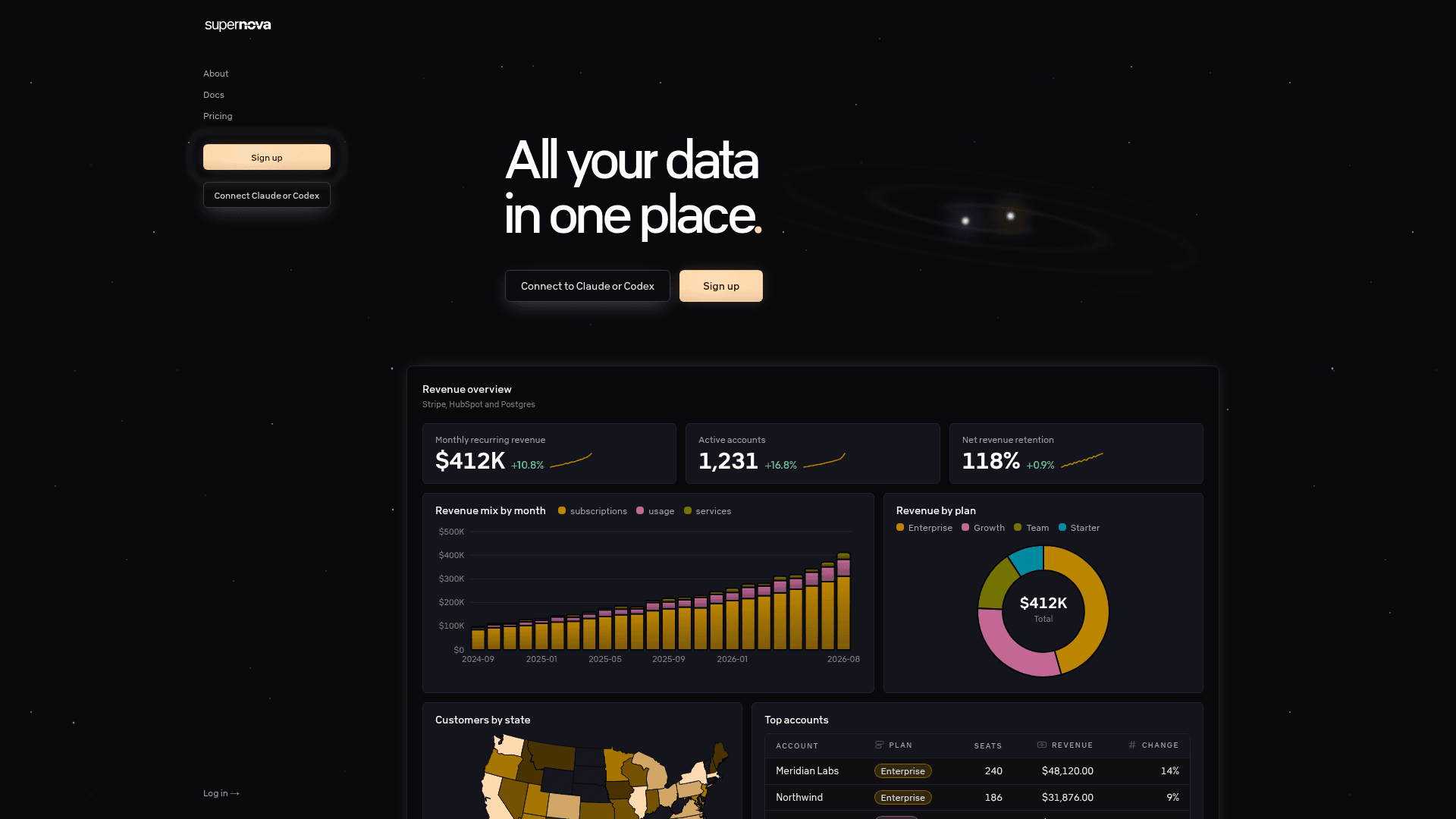
Supernova is an all-in-one data platform that syncs your sources into an encrypted Iceberg lake, lets you query with typed SQL, and connects to Claude or Codex via MCP.
At a Glance
About Supernova
Supernova is a data platform built for teams that want to query all their business data in one place without assembling a separate pipeline, warehouse, and BI stack. It has been in development since 2020 and is backed by Sequoia, Abstract, and SV Angel, with angel investors including founders of Segment, Datadog, Clearbit, and Loom. The platform is designed to be the pipeline, the lake, and the query engine in a single product.
What It Is
Supernova combines a data integration layer, an encrypted Apache Iceberg object-storage lake, a Rust-based query engine, and an AI chat interface into one product. Teams connect their SaaS tools and databases, and every synced table becomes immediately queryable through SQL, a built-in AI assistant, or an MCP endpoint that Claude and OpenAI Codex can call directly. The platform targets companies that previously needed a separate ETL tool, a cloud data warehouse, and a BI layer.
Core Architecture
Supernova's stack is built around several named components:
- Titan — the encrypted Iceberg lake in object storage, with table-level encryption, time travel (version history), and zero-copy connections for any engine that speaks Iceberg.
- TypeSQL — a schema-aware SQL dialect that autocompletes across joins and type-checks queries before they run, catching column typos and type mismatches at write time.
- FTL — the sync engine that tracks schema history, manages connector schedules, and supports real-time CDC for Postgres and MongoDB.
- CLI — a single binary for connecting sources, running queries, tailing live changes, and wiring up MCP from a terminal or CI environment.
- Particle — the built-in AI chat interface that lets users ask questions in plain language and receive generated models and dashboards.
The query engine is written in Rust, which the company says enables cold starts in milliseconds rather than minutes.
MCP Integration and AI Connectivity
A central feature of Supernova is its MCP (Model Context Protocol) server at mcp.supernova.ai/mcp. Adding this endpoint to Claude Desktop or OpenAI Codex gives those agents direct query access to every synced table. The CLI includes a supernova mcp command that registers the endpoint automatically. The company positions this as a first-class use case: the pricing page notes that Claude and Codex access via MCP is included at no additional charge.
Connector Catalog
Supernova supports a broad set of sources, including:
- Databases: Postgres (real-time), MongoDB (real-time), MySQL
- CRM/Sales: HubSpot, Salesforce
- Payments: Stripe
- Commerce: Shopify
- ERP: NetSuite
- Advertising: Google Ads, Facebook Ads, Microsoft Ads, Snapchat Ads, Reddit Ads
- Analytics: Google Analytics, Mixpanel, Amplitude, Pendo
- Support: Intercom, Zendesk, Help Scout
- Other: Google Sheets, Airtable, Jira, Klaviyo, Gainsight, SurveyMonkey, SendGrid, Postmark, PandaDoc, Pardot, Canny, Apple App Store
The company also offers custom connector builds within 24 hours on request.
Pricing Model
Supernova uses pure usage-based pricing with no per-seat fees and no per-feature tiers. The company states that seats are unlimited at no charge and that MCP access is included. Costs are metered on compute (billed by the second), storage, egress, and read/write/list operations. AI token usage is passed through at 1.5× the model's list price. The pricing page includes illustrative before/after comparisons showing significant cost reductions versus prior stacks for example customer profiles, though these figures are described as rounded and illustrative.
Backing and Team
According to the About page, Supernova has been building since 2020 and counts Sequoia's Konstantine Buhler, Abstract's Ramtin Naimi, and SV Angel's Beth Turner as institutional investors. Its angel network includes founders and executives from Segment, Datadog, Clearbit, Postmates, Webflow, Flexport, DoorDash, Loom, Sendbird, Instacart, Okta, and others. Data-ecosystem operators from Snowflake, Looker, dbt, Firebolt, SingleStore, and Monte Carlo are also listed as supporters.
Community Discussions
Be the first to start a conversation about Supernova
Share your experience with Supernova, ask questions, or help others learn from your insights.
Pricing
Usage-Based
Pay only for what you use. Unlimited seats, MCP access included. Metered on compute, storage, egress, and operations.
- Unlimited seats at no charge
- Claude & Codex MCP access included
- Compute: $0.15 per GB-hour (billed by the second)
- Storage: $0.05 per GB-month
- Egress: $0.10 per GB
- Read operations: $0.40 per million
- Write operations: $5 per million
- List operations: $5 per million
- AI tokens: 1.5× pass-through at model list price
- Encrypted Iceberg lake
- All connectors included
- CLI included
- Git version control for dashboards and models
Capabilities
Key Features
- Encrypted Apache Iceberg data lake in object storage
- Real-time CDC connectors for Postgres and MongoDB
- TypeSQL: schema-aware SQL with autocomplete and type-checking
- Built-in AI chat (Particle) for natural language data queries
- MCP server endpoint for Claude and OpenAI Codex integration
- CLI for connecting sources, running queries, and tailing changes
- Time travel / version history on all tables
- Zero-copy connections for external Iceberg-compatible engines
- Git-based version control for dashboards and models
- FTL sync engine with schema history tracking
- 30+ pre-built connectors (Stripe, HubSpot, Salesforce, Shopify, etc.)
- Custom connector builds within 24 hours
- Usage-based pricing with unlimited seats
- Rust-based query engine with millisecond cold starts
- Column-level type annotations (currency, geo, enum, etc.)