
Tauri
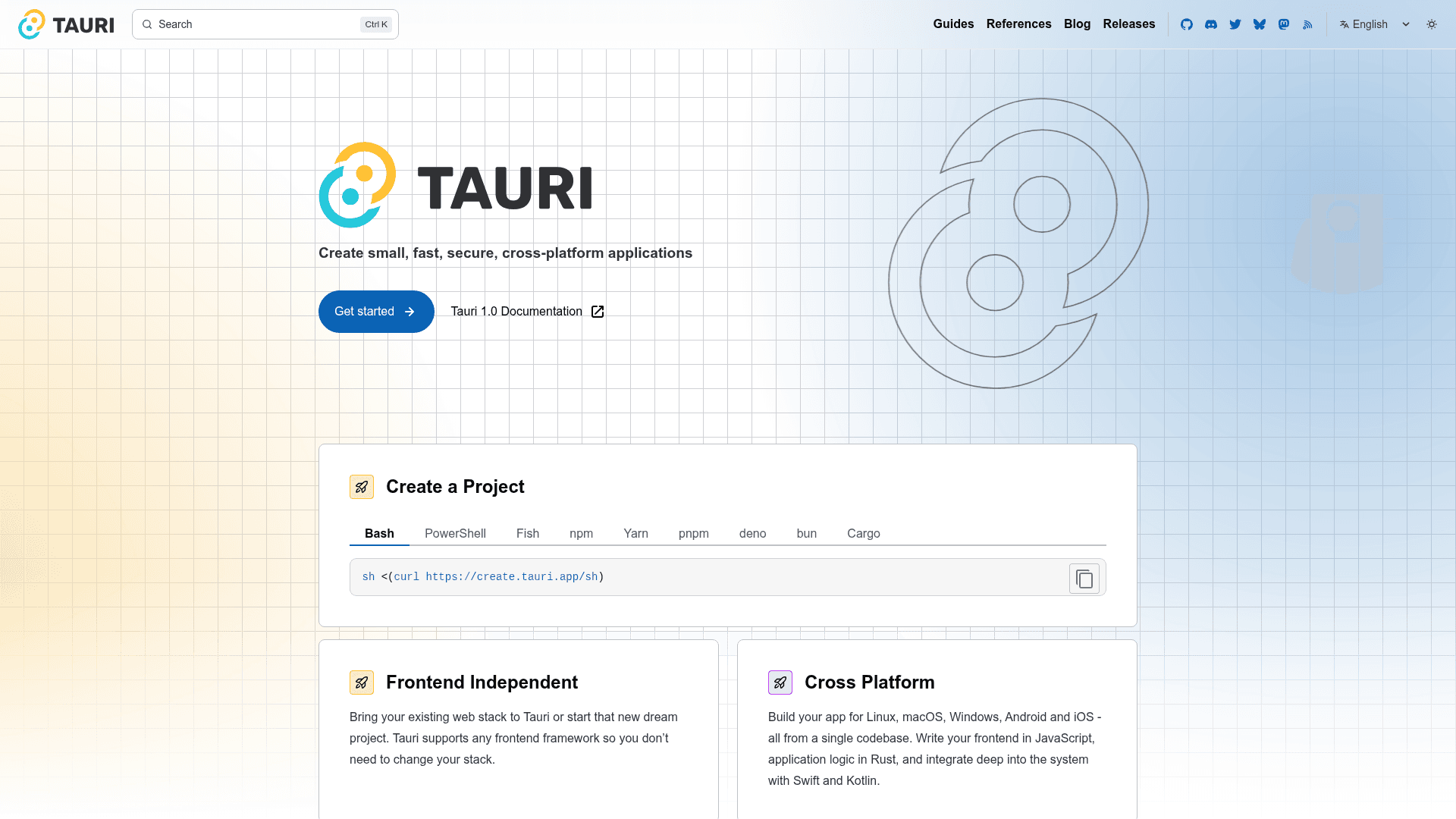
An open-source framework for building tiny, fast, and secure cross-platform desktop and mobile applications using web frontends and Rust backends.
At a Glance
About Tauri
Tauri is an open-source framework maintained by the Tauri Programme within The Commons Conservancy, licensed under MIT or Apache 2.0. It lets developers build native desktop and mobile applications using any frontend framework that compiles to HTML, JavaScript, and CSS, while writing backend logic in Rust, Swift, or Kotlin. The project is hosted on GitHub under the tauri-apps organization and is actively maintained with regular releases.
What It Is
Tauri is a cross-platform application framework that replaces the bundled browser engine approach (used by tools like Electron) with the operating system's native web renderer. On macOS and iOS it uses WKWebView, on Windows it uses WebView2, on Linux it uses WebKitGTK, and on Android it uses Android System WebView. This architecture means a minimal Tauri app can be less than 600KB in size. The framework is written primarily in Rust and exposes JavaScript-to-Rust bindings via an invoke function, with additional Swift and Kotlin bindings available through the Tauri plugin system.
Supported Platforms
Tauri 2.0 supports development and distribution across five platforms:
- Windows 7 and above
- macOS 10.15 and above
- Linux (webkit2gtk 4.1, e.g. Ubuntu 22.04 for Tauri v2)
- iOS/iPadOS 9 and above
- Android 8 and above
All platforms are targeted from a single codebase, with platform-specific native code accessible through the plugin system.
Architecture and Core Design
The framework is built on two lower-level libraries also maintained by the Tauri team: TAO handles window creation across all supported operating systems, and WRY provides a unified interface to the system webview. Developers who need deeper system integration can consume these libraries directly. The frontend is completely decoupled — any framework that outputs HTML, JS, and CSS works, including React, Vue, Svelte, SolidJS, and others. The backend logic runs as a compiled Rust binary, and the two sides communicate through a message-passing API rather than a localhost HTTP server, which the project notes as a security advantage.
Security Model
Security is described by the Tauri team as a top priority. The framework undergoes security audits for major and minor releases, covering both Tauri's own code and upstream dependencies. A public audit report for Tauri 2.0 is available in the repository. The Rust foundation provides memory, thread, and type safety by default, meaning applications inherit these properties even when developers are not Rust experts. An access control list (ACL) and capabilities system governs what plugins and windows can access.
Built-in Features
The GitHub README lists the following built-in capabilities:
- App bundler producing
.app,.dmg,.deb,.rpm,.AppImage,.exe(NSIS), and.msi(WiX) formats - Built-in self-updater for desktop platforms
- System tray icon support
- Native notifications
- Native WebView protocol (no localhost server)
- GitHub Action for CI integration
- VS Code extension
Update: tauri-cli v2.11.3
The latest release as of June 2026 is tauri-cli v2.11.3, published on June 17, 2026. The repository's default branch is dev and shows active daily commits. The project reached stable status with Tauri 2.0, which added mobile support (iOS and Android) alongside the existing desktop targets. Tauri 1.0 documentation remains available at a separate URL for projects that have not yet migrated.
Community Discussions
Be the first to start a conversation about Tauri
Share your experience with Tauri, ask questions, or help others learn from your insights.
Pricing
Open Source
Fully free and open-source under MIT or Apache 2.0 license. No cost to use, modify, or distribute.
- Full framework access for desktop and mobile
- Built-in app bundler
- Built-in self-updater
- Plugin ecosystem
- Community support via Discord
Capabilities
Key Features
- Cross-platform desktop and mobile app builds from a single codebase
- Uses OS native webview (no bundled browser engine)
- Minimal app size — as small as 600KB
- Rust backend with JavaScript-to-Rust invoke bindings
- Swift and Kotlin bindings via plugin system
- Built-in app bundler (.app, .dmg, .deb, .rpm, .AppImage, .exe, .msi)
- Built-in self-updater for desktop
- System tray icon support
- Native notifications
- Native WebView protocol (no localhost server)
- Access control list (ACL) and capabilities permission system
- Security audits for major and minor releases
- GitHub Action for CI
- VS Code extension
- Plugin ecosystem for extending core functionality
- Frontend-framework agnostic (React, Vue, Svelte, SolidJS, etc.)