
TencentDB Agent Memory
Open-source team memory hub that turns agent conversations, docs, and code into governed, shareable memory assets for AI agents.
At a Glance
About TencentDB Agent Memory
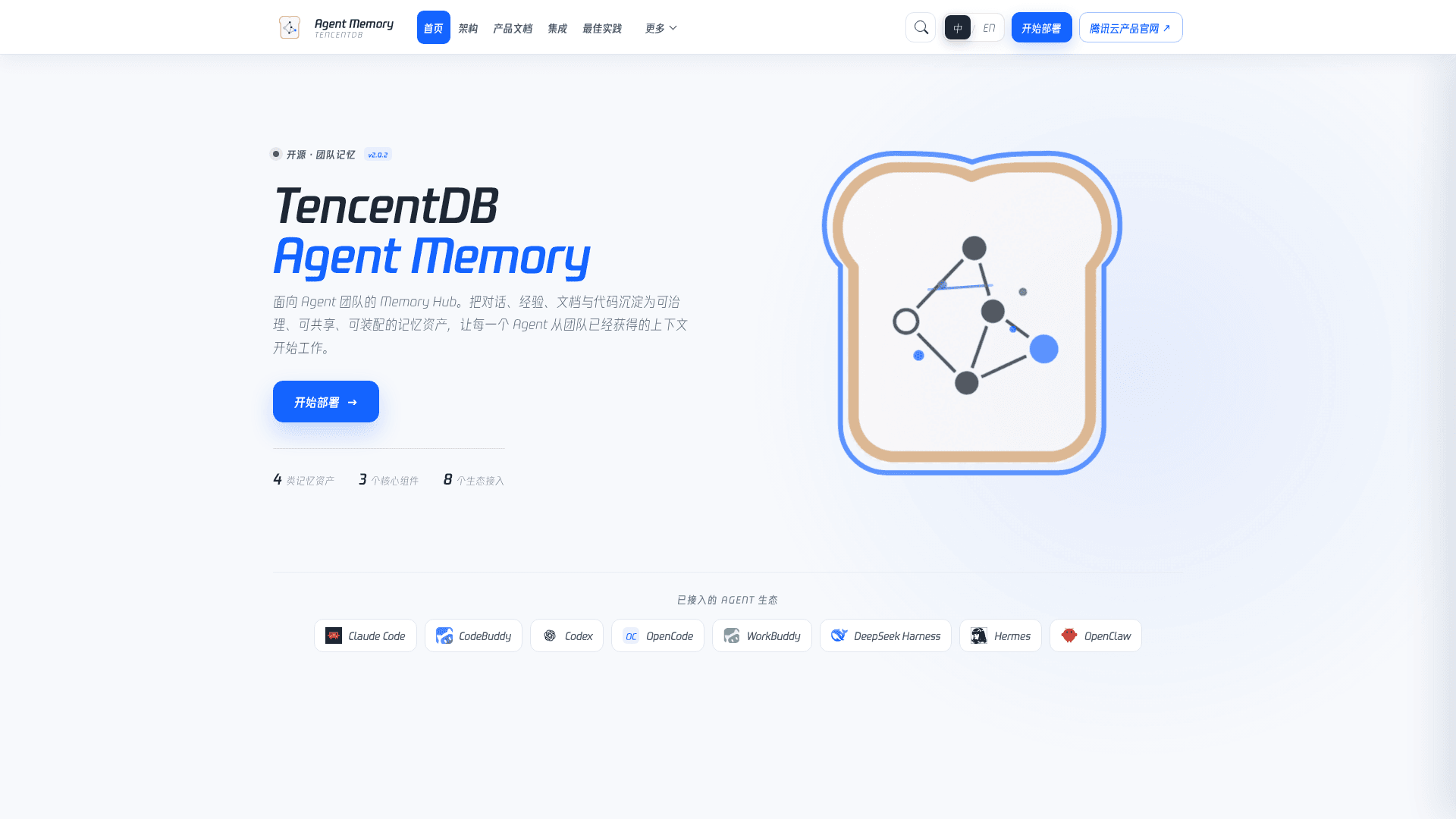
TencentDB Agent Memory is an open-source memory hub for AI agent teams from the Tencent Cloud database team. It turns conversations, documents, and code repositories into four kinds of memory assets (Chat Memory, Skill, LLM-Wiki, and CodeGraph) that can be governed, shared, and assigned to different agents. The latest listed release is v2.0.2, and the project is MIT-licensed.
What It Is
TencentDB Agent Memory is team-level memory infrastructure for agents. Three services run together: Memory Core, Memory Hub (including the Knowledge Service), and a Proxy. Agents connect by pointing their base URL at the Proxy, so the README describes the integration as requiring no plugin, hook, or MCP server.
Memory Hub is a control panel for creating teams and agents, reviewing and sharing assets, and binding assets to specific agents. Ownership, version, status, visibility, and usage counts are managed in one place.
The Four Memory Assets
- Chat Memory distills raw conversations (L0) into atomic facts and preferences (L1), scenarios (L2), and a long-term persona (L3). Retrieval normally starts from L2/L3 and falls back to L1/L0 using BM25, vector search, and RRF.
- Skill extracts reusable experience from conversations and tool calls, with versions, resource files, trigger boundaries, execution steps, and validation rules. Skills are private by default and can be shared after review.
- LLM-Wiki converts product docs, design specs, and runbooks into structured pages with a link graph.
- CodeGraph indexes code symbols, files, call relationships, and impact paths so an agent can check callers and callees before changing code.
Governance and Assembly
Assets are registered uniformly and routed with fixed binding plus access control. Visibility can be private, team, restricted (User/Role/Agent ACL), or agent. Wiki and CodeGraph are exposed to agents as tools discovered via /v3/tools/list and called via /v3/tools/call, so they enter context only when needed. Existing codebases, documents, and past conversation sessions can be imported to cold-start a new agent team.
Setup Path
The README's quick start clones the repository, copies a .env file, fills in two sets of LLM parameters (memory group and proxy group), and runs ./start-all.sh. The panel then opens on localhost port 8125. Documented client guides cover DeepSeek Harness, Claude Code, Codex, CodeBuddy, WorkBuddy, Hermes, and OpenClaw, plus a generic guide for other platforms. The MongoDB storage backend is marked experimental and off by default.
Current Status and Notes
The README notes that Wiki and CodeGraph are built asynchronously and need processing time before reaching ready status. CodeGraph currently prioritizes public HTTPS repositories, and fully automated memory routing is still under iteration. The project reports a PersonaMem benchmark result of 48% without memory versus 76% with it enabled.
Community Discussions
Be the first to start a conversation about TencentDB Agent Memory
Share your experience with TencentDB Agent Memory, ask questions, or help others learn from your insights.
Pricing
Open Source (Self-hosted)
Self-hosted core product (Memory Core, Memory Hub, Proxy) released under the MIT License. LLM provider costs for the memory and proxy parameter groups are external and not sold by the project.
- MIT License
- Self-hosted deployment via start-all.sh (memory-core + memory-hub + proxy)
- Chat Memory, Skill, LLM-Wiki, CodeGraph memory assets
- Integrations: Claude Code, CodeBuddy, Codex, OpenCode, WorkBuddy, DeepSeek Harness, Hermes, OpenClaw
- MongoDB storage backend is experimental and off by default
Capabilities
Key Features
- Chat Memory with L0–L3 layered distillation
- Skill extraction with versions, review, and sharing
- LLM-Wiki structured pages with link graph
- CodeGraph symbol, call, and impact analysis
- Private, team, restricted, and agent visibility with ACLs
- Fixed agent binding of memory assets
- Cold-start import of codebases, documents, and conversation sessions
- Hybrid retrieval with BM25, vector search, and RRF
- Proxy-based zero-code agent integration
- Knowledge OpenAPI and tool list/call endpoints
- Memory Hub web panel for team and asset management