
theAuth
Open-source auth library that gives AI agents their own identity, scoped permissions, delegation and audit trails alongside human sign-in and an MCP OAuth 2.1 server.
At a Glance
About theAuth
theAuth is an open-source authentication library from GLINCKER, the open-source division of GLINR STUDIOS. It handles human sign-in and gives each AI agent its own identity, scoped permissions, delegation chains and an audit trail. It also ships an MCP OAuth 2.1 authorization server. It is MIT licensed and can be self-hosted, with TypeScript and Go libraries, a Python client and a Terraform provider.
What It Is
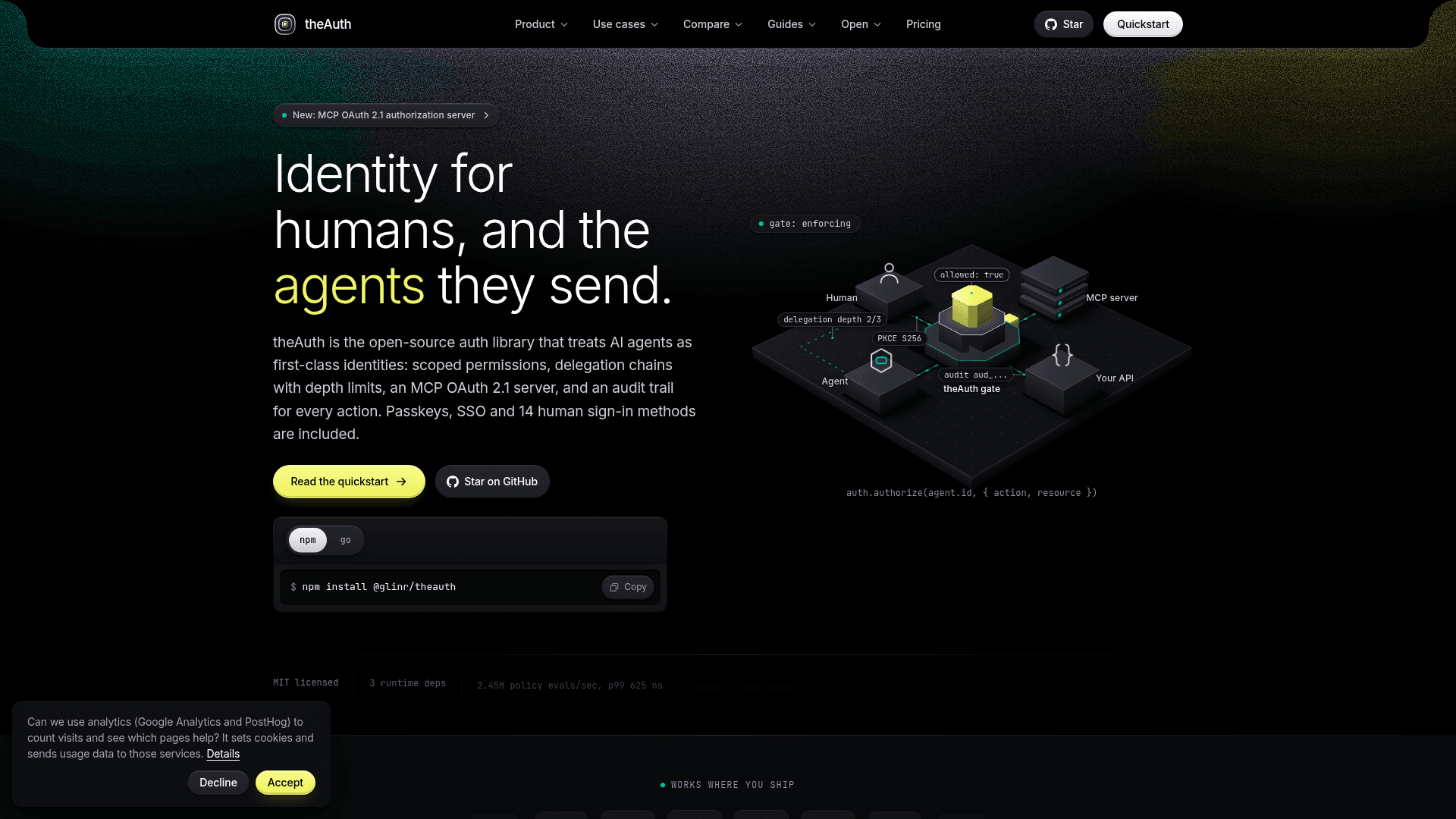
theAuth is an auth layer for people and the programs acting on their behalf. Agents are modeled as principals with an owner, a cryptographic bearer token and wildcard permissions such as mcp:github:*, rather than as shared API keys. Each authorize() call returns an allow or deny decision with a machine-readable code and writes an audit record.
How agent authorization works
A developer creates an agent with an owner and permissions, optionally delegates a narrower subset to sub-agents with a configurable depth limit, and checks each action before a tool runs. Sensitive actions can be held for human approval, and revoking an agent takes effect on the next call. Budget policies and trust scoring are documented for the TypeScript library.
MCP OAuth 2.1 and human sign-in
The authorization server supports PKCE S256, metadata discovery (RFC 8414, RFC 9728), resource indicators (RFC 8707) and dynamic client registration (RFC 7591). The Go library also lists token exchange, DPoP, PAR, JAR, CIBA and CIMD. For people, it supports passkeys, TOTP, magic links, email OTP, email and password with a breach check, and OAuth providers, plus organizations, RBAC, SAML/OIDC SSO and SCIM.
Packages and deployment
The TypeScript core runs on Node, Bun, Deno and Cloudflare Workers against SQLite, PostgreSQL, MySQL or D1, with framework adapters including Next.js, Hono, Express and Nuxt. theauth-go requires Go 1.25 or newer. A hosted Cloud option is described as early access. Compliance mappings to the EU AI Act, NIST, SOC 2 and ISO 42001 are reports, not certifications.
Community Discussions
Be the first to start a conversation about theAuth
Share your experience with theAuth, ask questions, or help others learn from your insights.
Pricing
Library (self-hosted)
MIT-licensed library you run on your own database and hosting; no license fee and no per-MAU charge from the vendor.
- Agent identity, MCP OAuth 2.1 server and human auth
- TypeScript, Go and Python SDKs
- Postgres, SQLite, MySQL, D1 (Go: Postgres, MySQL, in-memory)
- You pay for your own database and hosting
Capabilities
Key Features
- Per-agent identity with cryptographic bearer tokens and scoped permissions
- Delegation chains with depth limits
- Human approval for sensitive actions
- Per-agent audit trail with audit IDs
- MCP OAuth 2.1 authorization server with PKCE S256 and dynamic client registration
- Passkeys, TOTP, magic link, email OTP and password sign-in
- OAuth providers and generic OIDC
- Organizations, RBAC, SAML/OIDC SSO and SCIM 2.0
- Budget policies and trust scoring
- Audit streaming sinks in Go (Splunk HEC, webhook, OTLP)
- Framework adapters for Next.js, Hono, Express, Nuxt and more
- Self-hostable under MIT license