
tinker-ai-skill
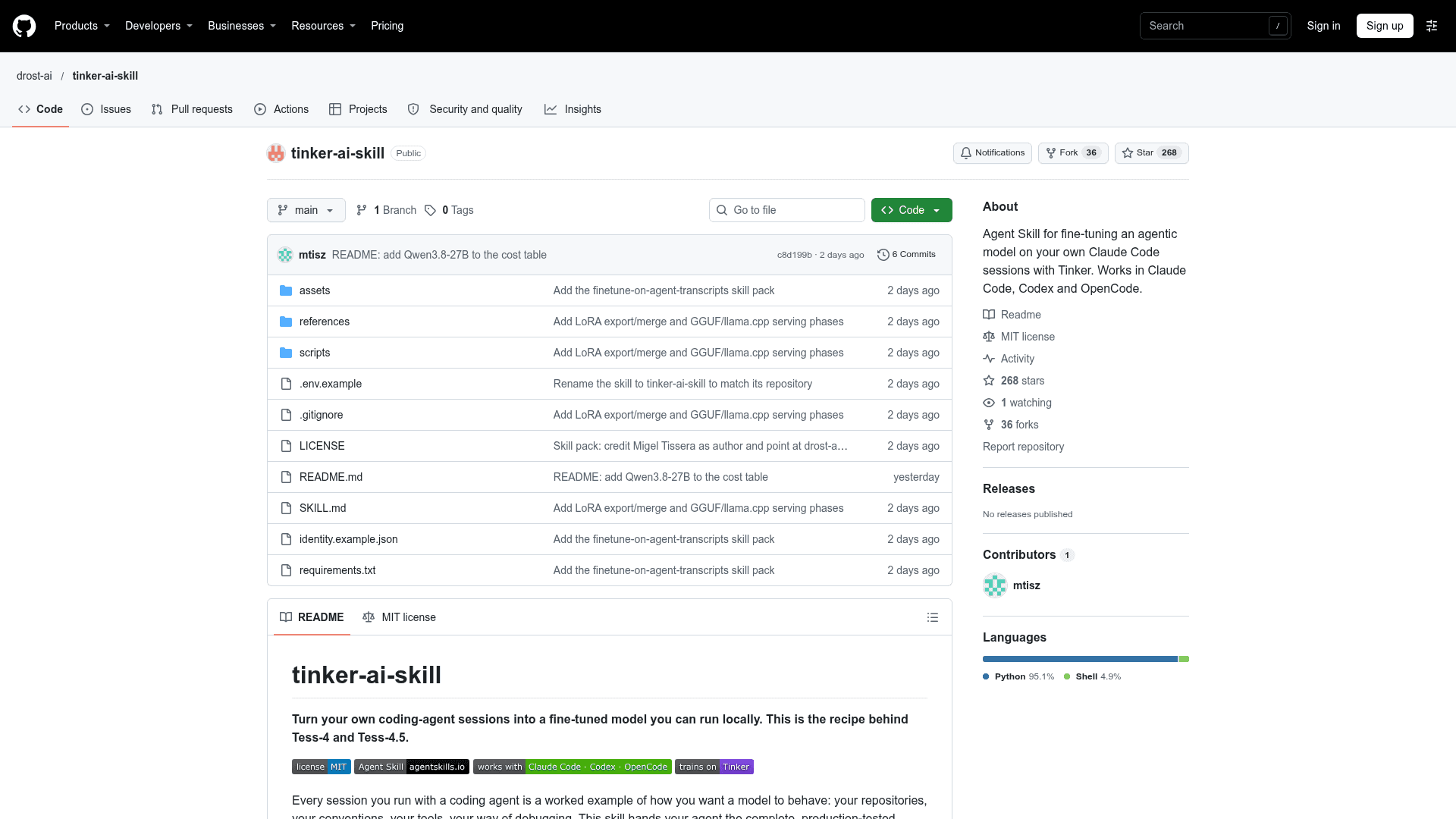
An Agent Skill that guides coding agents through fine-tuning a model on your own Claude Code sessions using Tinker and exporting a local GGUF.
At a Glance
MIT-licensed agent skill with scripts and reference notes. Tinker training costs are billed separately by Tinker (external cost).
Engagement
Available On
Listed Nov 2026
About tinker-ai-skill
tinker-ai-skill is an open-source Agent Skill that gives a coding agent a nine-step pipeline for turning Claude Code session transcripts into a fine-tuned model. It is written by Migel Tissera and distilled from the method used to build the Tess-4 and Tess-4.5 models. It works in Claude Code, Codex and OpenCode, and training runs on Tinker from Thinking Machines Lab.
What It Is
The repository packages a SKILL.md workflow, eleven Python and shell scripts, six reference notes and a synthetic transcript generator. A user installs the skill into an agent's skills directory and asks the agent to fine-tune a chosen base model on their past sessions. According to the README, the agent stops before any step that costs money.
How the Pipeline Works
The pipeline starts by collecting transcripts, normalizing them to OpenAI-style messages and anonymizing them per session, failing if anything leaks. It then slices sessions to the model's context length using the model's real renderer, adds compaction context to continuation slices and holds out whole sessions with a seeded hash. Training is a LoRA run on Tinker via tinker-cookbook, with an offline smoke test that prints token counts before launch. Afterwards, sample_checkpoint.py compares base and checkpoint behaviour, export_checkpoint.py merges the LoRA into the base model (or produces a PEFT adapter), and make_gguf.sh and serve_gguf.sh produce a quantized GGUF served with llama.cpp using training-matched settings.
Design Choices Documented
The README lists lessons built into the scripts: per-session anonymization, tool definitions and the system prompt on every row, thinking kept in history, measuring with the real tokenizer, judging checkpoints by sampled behaviour rather than loss, and serving with the training-matched template.
Setup Path
Requirements include Python 3.11+, uv or pip, tinker-cookbook 0.6.0 or newer, a Tinker API key, and optionally a Weights & Biases key. Steps 8-9 need a built llama.cpp checkout and disk space for the base and merged models. A five-minute dry run on synthetic data is provided. Tinker and tinker-cookbook are products of Thinking Machines Lab; this skill is an independent guide.
Community Discussions
Be the first to start a conversation about tinker-ai-skill
Share your experience with tinker-ai-skill, ask questions, or help others learn from your insights.
Pricing
Open Source (MIT)
MIT-licensed agent skill with scripts and reference notes. Tinker training costs are billed separately by Tinker (external cost).
- One SKILL.md nine-step workflow
- Eleven scripts for collecting, anonymizing, building datasets, training, exporting and serving
- Six reference notes
- Synthetic transcript generator for dry runs
- Dataset steps are free and run locally
Capabilities
Key Features
- Nine-step workflow from transcripts to a local GGUF model
- Collects Claude Code transcripts with checksums and project exclusion
- Per-session anonymization that fails on leaks
- Slicing and deterministic compaction context for long sessions
- Seeded session-level train/validation split
- LoRA training on Tinker with offline smoke test and cost shown before launch
- Checkpoint sampling to compare base vs fine-tuned behaviour
- LoRA merge to bf16 HuggingFace model or PEFT adapter
- GGUF conversion, quantization and llama.cpp serving scripts
- Synthetic transcript generator for dry runs