
TINY 2.1
A 367,000-parameter question-answering transformer written in Turbo C 2.0 that runs under plain DOS on a Pentium or 486DX and fits on a floppy disk.
At a Glance
TINY 2.1 code is released under the MIT License, free of charge to use, copy, modify and distribute. Three data files derived from public datasets keep their own licences (ODbL and CC BY-SA).
Engagement
Available On
Listed Nov 2026
About TINY 2.1
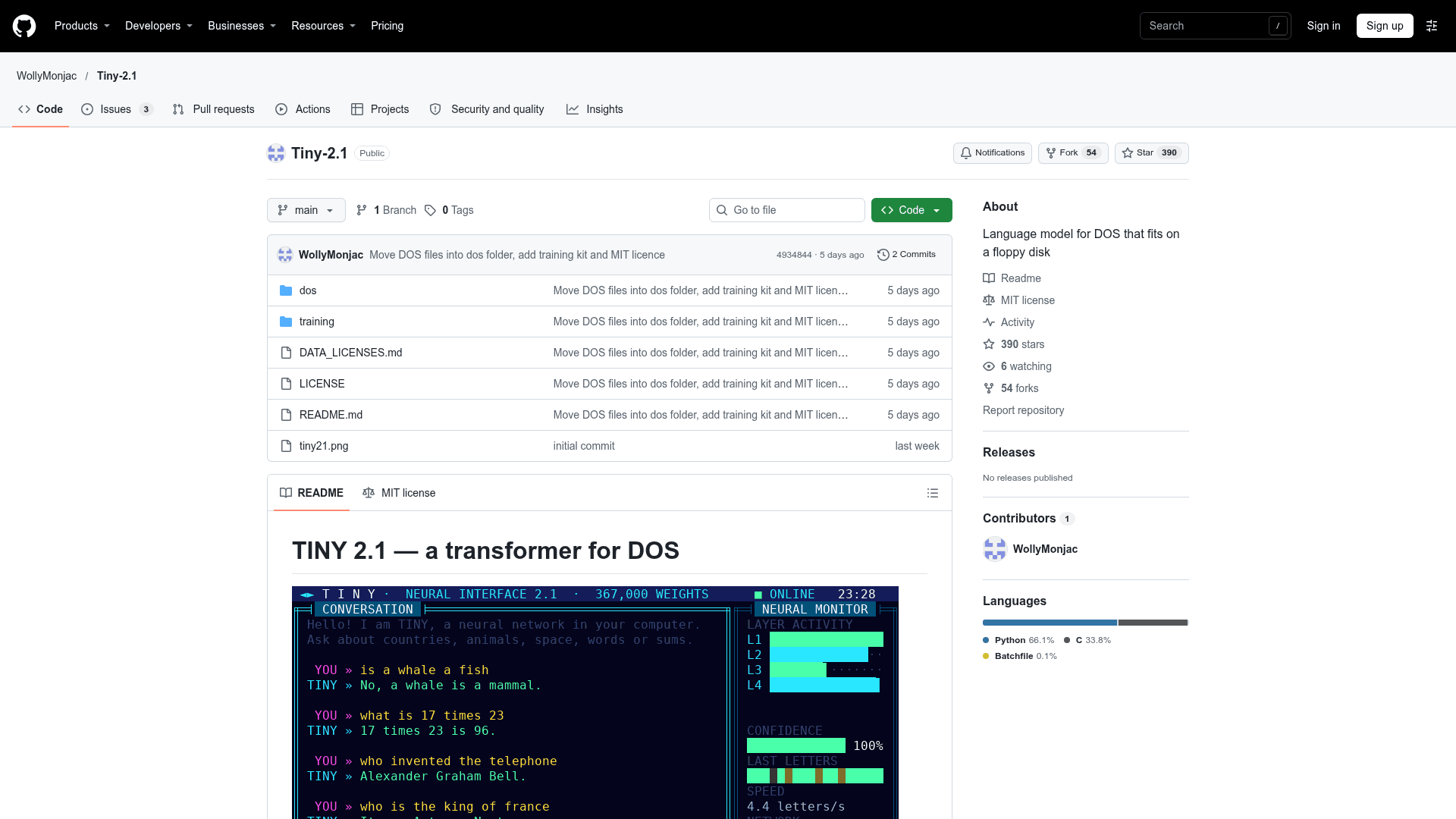
TINY 2.1 is an open-source, character-level question-answering transformer for DOS, published by WollyMonjac on GitHub. It is written in Turbo C 2.0, runs on a Pentium or 486DX under plain DOS, and fits on a floppy disk. The repository includes both the DOS runtime and a complete training kit.
What It Is
TINY 2.1 is a small language model with 4 layers and a width of 96, totaling 367,000 parameters. It reads and writes letter by letter. Weights are stored as 8-bit values with one scale per row, for 380 KB in all. It needs about 540 KB of free conventional memory. The model is trained on about 3,500 facts, each asked in many wordings. The README warns that outside those facts it makes things up confidently.
Running It on DOS
Copy the files from the dos folder to the DOS machine, change into the TINY directory, and run TINY. TINY.EXE and TINY.BIN must sit in the same folder. The interface is a neon full-screen display with a live neural monitor and a PC-speaker robot voice. The program can be rebuilt with TCC -ml TINY.C.
Training Your Own
The training folder holds the facts, a generator (gen2.py) that turns them into question/answer pairs in many wordings, and a PyTorch training script (train2.py). It needs Python 3, NumPy and PyTorch, and a normal CPU is enough. Users can add their own facts, train or resume from a checkpoint, evaluate, and export a new TINY.BIN that TINY.EXE reads. Exporting tiny2.pt unchanged reproduces the released TINY.BIN.
Licensing
The code is MIT licensed. Three data files derived from public datasets keep their own licences (ODbL and CC BY-SA), described in DATA_LICENSES.md.
Community Discussions
Be the first to start a conversation about TINY 2.1
Share your experience with TINY 2.1, ask questions, or help others learn from your insights.
Pricing
Open Source (MIT)
TINY 2.1 code is released under the MIT License, free of charge to use, copy, modify and distribute. Three data files derived from public datasets keep their own licences (ODbL and CC BY-SA).
- Code licensed under MIT (OSI-approved)
- Three data files derived from public datasets keep their own licences (ODbL and CC BY-SA); see DATA_LICENSES.md
- Complete training kit included (facts, gen2.py generator, train2.py PyTorch script)
- Runs on Pentium or 486DX under plain DOS; needs about 540 KB free conventional memory
Capabilities
Key Features
- 367,000-parameter character-level transformer (4 layers, 96 wide)
- 8-bit weights with one scale per row, 380 KB total
- Runs under plain DOS on Pentium or 486DX
- Needs about 540 KB free conventional memory
- Neon full-screen interface with live neural monitor
- PC-speaker robot voice
- Complete training kit with fact files and question/answer generator
- PyTorch training, evaluation and export to TINY.BIN
- Rebuildable with Turbo C 2.0