
TraceLLM
An open-source observability platform for AI applications that traces prompts, spans, tokens, errors, and model calls across LLM-powered workflows.
At a Glance
Free to use, modify, and self-host under the MIT License.
Engagement
Available On
Alternatives
Listed Aug 2026
About TraceLLM
TraceLLM is an open-source observability platform for AI applications, published under the MIT License and hosted at tracellm.in. It gives development teams a single trace timeline per AI workflow, replacing scattered logs and vendor dashboards with unified session, span, event, and error records. The project is built and maintained by Jyotishmoy12 on GitHub and targets production AI apps including chatbots, agents, RAG pipelines, and model routers.
What It Is
TraceLLM sits between your application code and your LLM providers, capturing the full lifecycle of each AI workflow without requiring you to change where model requests run. It records sessions, spans, lifecycle events, token usage, latency, metadata, and optionally prompt and output content. The platform ships a Node.js SDK (@use-tracellm/sdk-node) that wraps real provider calls and forwards telemetry to the TraceLLM API, which stores traces in its own UI and can export them to OpenTelemetry-compatible backends like SigNoz over OTLP.
Architecture and Tech Stack
TraceLLM is a monorepo with clearly separated layers:
- Backend: Node.js, Express, TypeScript, MVC/layered architecture
- Database: SQLite with Drizzle ORM
- Auth: Email/password with Argon2id hashing and JWT in HttpOnly cookies
- API Docs: Swagger/OpenAPI generated from Zod schemas
- Telemetry: OpenTelemetry OTLP HTTP export with SigNoz support
- Frontend: React, Vite, React Query, Tailwind CSS
- Docs: MkDocs Material
- Infra: Docker Compose, Caddy, Hostinger VPS, Vercel
The SDK is a separate package under packages/sdk-node and is published to npm as @use-tracellm/sdk-node.
How the Tracing Workflow Works
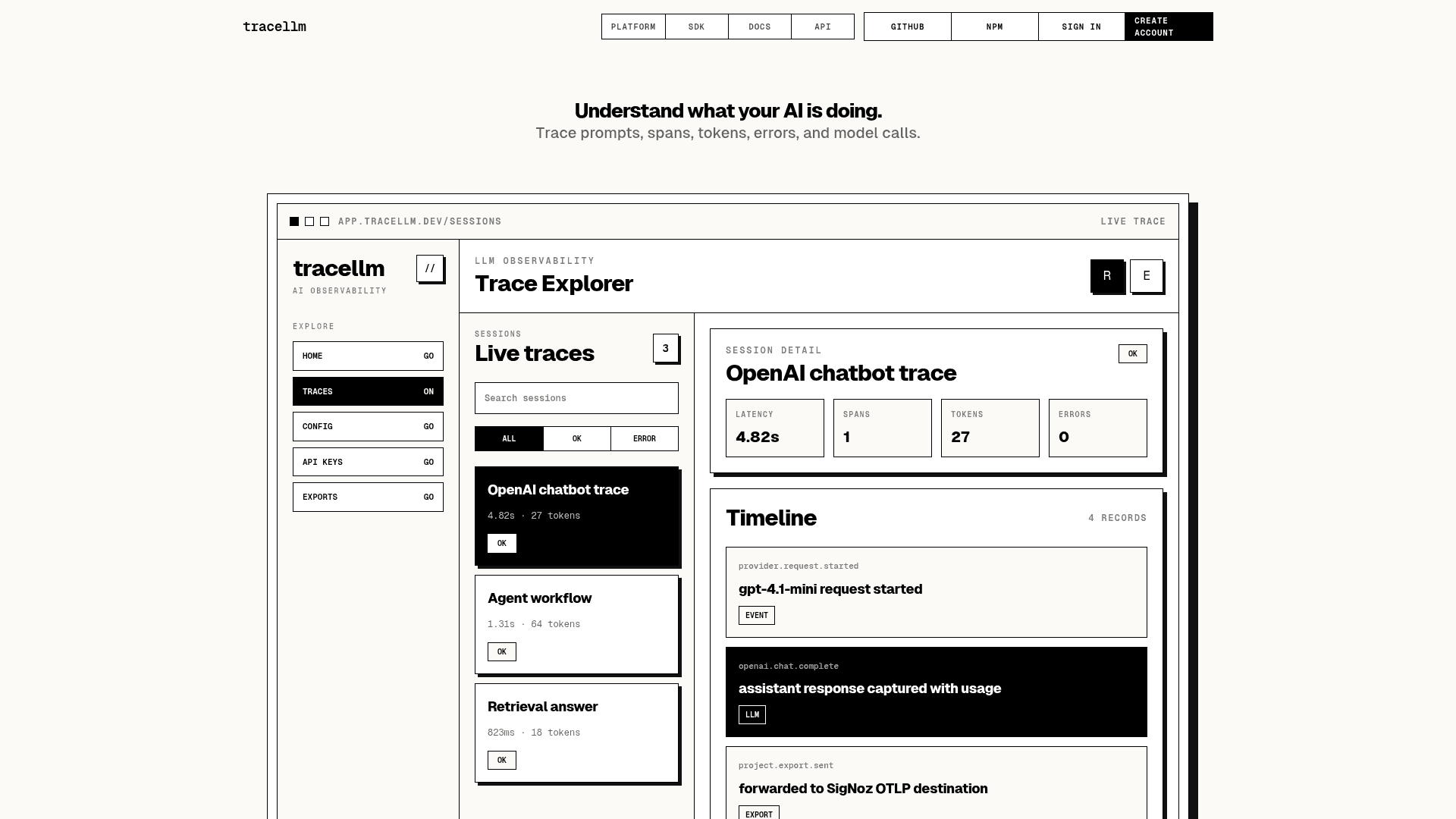
Developers install the SDK, create a project, and copy an API key from the TraceLLM dashboard. Each project key carries SDK behavior, capture policy, and ownership. In application code, a session is started per user workflow, spans wrap individual model calls, and events record lifecycle moments like provider responses or tool invocations. Errors are attached to the same trace with message, type, stack, and metadata. The Trace Explorer in the dashboard lets teams search sessions by name, status, or timestamp and inspect the full timeline of any workflow.
Project Controls and Capture Policy
TraceLLM exposes per-project configuration for what gets captured: content capture can be toggled on or off, metadata capture can be enabled independently, redaction can be applied, and sampling rate can be set (e.g., 70%). These controls are accessible from the UI or via the project API key, giving teams fine-grained control over data retention and privacy without code changes.
OpenTelemetry Export
TraceLLM keeps product-level traces in its own UI and can simultaneously export the same workflow telemetry to OTLP-compatible backends. The documented integration path is: SDK → TraceLLM API → OTLP Collector → SigNoz. This means teams can use TraceLLM for AI-specific debugging while feeding the same spans, events, and errors into their existing infrastructure observability stack.
Current Status
The repository was created in July 2026 and last pushed on July 13, 2026, indicating active early development. The live app is available at tracellm.in, the Node SDK is published to npm, and documentation is live at docs.tracellm.in. The project has an MIT license and is free to self-host via Docker Compose or deploy to a VPS using the provided Caddy and Docker Compose configuration.
Community Discussions
Be the first to start a conversation about TraceLLM
Share your experience with TraceLLM, ask questions, or help others learn from your insights.
Pricing
Open Source
Free to use, modify, and self-host under the MIT License.
- Full trace timeline per AI workflow
- Session, span, event, and error capture
- Token usage and latency tracking
- Optional prompt/output content capture
- Per-project capture policy controls
Capabilities
Key Features
- Session-level AI workflow tracing
- Span and lifecycle event capture
- Token usage and latency tracking
- Error capture with message, type, stack, and metadata
- Optional prompt and output content capture
- Per-project capture policy controls (content, metadata, redaction, sampling)
- OpenTelemetry OTLP export to SigNoz and other backends
- Trace Explorer with search by session name, status, and timestamp
- Node.js SDK (npm: @use-tracellm/sdk-node)
- API key management per project
- Live trace view in dashboard
- Docker Compose self-hosting support
- Swagger/OpenAPI documentation
- Email/password authentication with JWT