
Trigger.dev
Open-source platform for building and deploying fully-managed AI agents and long-running background workflows in TypeScript, with retries, queues, observability, and elastic scaling.
At a Glance
About Trigger.dev
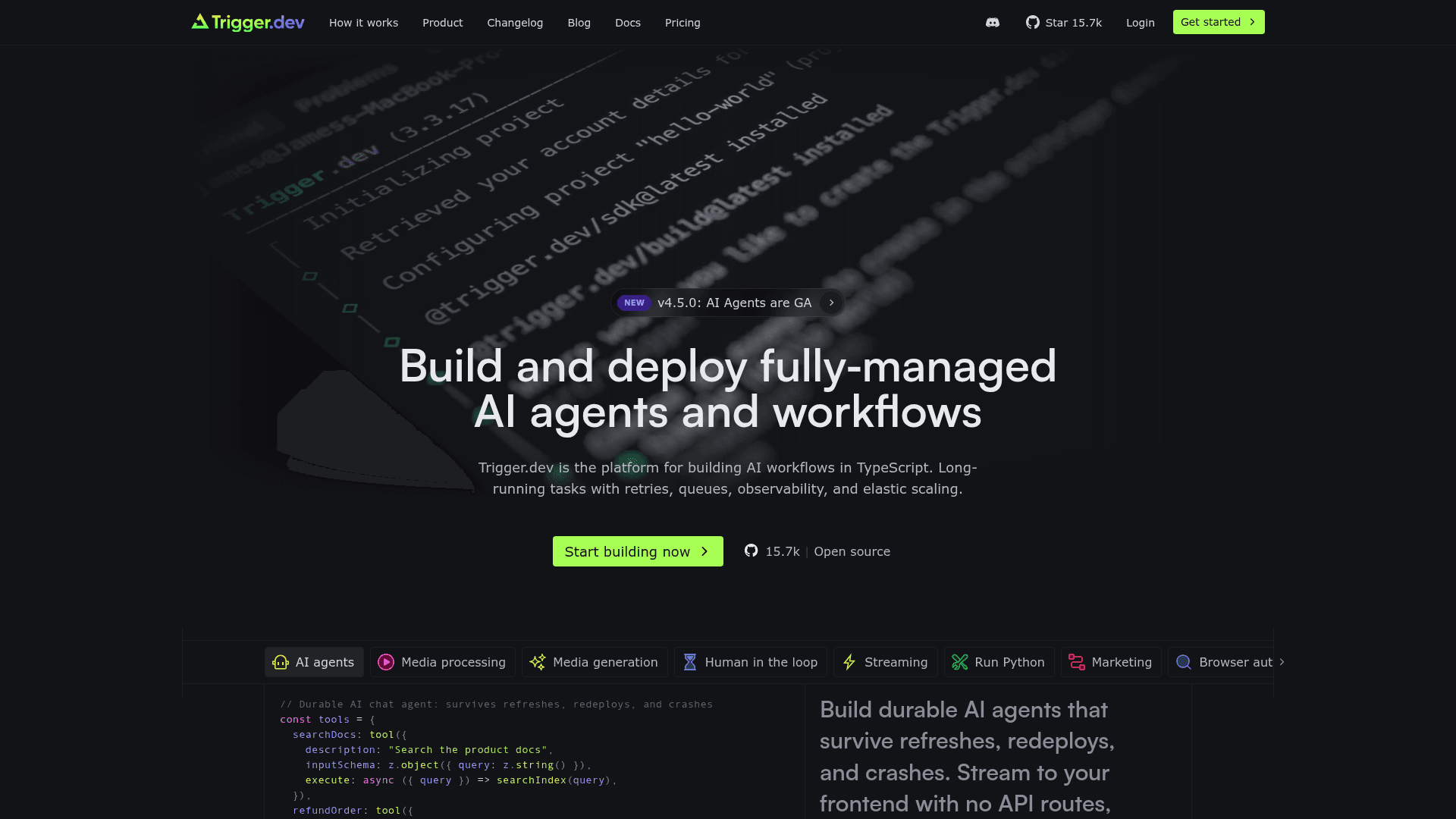
Trigger.dev is an open-source platform (Apache 2.0) for building AI workflows and background jobs in TypeScript. It runs tasks on managed infrastructure with no timeouts, automatic retries, durable execution, and real-time observability — without requiring developers to manage servers or worry about serverless function limits. The project is operated by API Hero Ltd and has accumulated over 15,700 GitHub stars as of mid-2026.
What It Is
Trigger.dev sits in the category of workflow orchestration and background job platforms, purpose-built for TypeScript developers who need to run long-running, reliable tasks — especially AI agent workloads. Unlike traditional serverless platforms (AWS Lambda, Vercel Functions) that impose strict execution time limits, Trigger.dev deploys tasks to elastic managed workers that can run indefinitely. Developers write tasks as ordinary async TypeScript functions inside a trigger folder in their codebase, then deploy them via CLI or through GitHub/Vercel integrations. The platform handles scheduling, queuing, retries, checkpointing, and observability automatically.
Core Architecture and Durability Model
The platform's durability model centers on checkpointing: when a task hits a wait (for time, an HTTP callback, or human approval), the process state is snapshotted and the worker is freed. The task resumes exactly where it paused when the condition is met, meaning developers pay only for actual execution time. Key architectural primitives include:
- Tasks: Exported async functions with configurable retry policies, machine sizes (0.25 vCPU/0.25 GB RAM up to 8 vCPU/16 GB RAM), and max durations
- Queues and concurrency: Per-task or per-key concurrency limits, priority queuing, and debounce support
- Environments: DEV, STAGING, PREVIEW (per-branch), and PROD with isolated API keys and schedules
- Realtime: A pub/sub bridge that lets frontend apps subscribe to run status and stream LLM responses without custom API routes
AI Agent Capabilities
With v4.5.0 (released as GA in 2026), Trigger.dev formally positioned itself as an AI agent platform. The chat.agent() primitive wraps the Vercel AI SDK's streamText, wiring in tool approval (human-in-the-loop), compaction, mid-turn steering, and OpenTelemetry telemetry. Supported agent patterns include:
- Autonomous agents with open-ended tool use
- Prompt chaining and multi-stage processing flows
- Routing tasks to specialized models based on content
- Parallelization of concurrent AI subtasks
- Orchestrator/evaluator-optimizer loops
Human-in-the-loop gates pause a task at zero compute cost until a human responds via the SDK, React hooks, or a webhook callback URL.
Runtime Freedom and Build Extensions
Trigger.dev provides a build extension system that lets developers customize the deployed container image beyond what standard serverless runtimes allow. Extensions include Python (with automatic requirements.txt installation), Puppeteer/browser automation, FFmpeg for video/audio processing, Prisma for database migrations, esbuild plugins, and arbitrary apt-get system packages. This makes it practical for media processing, ML inference, document conversion, and other workloads that require native binaries.
Open-Source Deployment Model
The core platform is open source under Apache 2.0 and self-hostable via Docker Compose or Kubernetes (official Helm chart). The self-hosted stack uses the same codebase as Trigger.dev Cloud. Some features — warm starts, auto-scaling, checkpoints, dedicated support, RBAC, and SSO — are available only on the managed cloud offering. The project reports over 5,000 Discord members and accepts community contributions on GitHub.
Update: v4.5.4 (July 2026)
The latest release as of July 14, 2026 is v4.5.4. Recent notable milestones include:
- v4.5.0: AI Agents went generally available, introducing the
chat.agent()API and production-ready durable agent infrastructure - US West (Oregon) region: Added July 13, 2026, expanding multi-region worker support
- Infisical integration: Added July 11, 2026, for secrets management
- Bun runtime: The team published a blog post (March 2026) describing a switch from Node.js to Bun for 5× throughput improvement in their internal infrastructure
The changelog is actively maintained at trigger.dev/changelog, and the GitHub repository shows regular pushes with 392 open issues and 1,354 forks as of mid-2026.
Community Discussions
Be the first to start a conversation about Trigger.dev
Share your experience with Trigger.dev, ask questions, or help others learn from your insights.
Pricing
Free
Get started with $5/month in free credits, unlimited tasks, and community support.
- $5/month free credits
- 20 concurrent runs
- Unlimited tasks
- 5 team members
- Dev and Prod environments
Hobby
For individual developers with $10/month credits included.
- $10/month credits included
- 50 concurrent runs
- Unlimited tasks
- 5 team members
- Dev, Preview and Prod environments
- 5 preview branches
- 1 custom dashboard
- 100 schedules
- 7 day log retention
- 7 days query period
- Community support
- 3 alert destinations
- 150 concurrent Realtime connections
- HIPAA BAA add-on available
Pro
For teams with $50/month credits included and expanded limits.
- $50/month credits included
- 200+ concurrent runs
- Unlimited tasks
- 25+ team members
- Dev, Preview and Prod environments
- 20+ preview branches
- 5+ custom dashboards
- 1000+ schedules
- 30 day log retention
- 30 days query period
- Dedicated Slack support
- 100+ alert destinations
- 1000+ concurrent Realtime connections
- AWS PrivateLink
- HIPAA BAA add-on available
Enterprise
Custom plans for teams shipping at scale with priority support and compliance features.
- Custom discounts
- All Pro plan features
- Custom log retention
- Priority support
- Role-based access control
- SOC 2 report
- Penetration test report
- SSO
- HIPAA BAA add-on available
- Uptime SLA
- Shared Slack channel with engineering team
Capabilities
Key Features
- Long-running tasks with no timeouts
- Durable AI agents with checkpointing
- Human-in-the-loop approval gates
- Automatic retries with configurable policies
- Concurrency and queue management
- Durable cron schedules
- Realtime run status and LLM streaming
- React hooks for frontend integration
- Build extensions (Python, FFmpeg, Puppeteer, Prisma, esbuild)
- Multi-region workers
- Static IPs and AWS PrivateLink
- Preview branches per git branch
- OpenTelemetry-powered observability and tracing
- Advanced run filters and bulk actions
- Run metadata and tagging
- Batch triggering and fan-out
- Structured inputs/outputs with schema validation
- Versioning with atomic deploys
- Configurable machine sizes (vCPU/RAM)
- Vercel and GitHub integrations
- MCP server for AI assistant integration
- Custom dashboards and TRQL query language
- Real-time alerts via email, Slack, or webhook
- Self-hosting via Docker Compose or Kubernetes
- SOC 2 Type II, GDPR, and HIPAA compliance (enterprise)
- SSO and RBAC (enterprise)
- Debounce triggering
- Input streams for mid-execution data injection
- Idempotency keys