txtai
An open-source, all-in-one AI framework for semantic search, LLM orchestration, RAG pipelines, autonomous agents, and language model workflows built with Python.
At a Glance
Fully open-source under Apache 2.0 license. Free to use, modify, and distribute.
Engagement
Available On
Listed Jun 2026
About txtai
txtai is an open-source AI framework developed by NeuML, released under the Apache 2.0 license and hosted on GitHub. It combines semantic search, LLM orchestration, retrieval augmented generation (RAG), and autonomous agents into a single Python library. The project was created in 2020 and has reached v9.10.0 as of June 2026, with active development continuing on the master branch.
What It Is
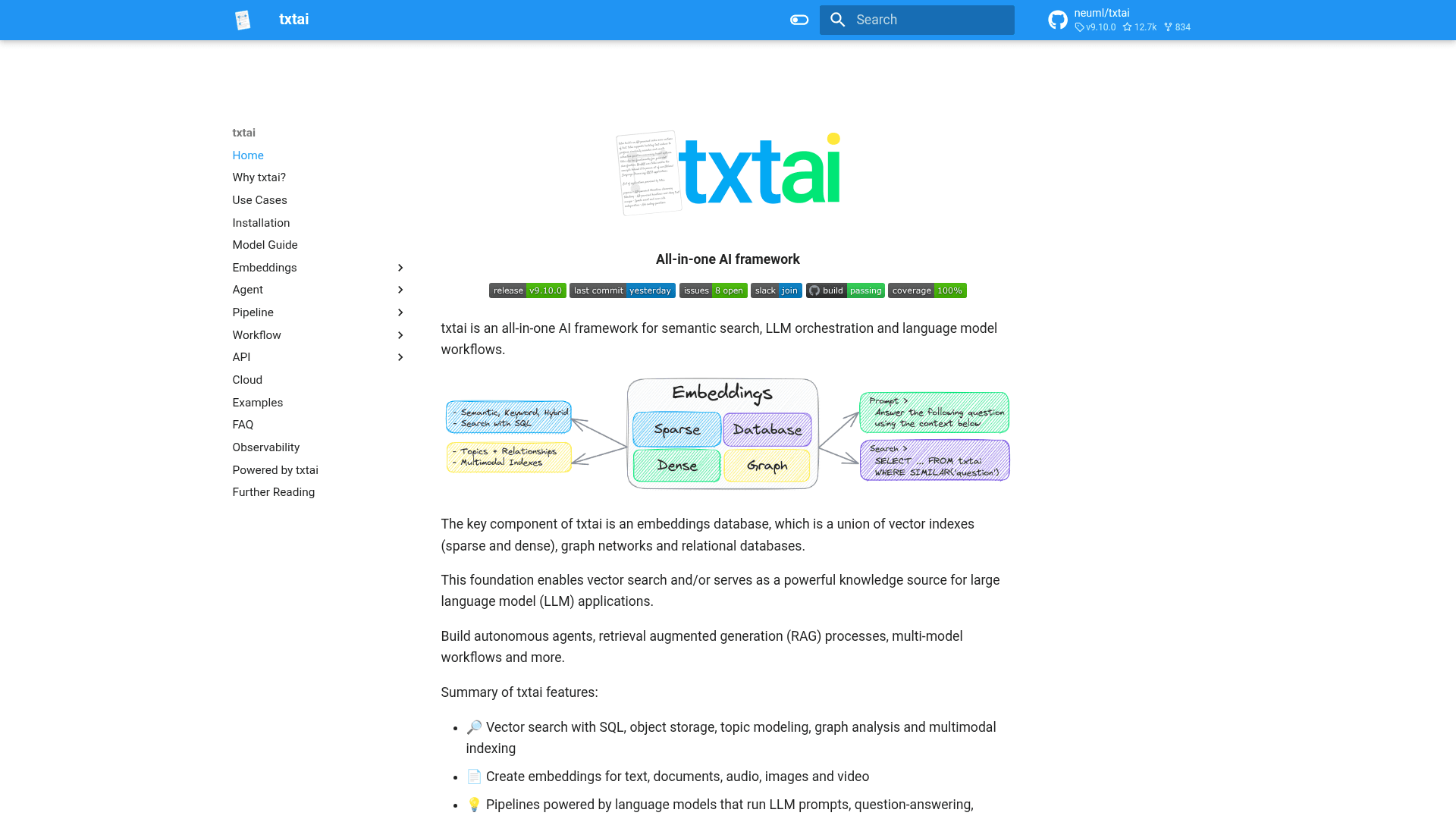
txtai is a Python framework that unifies vector search, language model pipelines, and agentic workflows under one API. Its core component is an embeddings database — a hybrid data store combining dense and sparse vector indexes, graph networks, and a relational database. This foundation powers both standalone semantic search applications and serves as a knowledge source for LLM-driven systems. The framework is built on top of Hugging Face Transformers, Sentence Transformers, and FastAPI, and can run entirely locally or be scaled out via container orchestration.
Architecture and Core Components
txtai is organized around four main building blocks:
- Embeddings database: Supports vector search with SQL, object storage, topic modeling, graph analysis, and multimodal indexing across text, documents, audio, images, and video.
- Pipelines: Language model-powered tasks including LLM prompting, question-answering, zero-shot labeling, transcription (Whisper), translation (OPUS), summarization (DistilBART), and text-to-speech (ESPnet JETS).
- Workflows: Composable pipeline chains that aggregate business logic, ranging from simple microservices to multi-model processing graphs.
- Agents: Built on top of the Hugging Face smolagents framework, agents autonomously connect embeddings, pipelines, workflows, and other agents to solve complex problems. Agent prompting via
agents.mdandskill.mdspecifications is supported.
The framework exposes both a REST API (via FastAPI) and a Model Context Protocol (MCP) API, with official client bindings for JavaScript, Java, Rust, and Go.
Setup Path
Installation is straightforward via pip:
pip install txtai
Python 3.10+ is required. Docker-based deployment is also supported for containerized or cloud environments. The README includes quickstart code that gets a working semantic search index running in a few lines. A YAML-based configuration system allows the built-in API server to be launched with a single command, making it accessible to non-Python consumers immediately.
Model Support and Integrations
txtai recommends commercially-usable models from the Hugging Face Hub as defaults for each pipeline component. For LLMs, it supports Hugging Face models, llama.cpp, and any model accessible via LiteLLM — which covers OpenAI, Anthropic Claude, and AWS Bedrock. Models can be loaded from the Hugging Face Hub by path or from local directories. The framework integrates with smolagents for agent orchestration and supports GraphRAG patterns via its built-in semantic graph capabilities.
Update: v9.10.0
The latest release is v9.10.0, published on June 4, 2026. The project has maintained a consistent major-version release cadence, with blog posts covering what's new in versions 4.0 through 9.0 published on Medium. Recent additions highlighted in the README include agent skill integration via skill.md, MCP API support, and GraphRAG capabilities. The repository shows 12,672 stars and 835 forks on GitHub, with the last code push on June 19, 2026, indicating active maintenance. NeuML also notes a hosted version of txtai applications is in development at txtai.cloud.
Community Discussions
Be the first to start a conversation about txtai
Share your experience with txtai, ask questions, or help others learn from your insights.
Pricing
Open Source
Fully open-source under Apache 2.0 license. Free to use, modify, and distribute.
- Full framework access
- Semantic search and embeddings database
- LLM orchestration and RAG pipelines
- Autonomous agents
- REST and MCP APIs
Capabilities
Key Features
- Embeddings database with dense and sparse vector indexes
- Semantic/vector search with SQL support
- Multimodal indexing for text, documents, audio, images, and video
- LLM orchestration with support for Hugging Face, llama.cpp, OpenAI, Claude, and AWS Bedrock via LiteLLM
- Retrieval augmented generation (RAG) pipelines
- Autonomous agents built on smolagents framework
- Graph networks and GraphRAG support
- Pipeline tasks: summarization, transcription, translation, text-to-speech, question-answering, labeling
- Composable workflow system for multi-model processing
- REST API via FastAPI
- Model Context Protocol (MCP) API
- Client bindings for JavaScript, Java, Rust, and Go
- Local execution with no external data shipping required
- Docker and container orchestration support
- Topic modeling and graph analysis
- Zero-shot and fine-tuned text labeling
- agents.md and skill.md agent prompting support