
Universal LLM Client
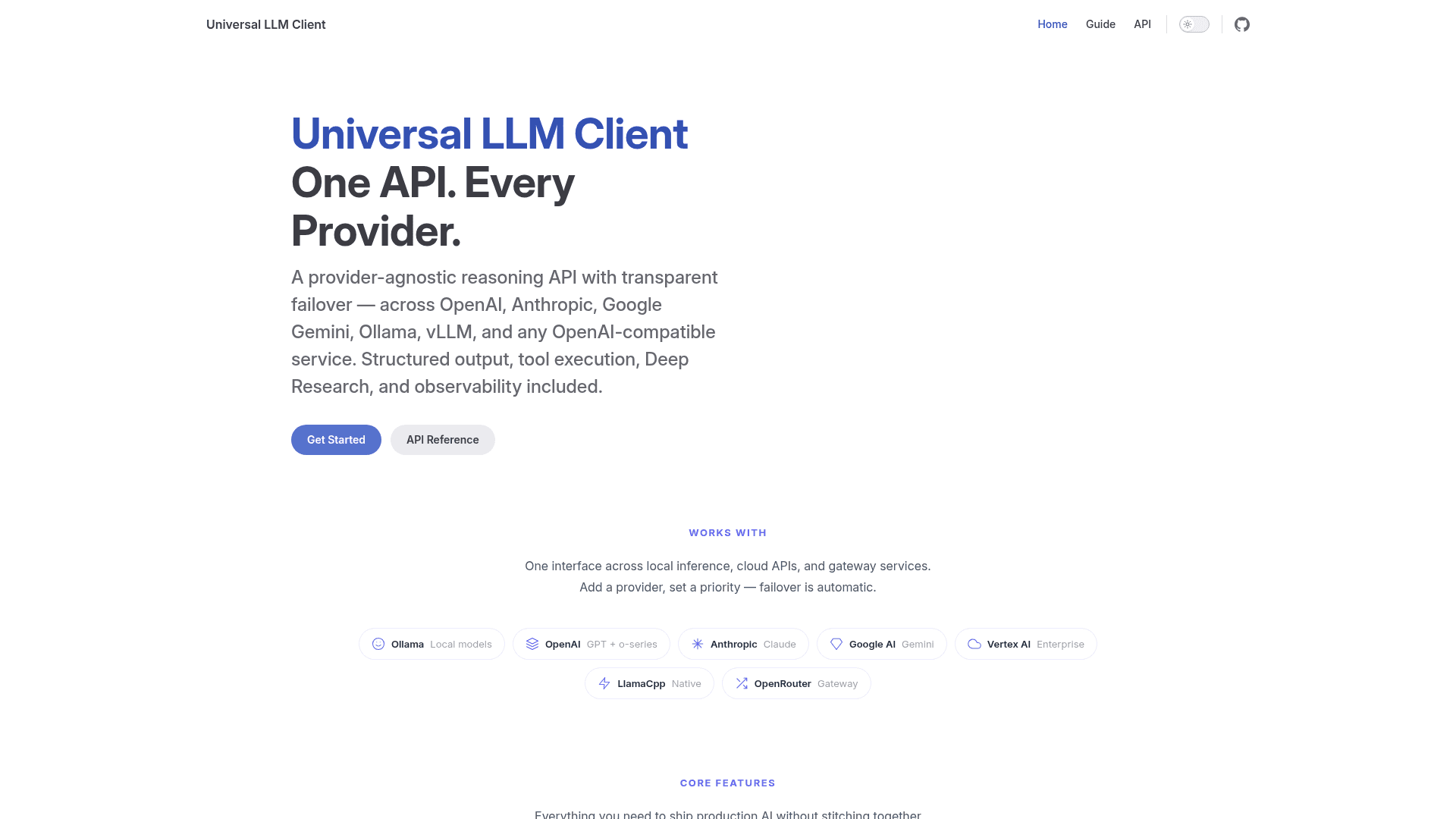
A provider-agnostic TypeScript/JavaScript LLM client with transparent failover across OpenAI, Anthropic, Google Gemini, Ollama, and any OpenAI-compatible endpoint.
At a Glance
Free to use, modify, and distribute under the MIT License.
Engagement
Available On
Listed Aug 2026
About Universal LLM Client
Universal LLM Client is an open-source TypeScript/JavaScript library that gives developers a single AIModel class to interact with any major LLM provider — OpenAI, Anthropic, Google Gemini, Ollama, Vertex AI, LlamaCpp, and any OpenAI-compatible endpoint. It is MIT-licensed, zero-dependency at its core, and designed to run on Node.js 22+, Bun, Deno, and modern browsers. The project is maintained by Igor Lins e Silva and published on npm as universal-llm-client.
What It Is
Universal LLM Client is a provider-agnostic reasoning and chat API for JavaScript/TypeScript. Rather than writing separate integration code for each LLM backend, developers configure a priority-ordered list of providers and call a single unified API. The library handles failover, retries, health tracking, streaming, structured output, tool calling, and observability behind the scenes — the calling code never needs to know which backend actually served the response.
Transparent Failover Architecture
The core differentiator is the built-in Router/failover engine. Providers are assigned priorities; if the highest-priority provider returns an error or times out, the library retries (configurable, default 2 retries) and then seamlessly moves to the next provider in the chain. Health tracking and cooldowns prevent repeated calls to a known-bad backend. The getProviderStatus() method exposes live health state at any time.
- Supports Google AI Studio → OpenRouter → local Ollama chains out of the box
- Configurable
retriesandtimeoutper model instance - Failover events are captured by the built-in Auditor for observability
Unified Reasoning and Streaming
The library exposes a single thinking flag — true/false or a level string ('minimal' | 'low' | 'medium' | 'high') — that maps to each provider's native reasoning control: Gemini thinkingLevel/thinkingBudget, OpenAI reasoning_effort, Anthropic budget_tokens, Ollama think, and vLLM enable_thinking. Chain-of-thought is surfaced as response.reasoning and as streaming thinking events. Streaming uses async generators with pluggable decoder strategies — standard chat, interleaved reasoning (parses <think> tags), and passthrough — selectable per call.
Tool Calling, MCP, and Structured Output
Tools are registered once via registerTool() or a fluent ToolBuilder and work across all providers. The chatWithTools() method runs an autonomous multi-turn execution loop and returns a full tool execution trace. MCP (Model Context Protocol) servers are bridged via MCPToolBridge, supporting both stdio and HTTP transports with automatic tool discovery — no glue code required. Structured output uses Zod 4 schemas: generateStructured() returns fully typed, validated JSON; tryParseStructured() is a non-throwing variant; and generateStructuredStream() yields partial validated objects as the response streams in.
Agent Framework Design
The library is explicitly designed as a transport layer for agent frameworks. Key design choices include:
- Stateless — no conversation history stored; the framework manages memory
- Composable — separate instances for chat, embeddings, and vision
- Observable — every request, response, retry, failover, and tool call is a structured, flushable
AuditEventvia theAuditorinterface (built-inConsoleAuditorandBufferedAuditorfor custom sinks like OpenTelemetry) - Context budget —
getModelInfo()exposescontextLengthfor budget management - Embeddings — single and batch embedding generation via
embed()andembedArray()
Update: v4.6.0 — Pool-Aware Routing and Failover Hardening
The latest release, v4.6.0 (published July 22, 2026), is titled "pool-aware routing, StreamLoopGuard & failover hardening." The repository was created in July 2025 and has seen active development through mid-2026, with the last push on August 3, 2026. The project is in active development with a versioned release cadence on npm.
Community Discussions
Be the first to start a conversation about Universal LLM Client
Share your experience with Universal LLM Client, ask questions, or help others learn from your insights.
Pricing
Open Source
Free to use, modify, and distribute under the MIT License.
- Full source code access
- MIT License
- All features included
- npm package: universal-llm-client
Capabilities
Key Features
- Transparent provider failover with retries and health tracking
- Unified reasoning API (thinking flag mapped to each backend)
- Streaming via async generators with pluggable decoder strategies
- Autonomous tool calling with multi-turn execution loop
- MCP server integration via MCPToolBridge (stdio and HTTP)
- Structured output with Zod 4 schemas and streaming partial objects
- Gemini Deep Research support (background interactions with polling)
- Built-in observability via Auditor interface (ConsoleAuditor, BufferedAuditor)
- Single and batch embedding generation
- Multimodal/vision support
- Zero core dependencies
- Runs on Node.js 22+, Bun, Deno, and modern browsers
- Provider health status API
- ToolBuilder fluent API and ToolExecutor wrappers
- Tree-shakeable structured output module