Upsonic
Open-source Python framework for building autonomous and traditional AI agents with tools, memory, RAG, multi-agent teams, and production deployment.
At a Glance
Full framework available under the MIT License at no cost.
Engagement
Available On
Listed Jun 2026
About Upsonic
Upsonic is an open-source Python framework for building autonomous and traditional AI agents, published under the MIT License on GitHub. The project has accumulated nearly 8,000 stars and over 700 forks since its creation in May 2024, signaling strong community traction. It is developed by the Upsonic team, which also builds AI-native fintech products on top of the same agent infrastructure.
What It Is
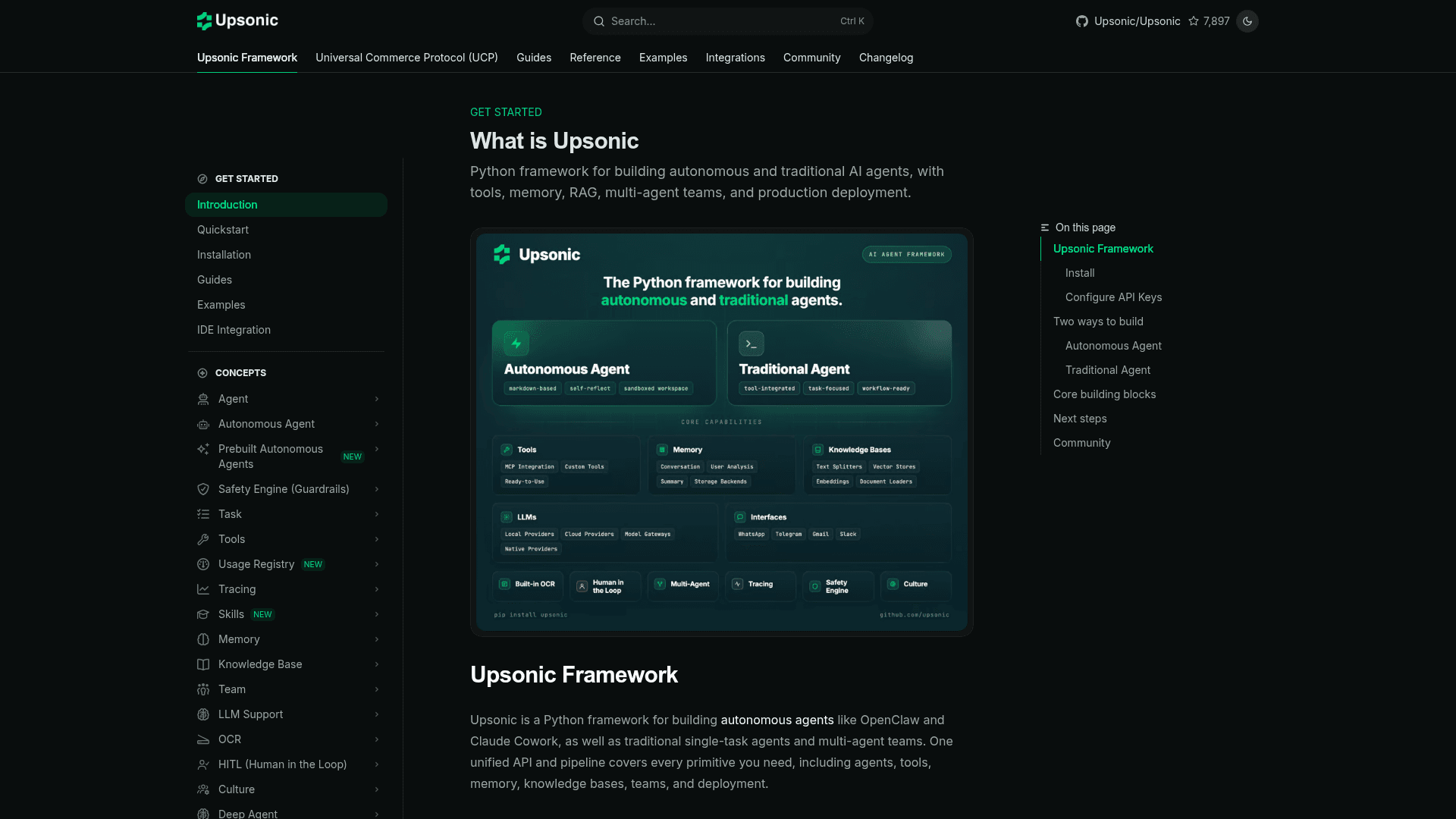
Upsonic provides a unified Python API for constructing AI agents at two levels of autonomy: an Autonomous Agent mode for open-ended, multi-step work with sandboxed file and shell access, and a Traditional Agent mode for structured, tool-driven tasks with defined input/output contracts. Both modes share the same underlying primitives — tools, memory, knowledge bases, teams, and deployment — so developers can mix and match patterns within a single project. The framework is installable via pip install upsonic or uv pip install upsonic and integrates directly with IDE tools like Cursor, VSCode, and Windsurf through a docs URL.
Core Building Blocks
Upsonic ships a broad set of first-class primitives documented at docs.upsonic.ai:
- Tools: Function tools via
@tooldecorator, full MCP (Model Context Protocol) support, and ready-to-use integrations including Tavily, Firecrawl, E2B, and YFinance. - Memory: Conversation, focus, and summary memory with pluggable backends — SQLite, Postgres, Redis, MongoDB, and Mem0.
- Knowledge Base (RAG): End-to-end retrieval-augmented generation with document loaders, text splitters, 7+ embedding providers, and vector stores including Qdrant, Pinecone, Chroma, pgvector, and Weaviate.
- Teams: Multi-agent coordination in Sequential, Coordinate, or Route modes.
- Skills: Reusable agent capabilities loadable from local paths, URLs, or GitHub.
- OCR: Unified interface across EasyOCR, Tesseract, PaddleOCR, RapidOCR, and DeepSeek OCR.
- HITL: Human-in-the-loop support for confirmations, user input, and durable execution pauses.
- Safety Engine: Optional guardrails with prebuilt privacy, financial, security, and content policies.
- Tracing: First-class tracing with Langfuse and PromptLayer.
LLM Provider Support
Upsonic supports 30+ LLM providers configured via environment variables in a .env file. The documented list includes OpenAI, Anthropic, Google, AWS Bedrock, Azure, Ollama, vLLM, Groq, and OpenRouter. This breadth means teams can swap models without changing agent code, and local inference via Ollama is supported out of the box.
Autonomous Agent Architecture
The Autonomous Agent primitive is designed for open-ended, multi-step work. All file and shell operations are restricted to a declared workspace path; path traversal and dangerous commands are blocked at the framework level. For fully isolated cloud execution, the docs describe plugging in an E2B sandbox provider. The framework also ships Prebuilt Autonomous Agents — community-contributed agents that package a skill, system prompt, and first message, enabling install-to-running in seconds. The collection is open to contributions via pull request.
Update: v0.77.3
The latest published release is v0.77.3, released on May 19, 2026. The repository was last pushed to on June 18, 2026, indicating active development. Recent additions highlighted in the docs include Prebuilt Autonomous Agents, a Usage Registry, and Skills — all marked as NEW in the navigation. The changelog is maintained at docs.upsonic.ai/changelog. The GitHub topics list ucp (Universal Commerce Protocol) and openclaw, pointing to higher-level product layers being built on top of the core framework.
Community Discussions
Be the first to start a conversation about Upsonic
Share your experience with Upsonic, ask questions, or help others learn from your insights.
Pricing
Open Source
Full framework available under the MIT License at no cost.
- Autonomous and Traditional Agent primitives
- MCP tool support
- Memory with pluggable backends
- RAG with multiple vector stores
- Multi-agent teams
Capabilities
Key Features
- Autonomous Agent mode with sandboxed file and shell operations
- Traditional Agent mode for structured tool-driven tasks
- MCP (Model Context Protocol) tool support
- @tool decorator for custom function tools
- Conversation, focus, and summary memory
- Pluggable memory backends: SQLite, Postgres, Redis, MongoDB, Mem0
- End-to-end RAG with document loaders and vector stores
- Multi-agent teams with Sequential, Coordinate, and Route modes
- Reusable Skills loadable from local paths, URLs, or GitHub
- Unified OCR interface (EasyOCR, Tesseract, PaddleOCR, RapidOCR, DeepSeek)
- Human-in-the-loop (HITL) support
- Safety Engine with prebuilt guardrail policies
- Tracing with Langfuse and PromptLayer
- 30+ LLM provider support via environment variables
- Prebuilt Autonomous Agents contributed by the community
- E2B sandbox integration for isolated cloud execution
- IDE integration via llms-full.txt for Cursor, VSCode, Windsurf
- CLI for agent project initialization and API startup
- Structured response schemas for Traditional Agents
- Evals and simulation support
Integrations
Demo Video