
Velane
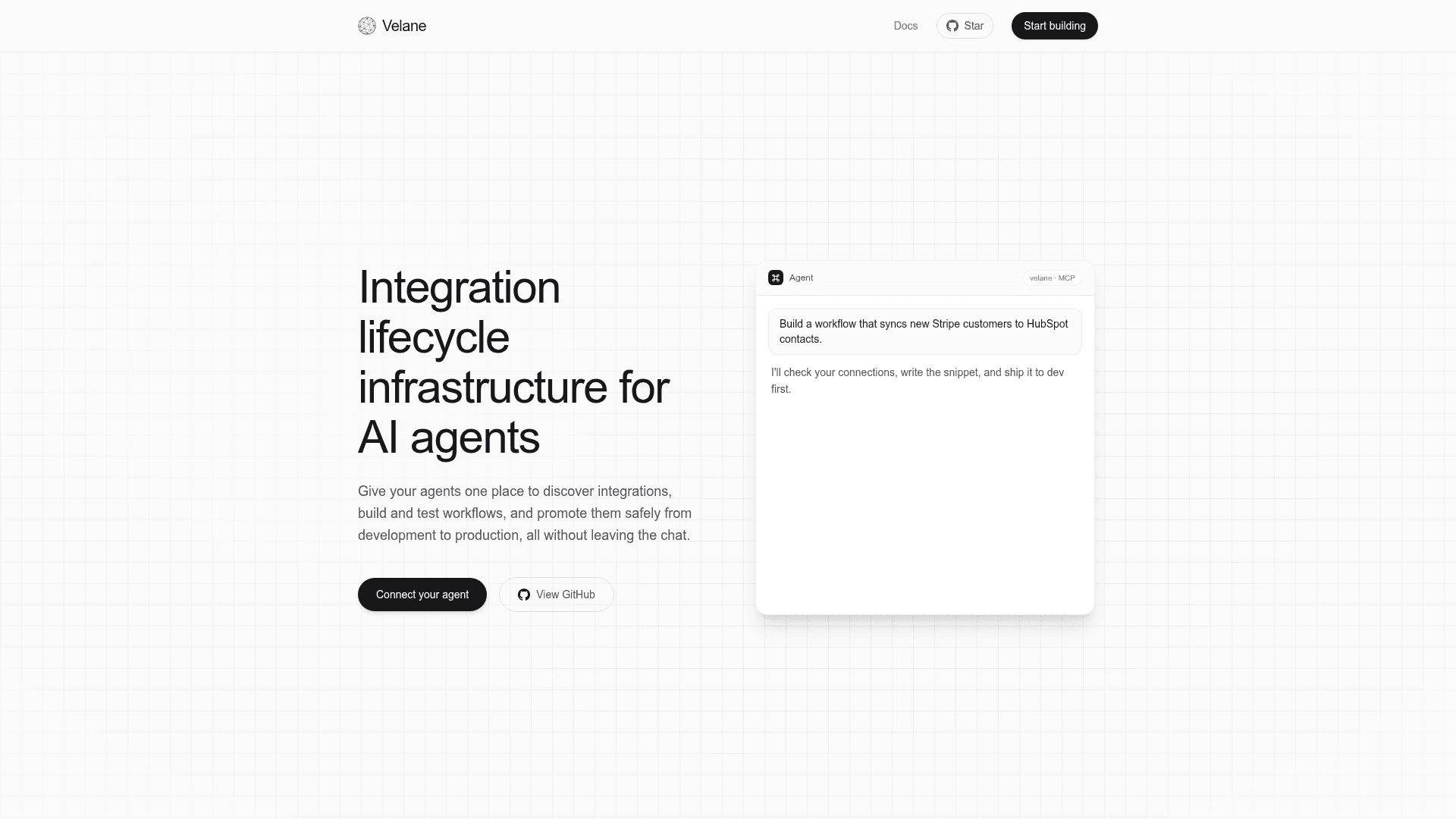
Integration lifecycle infrastructure for AI agents — 800+ OAuth integrations, sandboxed Bun/Python execution, and a full dev-to-prod deployment pipeline managed via MCP.
At a Glance
For personal projects and exploration.
Engagement
Available On
Alternatives
Listed Jul 2026
About Velane
Velane is integration lifecycle infrastructure built specifically for AI agents. It gives agents a single MCP connection to discover OAuth-connected accounts, write and test Bun or Python workflow snippets, and promote them through dev, staging, and production environments — all without leaving the chat window. The project is open source under AGPL-3.0, with a hosted cloud option and self-hosting support via Docker Compose or EKS.
What It Is
Velane sits between an AI coding agent (such as Cursor or Claude Code) and the external APIs that agent needs to call. Rather than embedding credentials in code or wiring up OAuth flows manually, the agent calls Velane's MCP tools to discover connected accounts, fetch live API docs, write a snippet, run it in an isolated sandbox, read execution logs, fix errors, and finally publish the workflow to a stable HTTP endpoint. The control plane is written in Go; snippets execute in ephemeral Bun or Python runtimes backed by Redis for queuing and ClickHouse for metrics.
Architecture
Velane's architecture separates a Go-based control plane from an executor pool:
- Control plane — chi router, pgx/v5, JWT and API-key auth, async worker, observability pipeline, and an OAuth proxy backed by Nango (800+ providers)
- Executor pool — isolated Bun (:8081) and Python (:8082) processes; optional VM-boundary isolation via AWS Firecracker (requires KVM)
- Storage layer — Postgres for state, Redis for the queue and warm pool, ClickHouse for per-invocation metrics
- MCP server — exposes
list_connections,get_logs,publish_snippet, and related tools so any MCP-compatible agent can manage the full lifecycle
Each invocation runs in an ephemeral sandbox with AES-256-GCM encrypted secrets injected as environment variables and an egress policy (per-tenant IP/CIDR and domain blocklist) enforced inside the executor.
Workflow: From Chat to Production
The three-step agent workflow the homepage describes:
- Create & Connect — the agent calls
list_connections, fetches live API docs for a provider, then writes Bun or Python code saved as a versioned workflow. - Run & Debug — the agent invokes the workflow on
dev, reads logs viaget_logs, and autonomously fixes errors inside the same chat session. - Promote — once tests pass, the agent calls
publish_snippetwithenv: "prod", producing a versioned, auditable, rollback-ready HTTP endpoint.
Additional deployment features include canary traffic splitting (route X% of prod traffic to a new version), sync/async/streaming invocation modes, git push-to-deploy (commit SHA tagging), and an embeddable white-label dashboard.
Who It's For
Velane targets two audiences the homepage explicitly names:
- Solo developers who want to call external APIs from an AI agent without maintaining OAuth plumbing, credential management, or backend infrastructure.
- Teams that need shared credential stores, environment promotion, invocation audit trails, and role-based access (invoke / manage / admin scopes) across multiple agents.
A CLI (velane login, snippets push, invoke) is also available for developers who prefer terminal-based workflows alongside the MCP interface.
Update: v0.7.17
The latest GitHub release is v0.7.17, published 2026-07-04, with the repository last pushed on 2026-07-27. The project was created in May 2026 and has been releasing actively since then, signaling early but rapid iteration. The GitHub repository carries an OpenSSF Baseline badge and a CI build-and-push workflow, indicating attention to supply-chain security from the start.
Community Discussions
Be the first to start a conversation about Velane
Share your experience with Velane, ask questions, or help others learn from your insights.
Pricing
Free
For personal projects and exploration.
- 500 invocations / month
- Up to 5 workflows
- Shared runtime
- All 800+ integrations
- Community support
Personal / Small Startup
Self-host the full stack under AGPL-3.0. Free forever for personal projects and startups building open-source products.
- Full source code access
- Deploy on your own infra
- OpenTofu configs for EKS included
- Community support via GitHub Issues
- AGPL-3.0 — changes must stay open source
Hobby
For active builders and indie developers.
- 10,000 invocations / month
- Unlimited workflows
- Shared runtime
- All 800+ integrations
- Email support
- 30-day execution log history
Dedicated
For production workloads that need isolation and guarantees.
- Unlimited invocations
- Unlimited workflows
- Dedicated cluster
- All 800+ integrations
- Priority support
- Uptime SLA
- Custom domain
Commercial
Self-host Velane in a proprietary product without the AGPL-3.0 copyleft requirement. Includes a commercial license for your entire organisation.
- Commercial license — no copyleft obligations
- Self-host on your own infra
- Full source code access
- Priority email support
- License covers your entire organisation
Capabilities
Key Features
- 800+ OAuth integrations via Nango
- MCP server for Cursor and Claude Code
- Sandboxed Bun and Python execution runtimes
- Three environments: dev, staging, prod
- Canary traffic splitting
- Versioned workflows with instant rollback
- AES-256-GCM encrypted secrets injected at runtime
- Per-invocation execution logs and metrics
- Egress policy (IP/CIDR and domain blocklist)
- Sync, async, and streaming invocation modes
- Git push-to-deploy with commit SHA tagging
- Embeddable white-label dashboard
- Optional AWS Firecracker VM-boundary isolation
- Role-based access: invoke, manage, admin scopes
- OpenAPI 3.1 contract at /openapi.json
- CLI for snippet push and invocation
- Self-hostable via Docker Compose or EKS (OpenTofu configs included)