
Video Forge
Agent skill toolkit that turns a brief or recording into an editable video using local Remotion and FFmpeg rendering.
At a Glance
Video Forge code is MIT-licensed and free to use, modify and distribute; runs locally with no account or hosted service required.
Engagement
Available On
Listed Oct 2026
About Video Forge
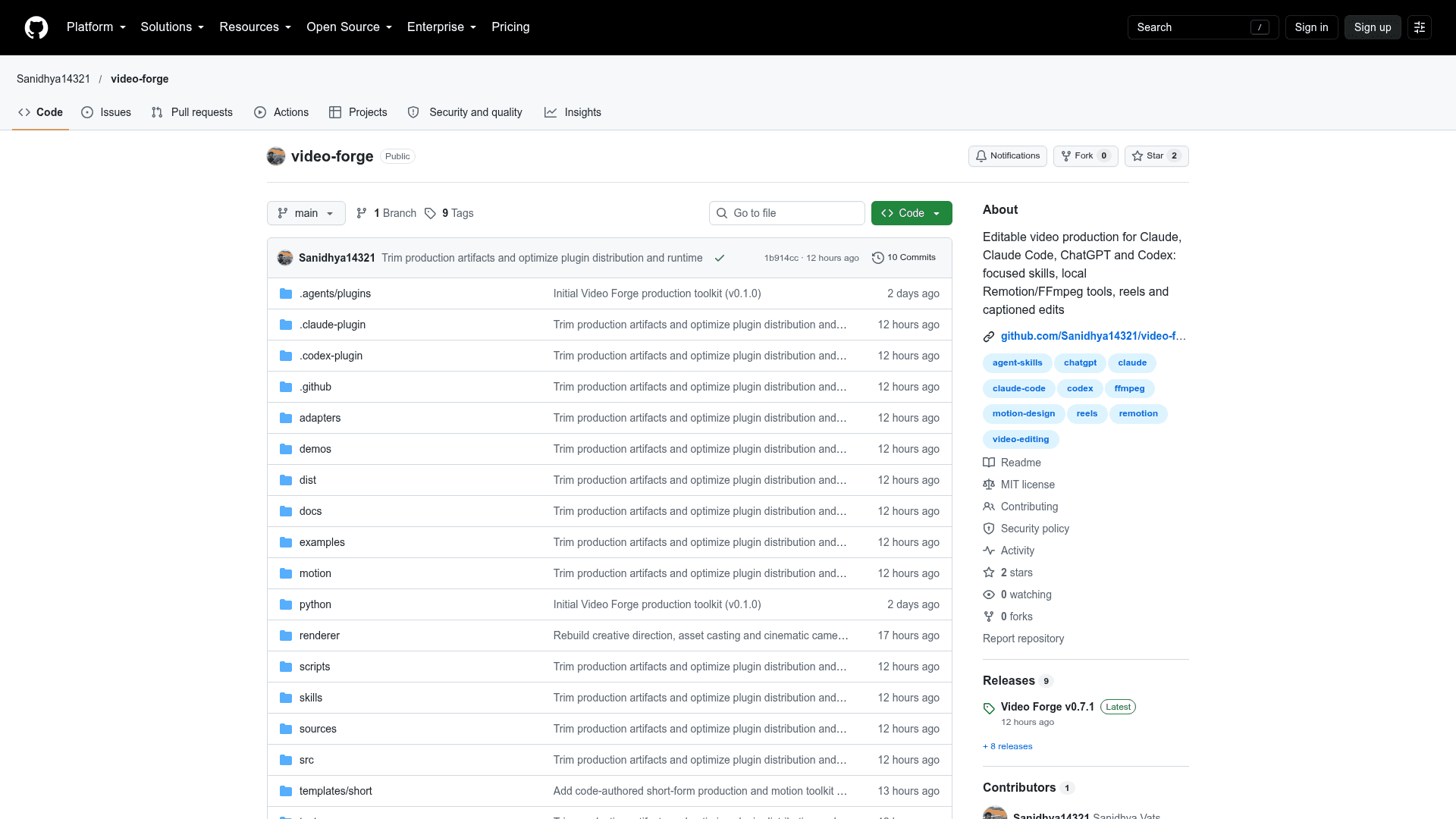
Video Forge is an open-source toolkit from GitHub user Sanidhya14321 for producing editable video from a brief or a recording. A compact directing skill coordinates planning, motion, editing, captions, audio, generation and delivery, backed by local Remotion/FFmpeg execution. It works with Claude Code, Codex, Claude custom skills, ChatGPT and other compatible local agents. The latest release listed is v0.5.1.
What It Is
Video Forge is a set of agent skills plus a local rendering runtime. You describe a video, for example a 30-second launch reel, and the skill picks a visual language and the relevant modules, then renders through the local toolchain. Without an executable environment it delivers the production plan and job rather than labeling an unrendered plan as an MP4.
Workflows and Outputs
The README documents three production workflows: screenshot product demos, supplied-state algorithm explainers, and captioned footage repurposing, plus native short-form reels. It offers twelve motion families in two treatments, abstract minimal or colorful comic/character choreography. Editing supports explicit segment edits and optional threshold-based silence removal, which does not do semantic footage selection. Audio and captions use local voice and transcription, music mixing, measured word highlighting and SRT files. Delivery includes project and renderer snapshots, staged assets and credits, transcripts, captions, thumbnails and MP4 presets with decoding checks.
Hosts and Setup
Codex and Claude Code install as plugins from a marketplace, while Claude chat uses an uploaded custom-skill archive and ChatGPT chat gets a companion for planning and a local render handoff. A standalone archive serves other Agent Skills hosts. Local use needs Node 22+, npm, and first-use network access for pinned dependencies and the browser. The CLI offers doctor, review, preview, run and inspect commands.
Providers and Licensing
Local Kokoro and faster-whisper are supported, along with opt-in budget-gated OpenAI speech and fal adapters. Local production needs no account or credentials. Code is MIT-licensed, while Remotion, model weights and assets retain their own terms.
Community Discussions
Be the first to start a conversation about Video Forge
Share your experience with Video Forge, ask questions, or help others learn from your insights.
Pricing
Open Source (MIT)
Video Forge code is MIT-licensed and free to use, modify and distribute; runs locally with no account or hosted service required.
- Code under MIT License
- Remotion, model weights and assets retain their own terms
- Local production needs no account, credentials, hooks or hosted service
- Paid providers (OpenAI speech/fal adapters) are opt-in external costs
Capabilities
Key Features
- Product demo, algorithm explainer and footage repurposing workflows
- Native short-form reels
- Twelve motion families in minimal and colorful treatments
- Brand-led overlays, browser focus, cursors and CTAs
- Segment edits and optional silence removal
- Local voice, transcription and music mixing
- Measured word-highlight captions and SRT export
- Editable project snapshots, thumbnails and MP4 presets
- CLI with doctor, review, preview, run and inspect
- Optional OpenAI speech and fal adapters