vLLM Semantic Router
A programmable, open-source routing layer for building Mixture-of-Models systems across heterogeneous LLM infrastructure, selecting the right model path per request based on signals, preferences, and policies.
At a Glance
Fully open-source under Apache License 2.0. Free to use, modify, and distribute.
Engagement
Available On
Alternatives
Listed Sep 2026
About vLLM Semantic Router
vLLM Semantic Router is an open-source, signal-driven routing framework for heterogeneous LLM inference, developed under the vllm-project organization and licensed under Apache 2.0. It enables teams to build Mixture-of-Models systems by evaluating request signals, user preferences, and application policies to select or compose the right model path for each request — without hard-coding routing logic into applications. The project is written primarily in Go, has accumulated over 5,800 GitHub stars, and is actively maintained by contributors from AMD, Microsoft, Red Hat, Delta Electronics, and other organizations.
What It Is
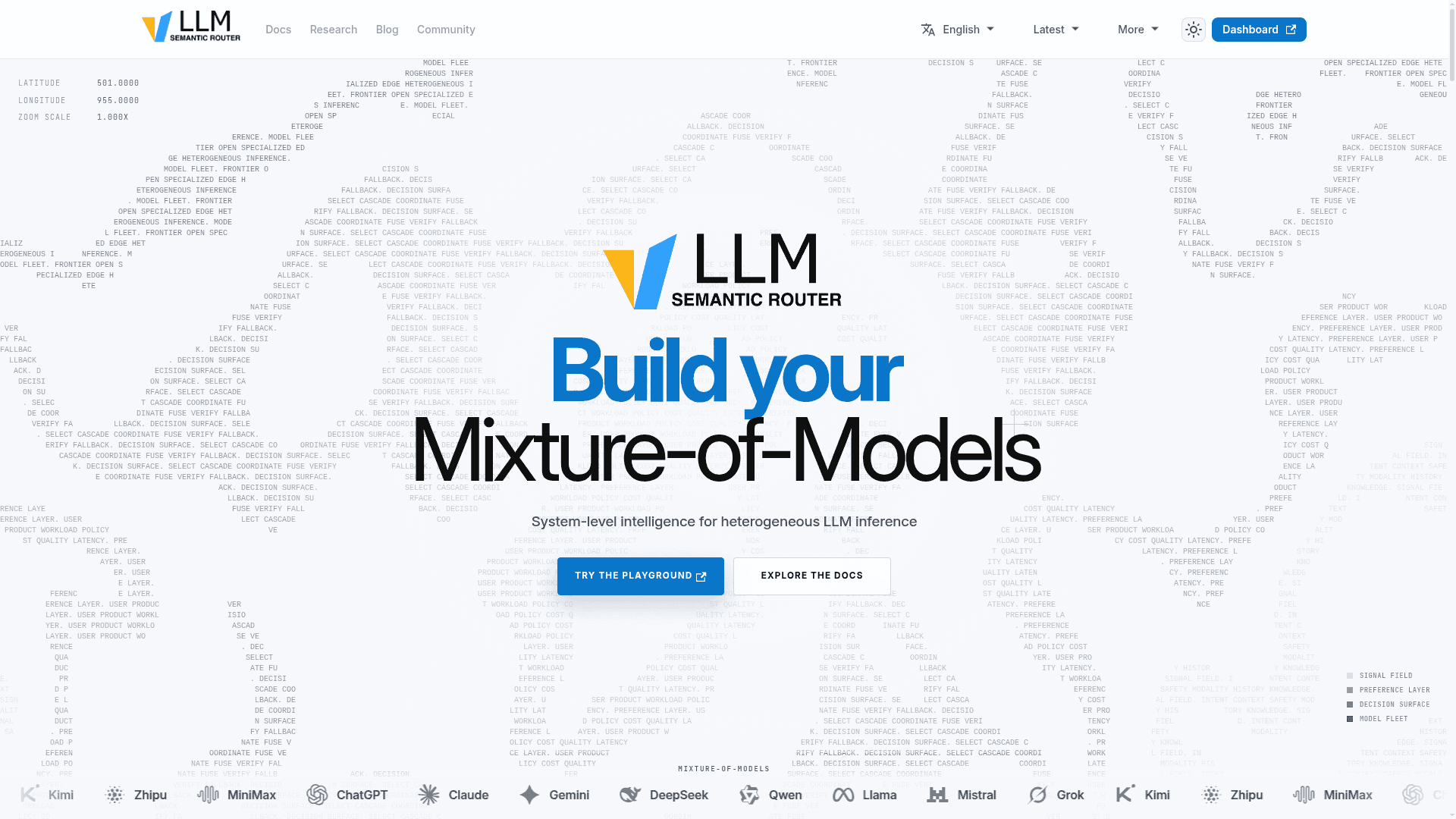
vLLM Semantic Router sits as a programmable routing layer between client applications and a heterogeneous pool of LLM backends — including closed models (Claude, ChatGPT, Gemini), open models (Mistral, DeepSeek, Llama), and hybrid configurations. Rather than sending every request to a single model, it evaluates up to 20 signal families — spanning domain, PII, jailbreak detection, embedding similarity, complexity, history, tool use, and more — then applies a configured recipe policy to select or compose the best model path. The result is a single OpenAI-compatible API surface that abstracts the entire model fleet.
Architecture: Signal → Decision → Model Path
The router maps each incoming request through a four-layer pipeline inspired by Shannon's communication theory:
- Signal Extraction: 20 signal families covering request context, safety, intent, preference, and system state
- Decision Engine: 11 selection algorithms (e.g.,
router_dcfor embedding-similarity matching,multi_factorfor balancing quality/latency/cost/load) plus 5 loopers for cascading, escalating, or fusing across models - Policy & Guardrails: Inline PII and jailbreak classifiers, authorization-aware routing, per-route rate limits, and hard constraints for data residency and locality — ineligible paths are removed before ranking runs
- Observability: OpenTelemetry-ready metrics export, replay-enabled routing records with
x-vsr-replay-idresponse headers, and dashboard analytics
Deployment Options
The router supports four primary deployment paths:
- Envoy ExtProc — production gateway filter
- Gateway API — Agentgateway integration for Kubernetes
- K8s Operator — declarative fleet routing
- Local vllm-sr — single-line install for dev and laptop workflows (
curl -fsSL https://vllm-sr.ai/install.sh | bash -s -- --channel stable)
An online playground is available at app.vllm-sr.ai for hands-on exploration without local setup.
Research Foundation
The project publishes actively across routing, safety, multimodality, and systems design. Notable papers include the position paper introducing the signal-driven decision routing framework for Mixture-of-Modality deployments (arXiv 2603.04444), the Workload-Router-Pool (WRP) vision paper (arXiv 2603.21354), and work on 98× faster routing latency using Flash Attention and prompt compression (arXiv 2603.12646). Additional papers cover span-level hallucination detection, adaptive VLM routing for computer-use agents, token-budget-aware pool routing, and IETF drafts for the Semantic Inference Routing Protocol (SIRP). The project lists 19 research papers in total across its publications page.
Update: v0.3 Themis Release
The latest stable release is v0.3.0 "Themis", published on June 5, 2026, described by the project blog as moving "from signals to stateful production routing." Prior major releases include v0.2 "Athena" (March 2026) and v0.1 "Iris" (January 2026). A July 2026 blog post announced a new chapter focused on Mixture-of-Models systems. The project also publishes a Micro-Agent capability (June 2026) enabling router-side model collaboration that the project claims can match or exceed frontier model benchmarks on LiveCodeBench (92.6) and GPQA-Diamond (96.0) by coordinating closed and open model pools behind a single API call.
Community Discussions
Be the first to start a conversation about vLLM Semantic Router
Share your experience with vLLM Semantic Router, ask questions, or help others learn from your insights.
Pricing
Open Source
Fully open-source under Apache License 2.0. Free to use, modify, and distribute.
- Signal-driven routing across 20 signal families
- Mixture-of-Models support
- OpenAI-compatible API surface
- 11 selection algorithms and 5 loopers
- Inline PII and jailbreak classifiers
Capabilities
Key Features
- Signal-driven routing across 20 signal families (domain, PII, jailbreak, embedding, complexity, preference, history, tool use, and more)
- Mixture-of-Models support: route across closed, open, and hybrid model pools
- OpenAI-compatible API surface for all backends
- 11 selection algorithms and 5 loopers for composing and retrying model calls
- Inline PII and jailbreak classifiers with block/steer actions
- Authorization-aware routing with identity and tenant policy binding
- Data residency and locality hard constraints — ineligible paths removed before ranking
- Per-route plugin policies for cache, memory, RAG, and hallucination checks
- Observability with OpenTelemetry export and replay-enabled routing records
- Envoy ExtProc, Gateway API, Kubernetes Operator, and local deployment modes
- Recipe-based routing policy: compose signal families into deployment-specific model paths
- Cost-aware selection using pricing metadata and token-budget estimation
- Cascade and fusion loopers for multi-model collaboration
- Online playground at app.vllm-sr.ai
- Single-line install via curl script
Integrations
Demo Video