
Voice Clone Lab
Locally fine-tune Qwen3-TTS on your own voice from a few minutes of audio and generate speech via CLI or web UI — fully on-device with no data leaving your machine.
At a Glance
Fully free and open-source under Apache-2.0. Self-host on your own Linux GPU machine.
Engagement
Available On
Alternatives
Listed Jul 2026
About Voice Clone Lab
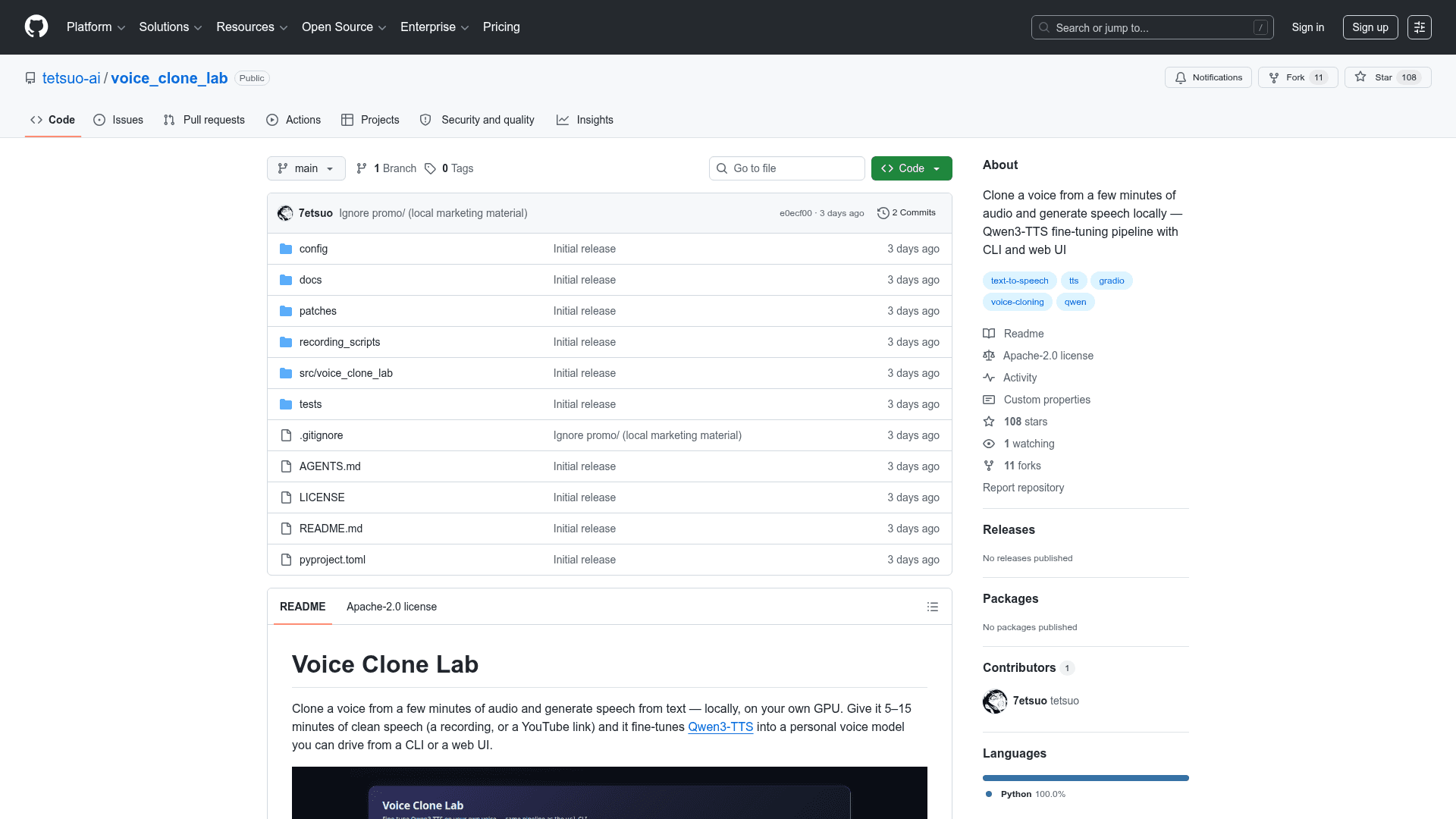
Voice Clone Lab is an open-source Python toolkit by tetsuo-ai that lets you clone a voice from 5–15 minutes of clean audio and generate speech from text entirely on your own GPU. It wraps Alibaba's Qwen3-TTS model in a guided fine-tuning pipeline accessible through both a command-line interface and a Gradio web UI, with all audio, transcripts, and trained models staying local.
What It Is
Voice Clone Lab is a local voice-cloning and text-to-speech fine-tuning pipeline built on top of Qwen3-TTS (Apache-2.0). It accepts audio from a file upload, microphone recording, or a YouTube/URL link, then walks the user through extraction, cleaning, splitting, transcription, proofreading, and training — producing a personal voice model organized by speaker name. A zero-shot mode lets users try a voice instantly from a single clip without any training.
How the Pipeline Works
The tool structures the workflow into discrete, repeatable steps that can be run individually or chained together:
- Data ingestion:
vcl run --speaker <name> --input <file or URL>handles extraction, cleaning, splitting, and transcription in one command. - Transcript review: An editable TSV file lets users fix transcription errors before training — the README notes bad transcripts are the primary cause of pronunciation problems.
- Training:
vcl prepareadds Qwen audio codes;vcl trainfine-tunes the model. The web UI exposes hyperparameter controls and a live training log. - Generation:
vcl generateproduces WAV output from the newest checkpoint; a--zeroshotflag enables instant cloning from a reference clip; a--specflag supports batch generation from a JSON list. - Organization: All data lives under
data/voices/<name>/andoutputs/checkpoints/<name>/, with epoch snapshots kept independently so users can compare and select the best-sounding checkpoint.
Hardware Requirements and Tradeoffs
The project targets Linux machines with NVIDIA CUDA GPUs. Training requires a minimum of 24 GB VRAM (RTX 3090/4090 class at batch size 2), while generation-only use works on cards with around 8 GB VRAM. Python 3.10 or later is required, along with ffmpeg and git. Optional extras — WhisperX for word-level timestamps, yt-dlp for URL sources, WebRTC VAD for better audio chunking, and mild denoising — are installable as pip extras. FlashAttention is optional; the tool falls back to sdpa automatically.
Architecture and Dependencies
Voice Clone Lab is built on Qwen3-TTS (Apache-2.0) by Alibaba's Qwen team, with faster-whisper for transcription, Gradio for the web UI, and yt-dlp for URL-based audio sourcing. The repository applies a vendor patch to Qwen3-TTS via a patches/ directory managed by vcl setup. The base model weights (~4 GB) are downloaded during setup. Source layout follows a standard Python package structure under src/voice_clone_lab/, with a single config/default.yaml as the configuration source.
Current Status
The repository was created on July 18, 2026, and last updated on July 19, 2026, indicating it is a very recently published project. It is licensed under Apache-2.0 and hosted publicly on GitHub under the tetsuo-ai organization. The project includes a CPU-only test suite and an AGENTS.md conventions document, suggesting active development infrastructure is in place from the outset.
Community Discussions
Be the first to start a conversation about Voice Clone Lab
Share your experience with Voice Clone Lab, ask questions, or help others learn from your insights.
Pricing
Open Source
Fully free and open-source under Apache-2.0. Self-host on your own Linux GPU machine.
- Full CLI and web UI pipeline
- Qwen3-TTS fine-tuning
- Zero-shot voice cloning
- Batch generation
- All data stays local
Capabilities
Key Features
- Clone a voice from 5–15 minutes of audio
- Fine-tune Qwen3-TTS locally on your own GPU
- CLI and Gradio web UI interfaces
- Audio ingestion from file upload, microphone, or YouTube/URL link
- Guided pipeline: extract, clean, split, transcribe, proofread, train
- Editable transcript review via TSV before training
- Zero-shot voice cloning from a single reference clip
- Batch speech generation from JSON spec file
- Speaker-organized data and checkpoint management
- Epoch snapshot comparison for best checkpoint selection
- Fully local — no data leaves your machine
- Optional WhisperX, yt-dlp, WebRTC VAD, and denoising extras