
VoxCPM
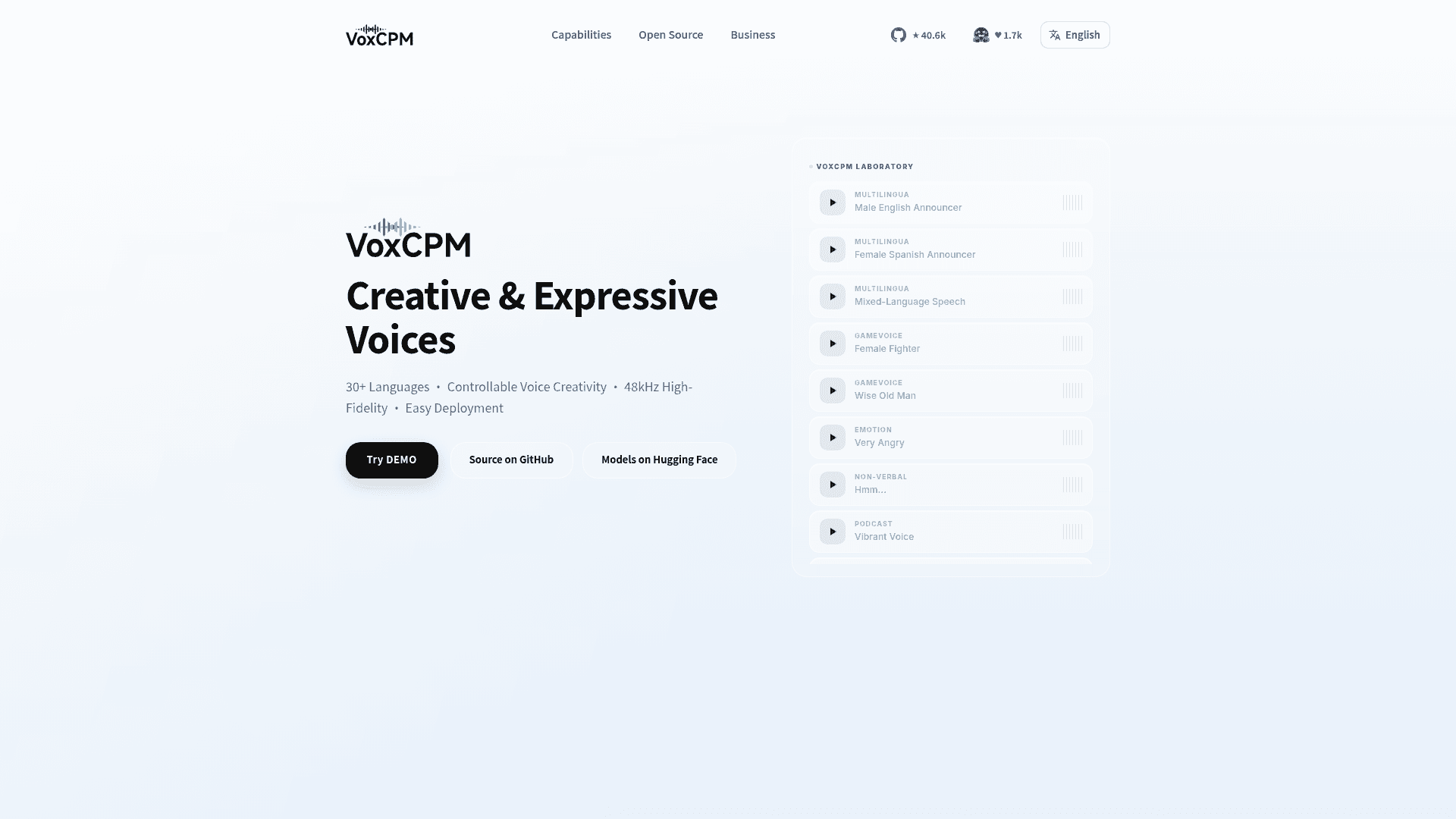
Open-source tokenizer-free text-to-speech model supporting 30 languages, voice design, voice cloning, and 48kHz audio output.
At a Glance
VoxCPM2 model weights and code released under the Apache-2.0 license, free for commercial use.
Engagement
Available On
Alternatives
Listed Nov 2026
About VoxCPM
VoxCPM is an open-source text-to-speech system from OpenBMB, with the website copyright held by Modelbest Technology Co., Ltd. The current release, VoxCPM2, is a 2B-parameter model that generates multilingual speech, designs voices from text descriptions, and clones voices from short reference clips, outputting 48kHz audio. The code and weights are released under the Apache-2.0 license.
What It Is
VoxCPM is a tokenizer-free TTS model. Instead of discrete speech tokens, it uses a diffusion autoregressive architecture to generate continuous speech representations. VoxCPM2 is built on a MiniCPM-4 backbone, and the README says it was trained on over 2 million hours of multilingual speech data. It accepts text in any of 30 supported languages without a language tag, plus several Chinese dialects.
Voice Creation and Cloning
There are three main modes. Voice Design creates a new voice from a natural-language description placed in parentheses at the start of the text, with no reference audio. Controllable Cloning copies the timbre of a short reference clip while allowing style guidance for emotion, pace, and expression. Ultimate Cloning takes a reference clip plus its transcript and continues from it to preserve timbre, rhythm, emotion, and style. The README notes that Voice Design and Controllable Cloning results can vary between runs, so several generations may be needed.
Running and Deploying It
The model installs with pip and is used through a Python API (including streaming), a CLI with design, clone, and batch commands, and a local web demo. For serving, the README points to Nano-vLLM-VoxCPM and vLLM-Omni, which exposes an OpenAI-compatible speech endpoint, and to llama.cpp-omni for on-device GGUF inference on CPU, Metal, CUDA, and Vulkan. The README lists Python 3.10 to below 3.13, PyTorch 2.5.0 or later, and CUDA 12.0 or later as requirements, and about 8 GB of VRAM for VoxCPM2.
Fine-tuning and Ecosystem
Full fine-tuning and LoRA fine-tuning are supported, and the README says 5 to 10 minutes of audio can adapt the model to a speaker, language, or domain. A WebUI is provided for training and inference. Community projects such as ComfyUI nodes, ONNX export, and Rust and C++ ports are listed but are not officially maintained by OpenBMB.
Current Status
The README lists VoxCPM2 as the latest release, released in April 2026, with VoxCPM1.5 as stable and VoxCPM-0.5B as legacy. The latest GitHub release is v2.0.3, published 2026-05-11. The README forbids using voice cloning for impersonation, fraud, or disinformation.
Community Discussions
Be the first to start a conversation about VoxCPM
Share your experience with VoxCPM, ask questions, or help others learn from your insights.
Pricing
Open Source
VoxCPM2 model weights and code released under the Apache-2.0 license, free for commercial use.
- Weights and code under Apache-2.0 license
- Free for commercial use
- 30 languages
- Voice Design and voice cloning
- 48kHz audio output
Capabilities
Key Features
- Tokenizer-free diffusion autoregressive TTS
- 30-language multilingual synthesis without language tags
- Voice Design from natural-language descriptions
- Controllable voice cloning with style guidance
- Ultimate cloning with reference audio and transcript
- 48kHz audio output
- Real-time streaming generation
- Python API, CLI, and web demo
- Full fine-tuning and LoRA fine-tuning
- Optional word and character timestamps
- Batch processing via CLI
- Apache-2.0 licensed weights and code