
WeKnora
Open-source, LLM-powered enterprise knowledge framework by Tencent that turns raw documents into a queryable RAG system, an autonomous reasoning agent, and a self-maintaining Wiki.
At a Glance
About WeKnora
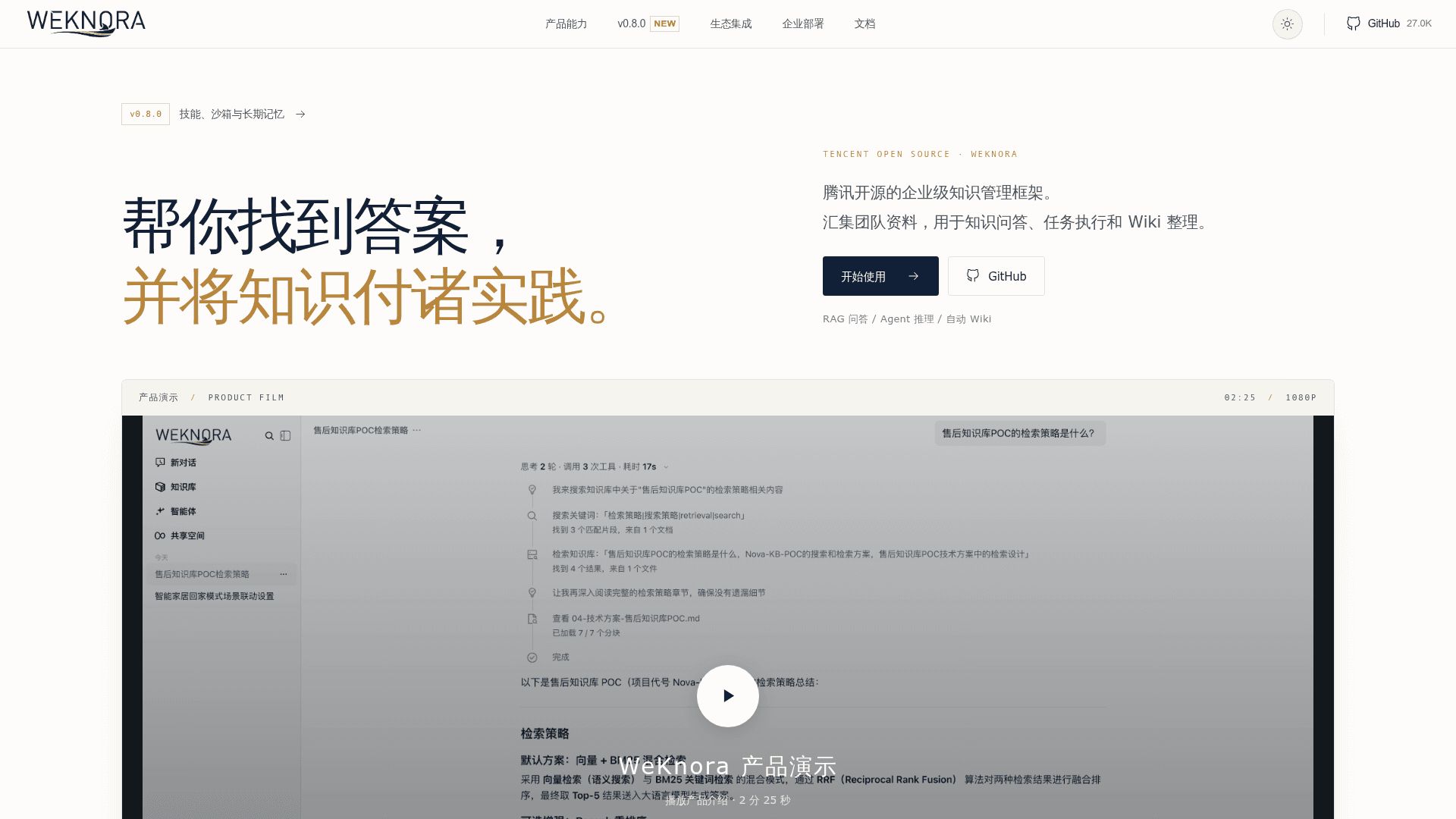
WeKnora is an open-source enterprise knowledge management framework released by Tencent under the MIT License. It combines RAG-based question answering, a ReAct autonomous agent, and an auto-generated Wiki into a single self-hostable platform. The project is written primarily in Go, supports private and offline deployment via Docker, Kubernetes, and Helm, and integrates with more than 20 LLM providers.
What It Is
WeKnora sits in the category of LLM-powered knowledge platforms designed for teams that need to make internal documents queryable, actionable, and continuously organized. Its three core modes share a single knowledge base: RAG Q&A for fast semantic and keyword retrieval with source citations, a ReAct Agent that autonomously orchestrates retrieval, MCP tools, skill sandboxes, and web search to handle multi-step tasks, and Wiki Mode in which agents distill raw documents into interlinked Markdown pages with a knowledge graph, revision history, and one-click rollback. The framework handles 10+ document formats including PDF, Word, Excel, images, EPUB, XMind, and more.
Architecture and Deployment Model
WeKnora is fully modular: every component — LLM provider, vector database, object storage backend, and document parser — is swappable. Deployment options include local Docker Compose, Kubernetes with Helm charts, and optional Docker Compose profiles for Neo4j (knowledge graph), MinIO (object storage), and Langfuse (tracing). The backend API runs on port 8080 and the Web UI on port 80 by default. A weknora CLI provides agent-first JSON output for headless and CI use, and an MCP Server (official PyPI package tencent-weknora-mcp) exposes 29 tools over stdio, SSE, and HTTP transports.
Integrations and Ecosystem
The platform connects to a wide range of external systems:
- Data sources: Feishu wiki, Feishu Drive, GitLab, Tencent IMA, Notion, Yuque, DingTalk Docs, RSS
- IM channels: WeCom, Feishu, Lark, QQBot, Slack, Telegram, DingTalk, Mattermost, WeChat, Yunzhijia
- LLM providers: OpenAI, Azure OpenAI, Anthropic, DeepSeek, Qwen, Zhipu, Hunyuan, Doubao, Gemini, MiniMax, NVIDIA, LiteLLM, Ollama, and more
- Vector databases: PostgreSQL (pgvector), Elasticsearch, OpenSearch, Milvus, Weaviate, Qdrant, Apache Doris, Tencent VectorDB
- Object storage: Local, MinIO, AWS S3 (IAM Role/IRSA), Volcengine TOS, Alibaba Cloud OSS, Huawei OBS, and others
- Web search: DuckDuckGo, Bing, Google, Tavily, Baidu, SearXNG, Exa, Metaso, and more
A Chrome Extension lets users capture web content directly into a knowledge base, and a WeChat Mini Program provides a lightweight mobile client.
Enterprise Access Control and Observability
WeKnora includes a 4-tier workspace RBAC model (Owner / Admin / Contributor / Viewer) with per-knowledge-base resource ownership, per-workspace audit logs, invite-only workspaces, and scoped API keys with capability-level grants. Security features include AES-256-GCM at-rest encryption for API keys and credentials, gRPC TLS between app and document reader, Redis TLS, SSRF-safe HTTP clients, and OIDC ID-token JWKS verification. Observability is provided through Langfuse integration for ReAct loop tracing, token tracking, and pipeline tracing, plus a built-in runtime task-queue dashboard for queue depth, per-model concurrency, and failed-task inspection.
Update: v0.8.0
Version 0.8.0 was published on September 3, 2026 and is the current release. Key additions include:
- Skill sandbox runtime: session-persistent Docker, E2B, and Cube backends with per-tenant network policy; the local host-process backend was removed
- Tenant skill catalog: install skills from ClawHub, SkillHub, git, or zip; per-sandbox snapshots, live progress, file browse and edit, personal and workspace environment variables
- Cross-session long-term memory: profile, preference, fact, task, and interest memory types with auto-extract, user confirmation, and on-demand
search_memory - In-process anydoc office parser for Word, Excel, and PowerPoint files
- Official DeepSeek Harness plugin (
@wxg-prc-cpg/dsh-weknora) giving coding agents four read-only WeKnora tools - GitLab and Tencent IMA data sources, LiteLLM support, Exa and Metaso web search, XMind parsing, chat artifacts, and context compaction
The GitHub repository shows 27,000+ stars and active development with frequent releases across the v0.3–v0.8 series since the project was created in July 2025.
Community Discussions
Be the first to start a conversation about WeKnora
Share your experience with WeKnora, ask questions, or help others learn from your insights.
Pricing
Open Source
Fully open-source under MIT License, free to self-host with all features included.
- RAG-based Q&A with hybrid retrieval
- ReAct autonomous agent
- Auto-generated Wiki with knowledge graph
- Cross-session long-term memory
- Skill catalog with sandbox backends
Capabilities
Key Features
- RAG-based Q&A with hybrid semantic and keyword retrieval
- ReAct autonomous agent with multi-step reasoning
- Auto-generated Wiki with knowledge graph and revision history
- Cross-session long-term memory (profile, preference, fact, task, interest)
- Skill catalog with Docker, E2B, and Cube sandbox backends
- MCP tool integration with OAuth2 support
- 10+ document format support (PDF, Word, Excel, images, XMind, EPUB, etc.)
- Multi-source data ingestion (Feishu, GitLab, Notion, Yuque, RSS, and more)
- IM channel integration (WeCom, Slack, Telegram, DingTalk, and more)
- 20+ LLM provider integrations including OpenAI, DeepSeek, Ollama, LiteLLM
- Multiple vector database backends (pgvector, Milvus, Qdrant, Weaviate, etc.)
- Multiple object storage backends (S3, MinIO, OSS, OBS, etc.)
- 4-tier workspace RBAC with per-KB ownership and audit logs
- Scoped API keys with capability-level grants
- Langfuse observability for agent tracing and token tracking
- Runtime task-queue dashboard with worker-pool governance
- Chrome Extension for web content capture
- WeChat Mini Program mobile client
- CLI with agent-first JSON output and MCP serve mode
- Website embed widget for publishing agents to external sites
- Chunk editing with revision history and automatic reindexing
- Folder tree view preserving upload directory structure
- OIDC integration and AES-256-GCM credential encryption
- Docker, Kubernetes, and Helm deployment support
- Web search integration (DuckDuckGo, Bing, Google, Tavily, Exa, and more)