
Wire Framework
A Claude Code plugin and Gemini CLI extension that encodes analytics engineering methodology as workflow specifications for structured data platform delivery.
At a Glance
About Wire Framework
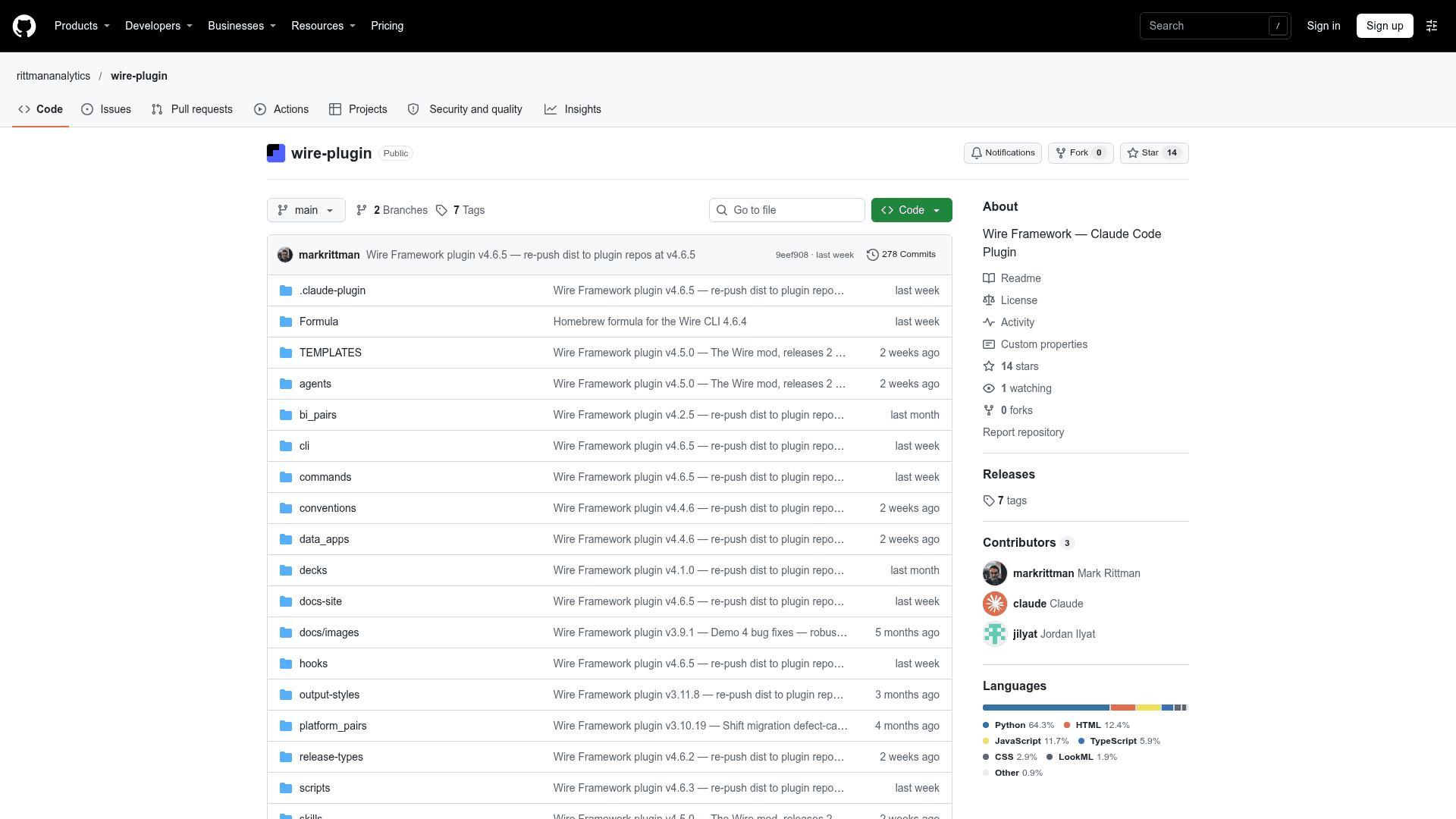
Wire Framework is a structured delivery system for data platform engagements from Rittman Analytics, distributed as a Claude Code plugin and a Gemini CLI extension. It encodes analytics engineering methodology as workflow specifications that the AI reads before generating anything, so output follows consistent patterns, traces back to requirements and can be validated automatically. The README describes version 4.6.5.
What It Is
Wire is a command-driven framework for consultants and analytics engineers delivering data projects. Rather than prompting an AI to write a dbt model and hoping it follows conventions, a user runs a command such as /wire:dbt-generate. The AI then receives a specification that names the upstream design decisions to read, the naming patterns and tests to apply, and how to update the project status tracker.
Engagements are stored in a .wire/ folder with a two-tier layout: engagement-level context (client objectives, SoW, call notes) and individual scoped releases, each with its own status file and execution log.
Generate, Validate, Review
Every artifact follows a three-step lifecycle. Generate reads upstream artifacts and applies templates; validate runs automated checks and produces a PASS/FAIL report; review presents the artifact for stakeholder sign-off, surfacing meeting transcript context and document-store comments. Approval gates the next phase. A precondition gate blocks commands on unmet prerequisites, and overriding requires a recorded name and reason.
Release Types and Commands
The README lists 12 release types, including Shape Up and SOP discovery, full platform, pipeline-only, dbt development, dashboard extension, dashboard-first, enablement, agentic data stack, platform migration (BigQuery and Snowflake), droughty schema introspection, and custom releases derived from a SoW. On Claude Code, users can describe what they want and Wire works out the command, stopping at review gates; a manual mode restores typed-command behaviour. An autopilot mode runs the lifecycle end to end, with self-review at review gates and pauses at safety gates.
Skills, Agents and MCP Connections
Skills activate automatically during ad-hoc work, covering dbt, LookML, Dagster, Python, Fivetran, Airbyte, Coupler.io, RudderStack, Segment, Snowflake, Hightouch, BigQuery, Cloud Run and gcloud, plus bundled Amplitude product-analytics skills. Thirteen specialist subagents are dispatched on generate and validate commands. Optional MCP servers connect Jira, Confluence, Linear, Notion, Fathom, Context7 and several data tools.
Setup Path
Prerequisites are Claude Code or Gemini CLI, plus Git. Install the plugin from the marketplace, reload plugins, then run /wire:new to create an engagement. The code is source-available under the Functional Source License with an Apache 2.0 future license; its Competing Use definition restricts using Wire as a delivery methodology for third-party consulting.
Community Discussions
Be the first to start a conversation about Wire Framework
Share your experience with Wire Framework, ask questions, or help others learn from your insights.
Pricing
Commercial license (Competing Use)
Separate commercial licence required from the licensor for Competing Use (using Wire to deliver consulting services to third parties). Price not published; contact the licensor.
- Required for Competing Use of the Licensed Work
- Functional Source License 1.1 with Apache 2.0 future license on 2028-05-04
Capabilities
Key Features
- Slash commands covering the full delivery lifecycle
- 12 release types for common engagement shapes
- Generate / validate / review lifecycle for every artifact
- Precondition gate with recorded overrides
- Directed mode that maps plain-language requests to commands
- Autopilot mode for end-to-end delivery
- Status reconciliation with /wire:status-sync
- Business rules discovery and modality model input
- 13 specialist subagents with parallel delegation
- Auto-activating development skills for dbt, LookML, Dagster, and more
- Bundled Amplitude product analytics skills
- Jira, Linear, Confluence, Notion and Fathom integration