
WorldX
Open-source tool that turns a one-sentence prompt into an AI-driven pixel world with autonomous characters, memory, and god-mode controls.
At a Glance
Self-hosted WorldX core released under the MIT License. Users supply their own LLM/image model API keys, which are external costs.
Engagement
Available On
Alternatives
Listed Oct 2026
About WorldX
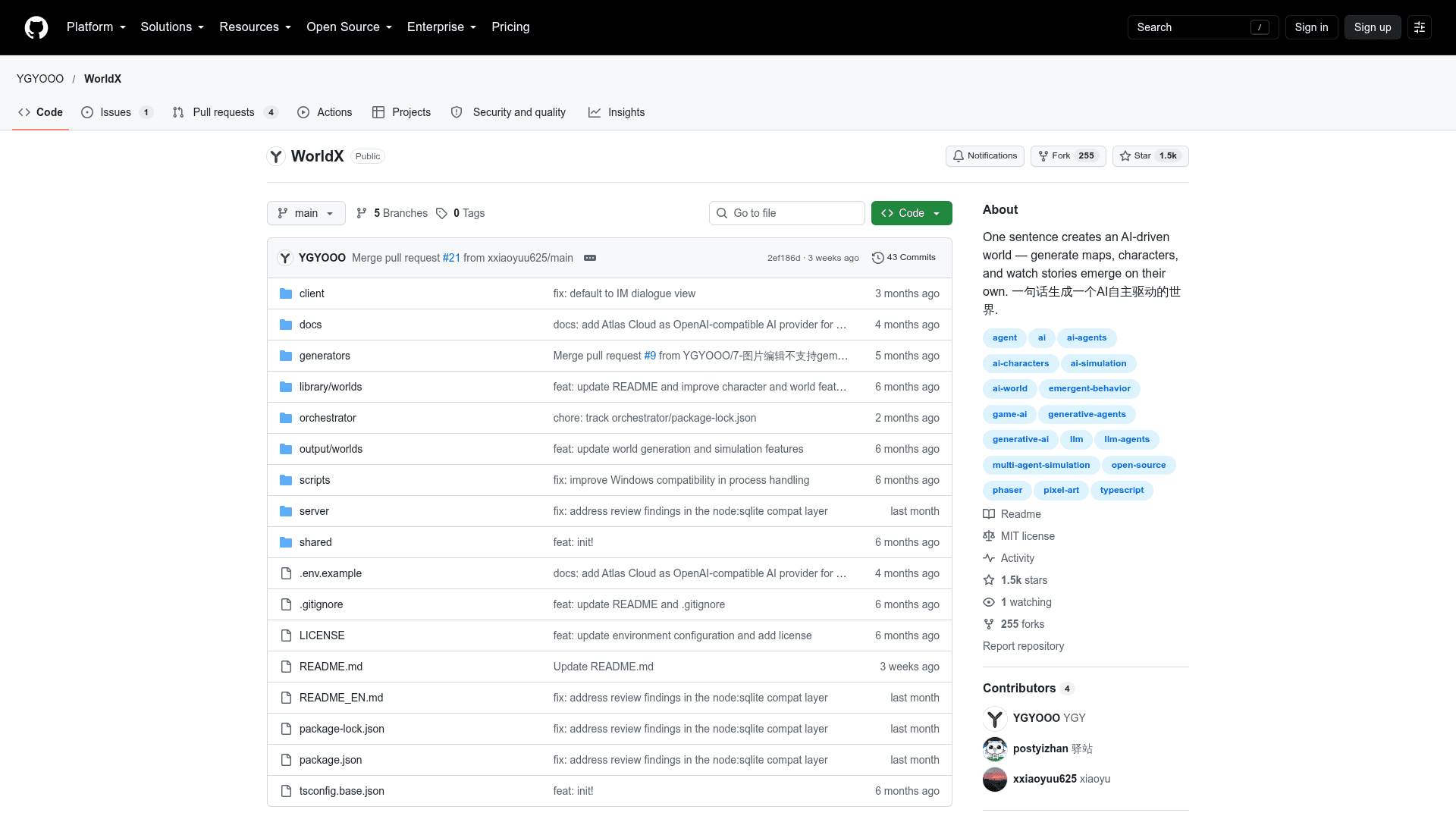
WorldX is an open-source project (MIT license) that generates a complete virtual world from a single sentence. AI characters then live in it autonomously, making decisions, interacting with scenes, forming relationships, holding conversations, and remembering past events. The README marks the project as Alpha, with the core working and still being refined.
What It Is
WorldX is an LLM-driven world generation and multi-agent simulation tool. The user describes a scenario, such as a night market street in Song-dynasty Bianjing with a fortune teller, pawnbroker, thief, constable, and a time traveler. An orchestration pipeline designs the world structure, characters, and rules, and image-generation steps produce the map art and character sprites. The result is played in a Phaser 3 and React 19 client, backed by an Express and SQLite simulation server.
How the Workflow Runs
WorldX uses four separately configured model roles:
- Orchestrator: designs the world structure, characters, and rules.
- Image generation: produces map art and character portraits.
- Vision review: checks map quality and locates regions and elements.
- Simulation: drives runtime character behavior.
The roles use OpenAI-compatible chat/completions endpoints. Image generation can also use Google AI Studio's native image interface. Worlds can be created from the web page at /create or with an npm command-line script. Two pre-generated worlds are included for a quick trial that only needs the simulation model configured.
God Mode and Timelines
Users can intervene as a god: broadcast events, edit character personas or memories, and hold hypothetical conversations with any character. Worlds can run across multiple days with day-night cycles, and one world can branch into several timelines, each with its own SQLite persistence. The interface supports Chinese and English.
Setup Path
It requires Node.js 22.13 or newer, and the built-in node:sqlite module means no native modules need compiling. Users clone the repository, copy .env.example to .env, add model API keys, then run npm install and npm run dev. The client runs on port 3200 and the server on port 3100. The README also covers proxy settings for Node.js when a model provider is not reachable.
Community Discussions
Be the first to start a conversation about WorldX
Share your experience with WorldX, ask questions, or help others learn from your insights.
Pricing
Open Source (MIT)
Self-hosted WorldX core released under the MIT License. Users supply their own LLM/image model API keys, which are external costs.
- MIT License
- Self-hosted
- Requires Node.js 22.13+
- Bring your own API keys for orchestrator, image generation, vision and simulation models (external costs)
- Two pre-generated sample worlds included
Capabilities
Key Features
- One-sentence world generation
- AI-generated maps and character art
- Autonomous agent decision-making, relationships and dialogue
- Character memory and personality
- Multi-day simulation with day-night cycles
- God mode: broadcast events, edit personas and memories, hypothetical dialogue
- Multiple timelines per world
- Chinese and English support
- Built-in pre-generated example worlds
- Web and command-line world creation
- Per-role model configuration