
Xalgorix
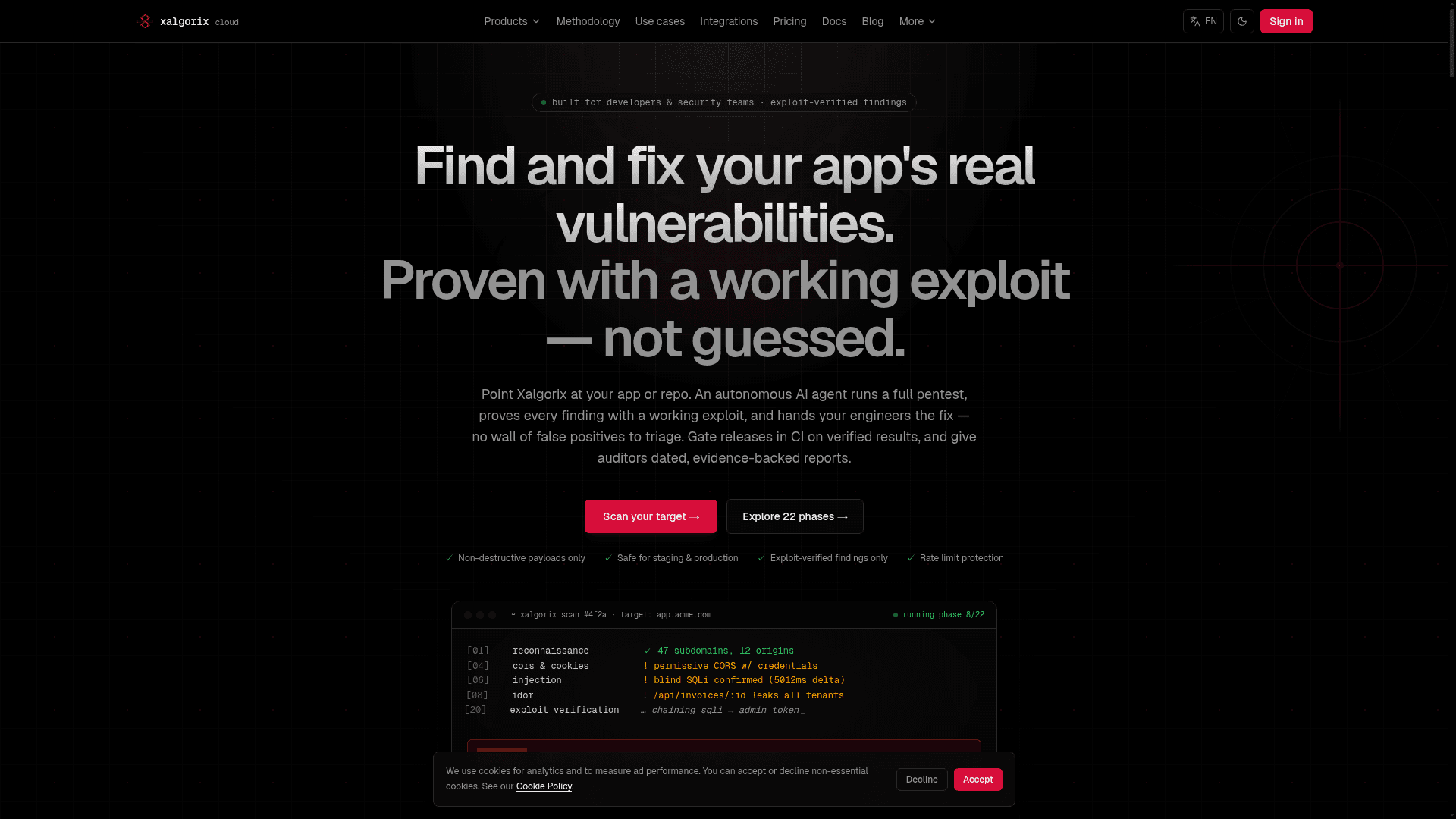
Xalgorix is an autonomous AI pentesting platform that runs a 22-phase offensive methodology against apps, APIs, and source code, then re-exploits every candidate finding so reports contain proven vulnerabilities instead of unverified alerts.
At a Glance
Open-source engine you install and run yourself, with your own model provider
Engagement
Available On
Alternatives
Listed Sep 2026
About Xalgorix
Xalgorix is an autonomous AI penetration testing platform that tests web applications, APIs, and source code, then tries to reproduce every candidate finding before it reaches a report. An LLM-driven agent works through a fixed offensive methodology, and a separate verification step re-exploits what it found. It is published as an Apache-2.0 licensed Go and TypeScript project that teams can self-host, and the same engine also runs as a managed cloud service.
What It Is
The project describes itself as an open-source AI pentester that proves vulnerabilities rather than guessing at them. Instead of matching signatures or templates, the agent reasons about authentication flows, business logic, and access control, chaining steps the way a human tester would. Coverage spans injection, SSRF, IDOR and broken access control, file upload, deserialization, race conditions, and subdomain takeover, among others. Findings carry CVSS scores, evidence, and remediation guidance, and can be exported as branded PDF reports.
The 22-Phase Methodology
Every engagement is organized into 22 numbered phases, running from reconnaissance through directory discovery, CORS and cookie analysis, session testing, cloud and infrastructure checks, and a final report. Output from each phase feeds the next, so reconnaissance results shape later exploitation attempts. Operators can run the full sweep or select a subset when an engagement only calls for certain phases.
Verification Instead of Triage
Phase 20 is dedicated to exploit verification. An independent verifier re-tests each candidate finding, and the vendor states that anything it cannot reproduce is flagged for review rather than reported as confirmed. That is the design decision separating Xalgorix from template scanners, trading runtime and depth for a much shorter list to triage. Payloads are described as non-destructive, with configurable rate limits, proxy rotation, and circuit breakers intended to make runs safe against staging and production systems.
Self-Hosted or Managed
The self-hosted build runs a local dashboard and REST API on your own machine, with a bring-your-own-model setup supporting OpenAI, Anthropic, DeepSeek, Gemini, Groq, Ollama, and MiniMax, plus any OpenAI-compatible gateway such as LiteLLM. The documentation states that no target data, keys, or findings leave your infrastructure. The managed cloud version removes setup and model-key management, routes across frontier models per phase, and adds scheduling, team workspaces, and out-of-band infrastructure for blind SSRF and RCE testing.
Code Scanning and Pull Request Reviews
Xalgorix also scans code directly. Source review mode traces user input from entry point to dangerous sink without a running target, while provision mode builds and runs the application locally, then pentests the instance it started. A GitHub App reviews pull request diffs and posts findings as a single comment that updates in place on new commits, with no workflow file or API key to manage, and a GitHub Action can fail a build when verified findings cross a severity threshold the team sets.
Community Discussions
Be the first to start a conversation about Xalgorix
Share your experience with Xalgorix, ask questions, or help others learn from your insights.
Pricing
Self-Hosted
Open-source engine you install and run yourself, with your own model provider
- Apache-2.0 licensed engine, self-hosted on your own infrastructure
- All 22 methodology phases and exploit verification
- Bring your own LLM provider and API key
- Local web dashboard, REST API, and WebSocket telemetry
- Branded PDF reports and built-in scheduler
GitHub App
Automatic pull request security reviews posted as a GitHub comment
- Diff-scoped security review on every pull request
- Covers injection, broken auth and IDOR, SSRF, secrets, and unsafe patterns
- Comment @xalgorix review to re-run on demand
- Updates its review comment in place on new commits
- No workflow file, API key, or account required
Starter
Hosted cloud plan for indie developers running regular scans
- 50 scan credits per month
- 1 concurrent scan
- All 22 phases and exploit-verified findings
- Branded PDF reports and public share links
- Daily scheduled scans
- API access
- Email and Discord notifications
- Email support within 48 hours
Pro
Hosted cloud plan for founders and security engineers shipping continuously
- 200 scan credits per month
- 3 concurrent scans
- All 22 phases and exploit-verified findings
- Branded PDF reports and public share links
- Daily scheduled scans
- API access
- Slack, Discord, and email notifications
- Email support within 24 hours
Team
Hosted cloud plan for security teams scanning many properties
- 1000 scan credits per month
- 5 concurrent scans
- All scan modes plus priority queue
- Branded PDF reports with custom logo
- Password-protected share links
- Hourly scheduled scans
- Audit log and 10x API rate limit
- Email support within 4 hours
Enterprise
Custom-priced tier for organizations standardizing on exploit-verified testing
- Everything in Team
- SSO/SAML and SCIM provisioning
- Self-hosted or private deployment
- Volume credits and higher concurrency
- RBAC, audit log, and SSO-enforced workspaces
- DPA, security review, and SLA
- Annual invoicing via ACH, wire, or PO
- Custom SIEM, GRC, and ticketing integrations
- Dedicated support and onboarding
Credit Pack
One-time credit packs starting at a single credit, with no subscription required
- 1 credit for $1
- 10 credits for $9
- 50 credits for $29
- 200 credits for $99
- 1000 credits for $399
- Credits never expire
- Stacks with any subscription and is consumed after monthly credits
Capabilities
Key Features
- Autonomous LLM agent that runs a 22-phase penetration testing methodology
- Dedicated exploit verification phase that independently reproduces each finding
- Reasoning over auth flows, business logic, IDOR/BOLA, and chained exploits
- Single target, wildcard/multi-target, and browser-assisted DAST scan modes
- Source code scanning from a Git URL, local path, or uploaded archive
- Provision mode that builds and runs an app locally, then pentests it
- GitHub App that reviews pull request diffs and comments findings
- GitHub Action that fails builds at a chosen severity threshold
- Live WebSocket telemetry of tool calls, agent messages, HTTP, and LLM activity
- Findings management with CVSS scoring, severity filters, and deduplication
- Branded PDF reports with executive summary, proof of concept, and remediation
- Scheduled recurring scans and resumable scan persistence
- REST API and signed scan.completed webhooks
- Bring-your-own-LLM support across OpenAI, Anthropic, DeepSeek, Gemini, Groq, Ollama, and MiniMax
- Self-hosted local dashboard with Docker images for amd64 and arm64
- Configurable rate limits, proxy rotation, and non-destructive payload safeguards