
Xberg
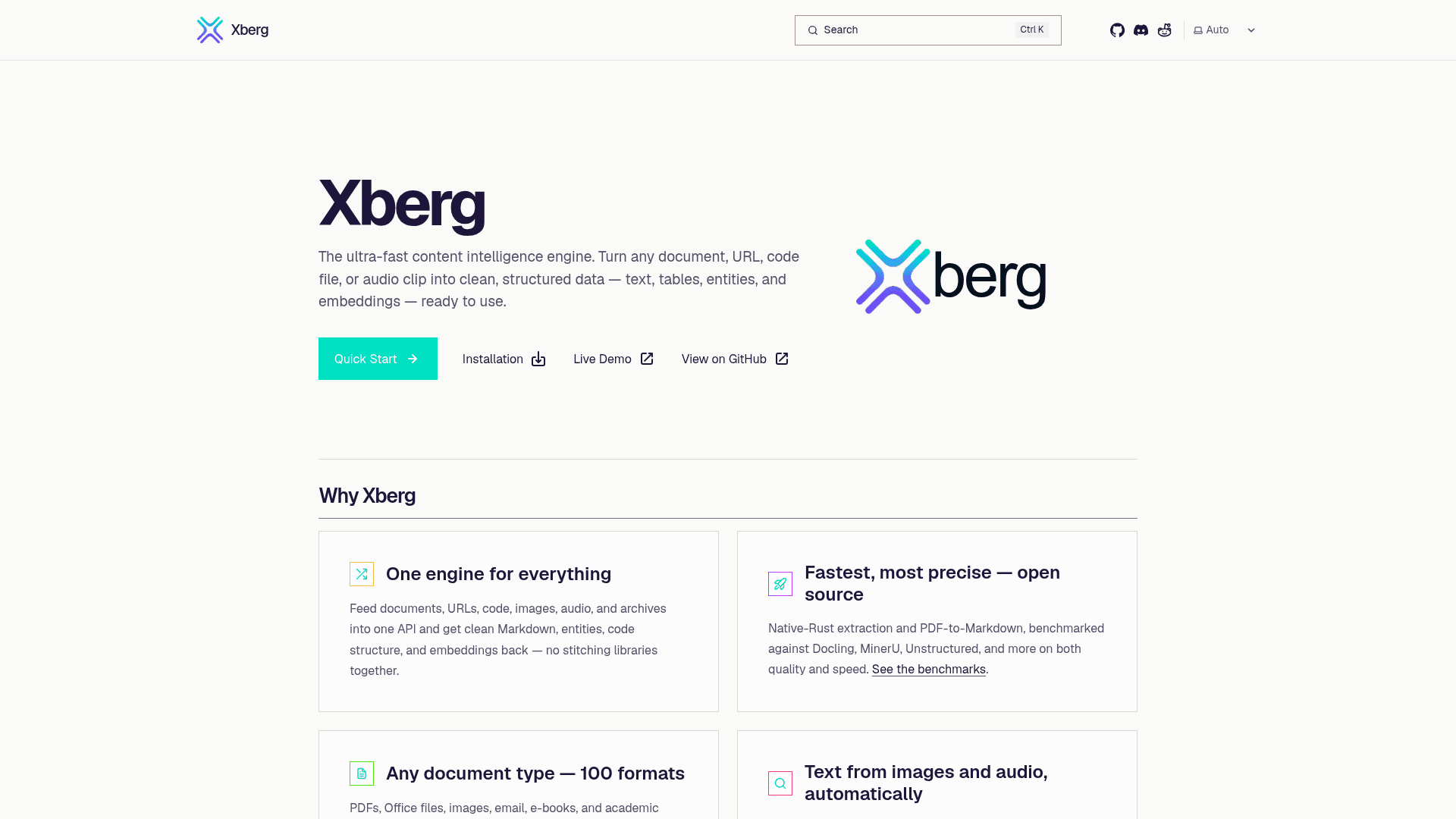
Ultra-fast open-source document intelligence engine that extracts text, tables, entities, and embeddings from 100+ formats with 15 language bindings and a Rust core.
At a Glance
About Xberg
Xberg is an open-source, polyglot document intelligence framework built on a native-Rust core, published under the MIT License by Kreuzberg, Inc. It turns any document, URL, code file, or audio clip into clean, structured data — text, tables, entities, and embeddings — ready to use in downstream pipelines. The project is the next iteration of Kreuzberg (previously published as kreuzberg), rebuilt and rebranded under a fresh v1 line.
What It Is
Xberg is a content-extraction engine that handles format detection, reading, OCR, transcription, and structured output in a single library call. Rather than stitching together a dozen specialized libraries, developers point Xberg at a PDF, spreadsheet, scanned image, audio file, URL, archive, or source tree and receive clean Markdown, plain text, HTML, JSON, or Djot back. The engine supports 100 document formats across 120 file extensions, code intelligence for 371 programming languages, and 6 output formats. It runs as a library, CLI tool, REST API server, MCP server, Docker container, or Helm chart — with no GPU required.
Architecture and Language Bindings
The Rust core is exposed through 15 language bindings generated by the project's own polyglot binding generator, alef. Supported runtimes include:
- Native NAPI-RS bindings for Node.js/TypeScript
- WebAssembly (
@xberg-io/xberg-wasm) for browsers, Cloudflare Workers, Deno, and Bun — running at 60–80% of native speed - Python, Go, Java/Kotlin JVM, Kotlin (Android), C#, Ruby, PHP, Elixir, Dart/Flutter, Swift, Zig, and C FFI
The CLI ships 12 commands (extract, batch, detect, formats, serve, mcp, embed, chunk, cache, api, version, completions) and can be installed via Homebrew. The Docker image at ghcr.io/xberg-io/xberg bundles the common feature set and supports API, CLI, and MCP modes.
Capabilities in Depth
Xberg's extraction pipeline covers a wide surface area:
- OCR: Tesseract, PaddleOCR, Candle (pure Rust), and VLM backends (GPT-4 Vision, Claude Vision, Gemini Vision, and 165 providers via the companion
liter-llmlibrary), with fallback chains and confidence scores. - Audio/video transcription: Speech-to-text from MP3, M4A, WAV, WebM, and MP4 via Whisper ONNX (tiny through large-v3).
- Layout and tables: ML layout models (PP-DocLayout-V3, RT-DETR) and table structure models (TATR, SLANet) reconstruct reading order and cell grids.
- Code intelligence: Functions, classes, imports, symbols, and docstrings from 371 languages via tree-sitter, with syntax-aware chunking for RAG pipelines.
- Embeddings: Local ONNX presets (fast, balanced, quality, multilingual) or provider-hosted via 165 providers, plus cross-encoder reranking.
- Structured LLM extraction: Schema-driven JSON from any document using local engines (Ollama, LM Studio, vLLM) or remote providers — no prompt engineering required.
- Enrichment: NER (GLiNER or LLM-based), PII redaction, summarization, translation, keyword extraction (YAKE/RAKE), QR code detection, language detection, and token reduction via the TOON wire format.
- Web crawling: Auto, Document, and Crawl modes via the companion
crawlbergengine. - Archives: Recursive extraction from
.zip,.tar,.gz, and.7zwith zip-bomb and nesting-depth guards.
MCP Server and AI Coding Assistant Integration
Xberg ships a built-in MCP server (xberg mcp --transport stdio) exposing 9 tools, 3 prompts, and 4 resources. It integrates directly with Claude Desktop, Cursor, and other MCP-compatible agents. The project also publishes plugins for Claude Code, Codex CLI, Cursor, Gemini CLI, Factory Droid, GitHub Copilot CLI, and opencode, making document extraction available inside AI coding workflows without additional configuration.
Update: v1.0.14
The latest release is v1.0.14, published on 2026-08-04, with the repository last pushed on 2026-08-14. The project launched in January 2025 and has accumulated over 9,000 GitHub stars and 554 forks across its active development period. The README lists 16 downstream open-source projects that declare Xberg (or its predecessor kreuzberg) as a dependency, including Haystack core integrations (deepset-ai), MANSPIDER (blacklanternsecurity), and several MCP server projects. The project is part of the broader Xberg.io ecosystem, which also includes crawlberg, html-to-markdown, liter-llm, tree-sitter-language-pack, and alef.
Community Discussions
Be the first to start a conversation about Xberg
Share your experience with Xberg, ask questions, or help others learn from your insights.
Pricing
Open Source
Full open-source release under MIT License, free to use, modify, and distribute.
- All document extraction capabilities
- 100 formats, 120 file extensions
- 15 language bindings
- CLI, REST API, MCP server, Docker
- OCR, transcription, embeddings
Capabilities
Key Features
- Extract text, tables, and metadata from 100 document formats across 120 file extensions
- Native-Rust core with 15 language bindings (Python, TypeScript, Rust, Go, Java, C#, Ruby, PHP, Elixir, Dart, Swift, Zig, WASM, Kotlin, C FFI)
- OCR via Tesseract, PaddleOCR, Candle, and VLM backends with fallback chains
- Audio and video transcription via Whisper ONNX (tiny to large-v3)
- Code intelligence for 371 programming languages via tree-sitter
- Recursive archive extraction from .zip, .tar, .gz, and .7z with zip-bomb protection
- Web fetching and crawling via crawlberg engine (Auto, Document, Crawl modes)
- Schema-driven structured JSON extraction via local or hosted LLMs
- Local and provider-hosted embeddings with cross-encoder reranking
- NER, PII redaction, summarization, translation, keyword extraction, and QR code detection
- 6 output formats: Plain, Markdown, Djot, HTML, JSON tree, Structured
- CLI with 12 commands, REST API server, MCP server, Docker, and Helm chart
- MCP server with 9 tools, 3 prompts, and 4 resources for AI agent integration
- Content-hash caching, parallel batch processing, and per-file timeouts
- WebAssembly build for browsers, Cloudflare Workers, Deno, and Bun
- ML layout models (PP-DocLayout-V3, RT-DETR) and table structure models (TATR, SLANet)
- TOON wire format for ~30–50% token reduction vs JSON