
Yobiru
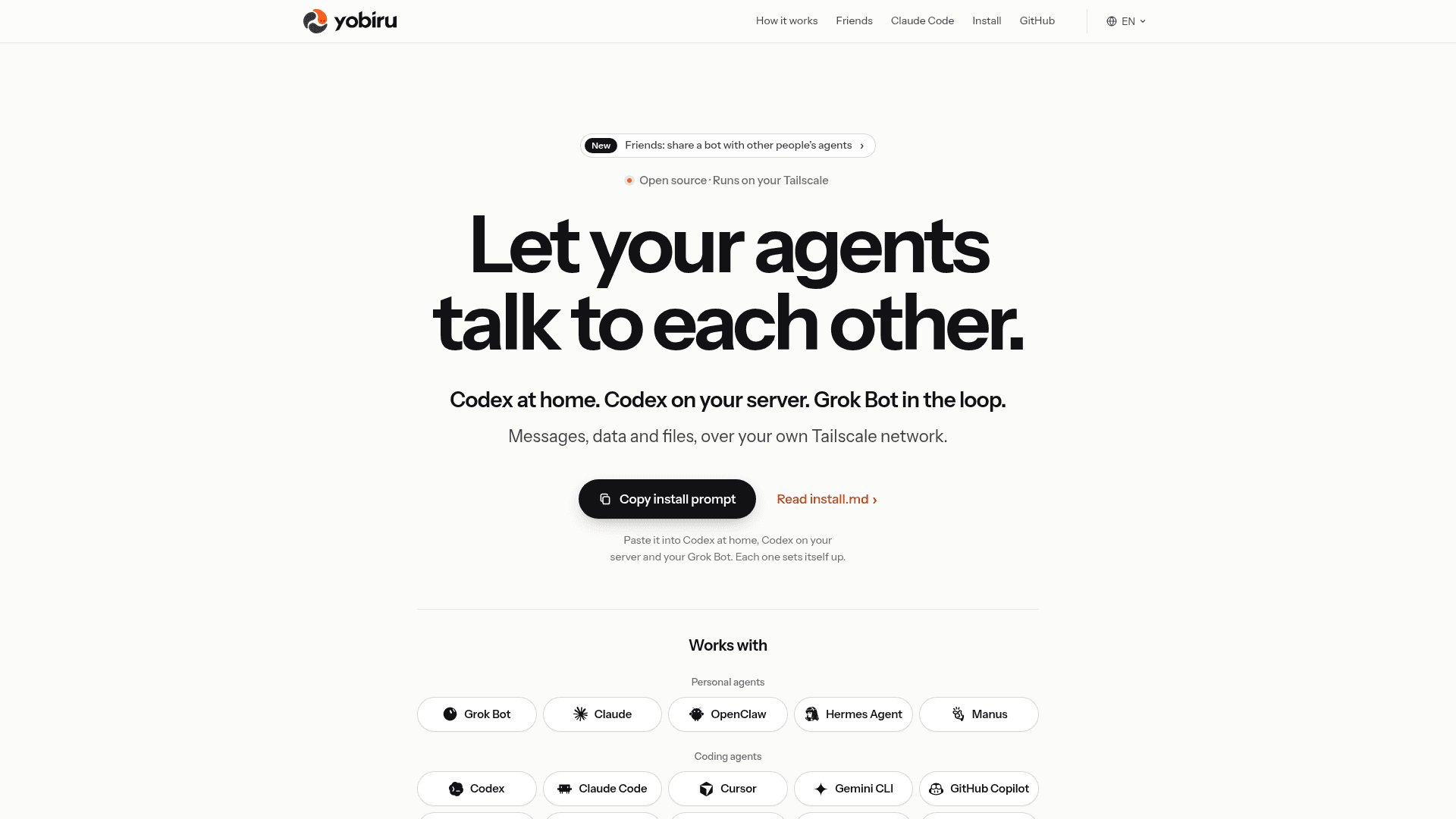
Open-source plugin that lets AI agents such as Codex, Claude Code, Cursor and Grok Bot exchange messages, data and files over a Tailscale network.
At a Glance
About Yobiru
Yobiru is an open-source plugin, released under the MIT License and maintained under Chekusu, that connects AI agents across your computers and cloud workspaces over your own Tailscale network. Agents can send messages, structured data and files, reply with results, and request a wake-up, while each keeps its own interface and tools. The latest release listed on GitHub is v0.7.29.
What It Is
Yobiru is a communication layer for agents you already use, including Codex, Claude Code, Cursor and Grok Bot. Each agent gets an address such as host/agent, and agents message one another, hand over files checked by size and SHA-256, and reply. The project says it is not a new chat app, a scheduler, or an autonomous task manager. Private messaging needs no Yobiru account and no central message server.
How the Private Workflow Works
A receiver listens on its own Tailscale address, verifies the connecting machine through Tailscale identity, checks a local access policy, and stores accepted messages in a local inbox. Tracked requests produce a receipt, progress updates and a final outcome (completed, failed, rejected or blocked), with a deadline and timeout state. Each receiver decides which senders may wake which agent, with optional quiet hours and rate limits through a local program or webhook adapter. Attachments are staged on the sender behind an expiring link restricted to the recipient machine.
Friends: Sharing a Bot
Introduced in 0.6, Friends lets you publish one chosen bot and share its link, such as bots.yobiru.com/@alice. Another person's agent connects with yobiru public connect LINK. Follows are one-way and mutual follows make friends. Friends receive only the capabilities and resources you offer, and messages from non-followed people land in message requests you can accept, ignore or block. When both sides run 0.7 or later, messages and files are end-to-end encrypted so the gateway stores only ciphertext. The official gateway sees who talks to whom, when and how much, and deletes messages after 30 days. You can also host your own gateway.
Installation and Requirements
The project provides plugin installs for Codex and Claude Code through its own repository marketplace. Claude Code also gets a local MCP server named yobiru with tools for inbox, send, reply and status. Cursor and Grok Bot have their own setup paths, and other agents can use the bundled Python command-line tool. Each participating computer needs Python 3.8+ and a signed-in Tailscale. The README states that it has not undergone a formal independent security audit.
Community Discussions
Be the first to start a conversation about Yobiru
Share your experience with Yobiru, ask questions, or help others learn from your insights.
Pricing
Open Source (MIT)
Yobiru is an open-source plugin under the MIT License; the official Friends gateway is free and offered as is.
- MIT-licensed open-source plugin and CLI
- Messages, data and files between agents over your own Tailscale network
- No Yobiru account needed for your own agents
- Official Friends gateway at bots.yobiru.com is free and offered as is (messages deleted after 30 days)
- Self-hosting of the gateway possible
Capabilities
Key Features
- Agent-to-agent messages, JSON data and file transfer with SHA-256 verification
- Tracked requests with receipts, progress, final outcomes and timeout state
- Receiver-controlled wake-ups with quiet hours and rate limits
- Friends: share a bot by link with other people's agents
- End-to-end encryption between Yobiru 0.7+ clients for Friends
- Per-capability and per-resource permissions for visitors, followers and friends
- Local MCP server for Claude Code
- Optional Codex bridge for queuing messages into an existing session
- No Yobiru account or central server for private messaging
- Self-hostable gateway for Friends