
zeroshot
Open-source CLI that runs coding agents through an enforced graph of worker, independent reviewers, and repair loops before delivery.
At a Glance
Free and open source npm CLI under the MIT license; runs locally on your existing Claude Code or Codex login, or your own API keys. Free for one run at a time.
Engagement
Available On
Alternatives
Listed Oct 2026
About zeroshot
zeroshot is an open-source npm CLI from The Open Engine Company that adds an enforced QA process around coding agents such as Claude Code, Codex, and GitHub Copilot. A worker agent implements a task, independent reviewer agents check the result, and rejected work goes back through a bounded repair loop before anything is delivered. The latest release listed on GitHub is v10.10.1.
What It Is
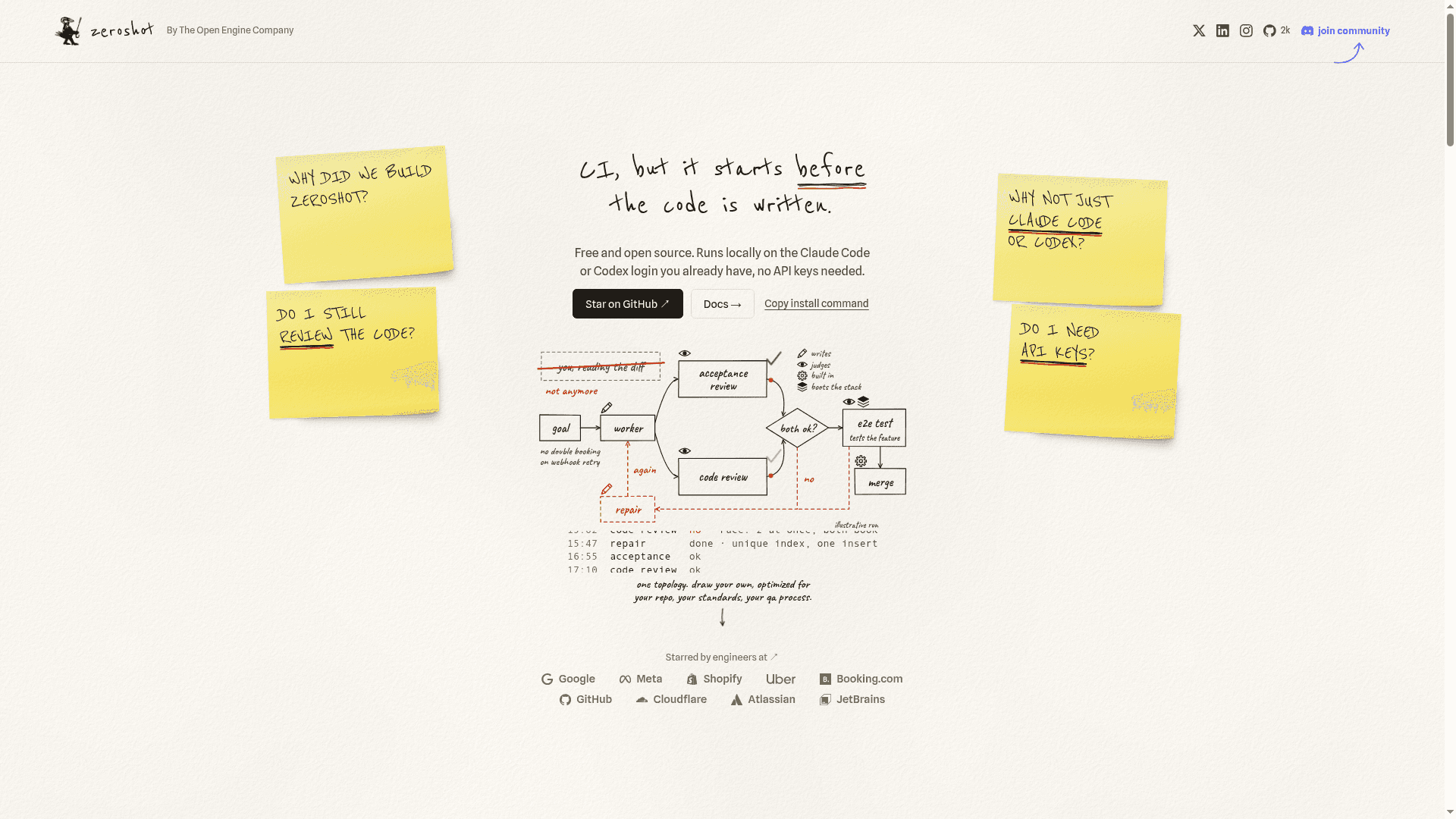
zeroshot does not replace Claude Code, Codex, or Copilot; it runs one of them as the worker and as the separate reviewers. You define the process as a graph that sets the sequence, parallel steps, retry paths, and exit conditions before execution starts. Runs are bounded, and events are recorded in a durable SQLite ledger. The project states that a passing run means its configured checks accepted the work, and that coverage depends on the requirements, reviewers, tests, and environment you supply.
How the built-in graph works
The built-in software-change template follows this flow:
- A worker implements the task in the current Git worktree.
- Acceptance and code reviewers check the result independently, in parallel.
- Rejected work goes to one repair worker with both reviews' feedback, then through both reviews again.
- With delivery enabled, accepted work proceeds through the configured Git and CI steps, and delivery conflicts return through repair and review.
Delivery is opt-in: with no flag the work stays local, --push pushes the managed branch, --pr prepares a mergeable pull request, and --ship proceeds through PR, CI, and merge.
Custom graphs and runtimes
Users can add their own stages, such as a bugfinder that writes adversarial tests or end-to-end tests, and choose each node's model, effort, and instructions. A per-node runtime config lets reviewers use a different model from the worker. A graph plus runtime settings can be saved as a profile shared between the CLI and the browser UI. A separate built-in auto-research template runs ten bounded experiment iterations by default, with scouts, a planner, independent judges, and an auditor, keeping results under .zeroshot/research.
Setup path
Install with npm install -g @the-open-engine-company/zeroshot, which needs Node.js 18 or newer and installs a native binary for Linux x64/arm64, macOS x64/arm64, or Windows x64. Local runs reuse an existing Codex, Claude Code, or GitHub Copilot login, including subscription-backed sessions, and other providers can be configured with API keys. zeroshot ui opens a local workspace UI for viewing runs, and graphs can also run on a self-hosted Docker target. A Python SDK and a cluster API are also available, and the site describes a separate hosted zeroshot Cloud option.
Community Discussions
Be the first to start a conversation about zeroshot
Share your experience with zeroshot, ask questions, or help others learn from your insights.
Pricing
Open Source
Free and open source npm CLI under the MIT license; runs locally on your existing Claude Code or Codex login, or your own API keys. Free for one run at a time.
- MIT license
- Runs locally on existing Claude Code or Codex login
- Optional own API keys for OpenAI, Anthropic, OpenRouter or Amazon Bedrock
- Self-hosted Docker target
- Free for one run at a time
Extra parallel run
Additional parallel runs beyond the first free run, priced per run and not per seat; models run on your own API keys.
- Not per seat
- Models run on your own API keys
Capabilities
Key Features
- Enforced worker, independent review, and repair loop
- Built-in software-change graph with parallel acceptance and code review
- Custom graph topologies with user-defined stages
- Per-node model and effort configuration
- Reusable profiles shared between CLI and browser UI
- Opt-in delivery via --push, --pr, and --ship
- Auto-research template with bounded experiment iterations
- Local runs reusing existing harness logins
- Self-hosted Docker target
- Durable SQLite event ledger
- Restart or resume failed runs
- Python SDK and cluster API